Languages
Monday, October 19, 2026



News and Views from the Global South
Financial Crisis
DEVELOPMENT: Rights In Times of Crisis
For the past three decades, indebted developing countries have been forced by the International Monetary Fund (IMF) and the World Bank to deregulate financial and labour markets, privatise national industries, abolish subsidies, and reduce social and economic spending.DEVELOPMENT: An Opportunity to Create a New Financial Architecture
The most severe financial crisis since the Great Depression needs massive economic stimulus packages that are coherent and linked with sustainable development imperatives, asserts a new report by top U.N. economists released Monday on the sidelines of the Monterrey Review conference in Doha.ECONOMY-US: Past Crises Could Inform or Haunt Team Obama
Faced with the worst crisis since the Great Depression, President-elect Barack Obama ditched tradition this week, naming his economic team before anointing a secretary of state - by custom the first and senior-most cabinet appointment.
DEVELOPMENT-LATAM: Solutions from Below
The global financial crisis has not demoralised those involved in community projects throughout Latin America and the Caribbean who took part in ECLAC’s fourth social innovation fair, which ended Friday in this city in northwest Colombia.
Q&A: “Less Funding Could Lead to Millions of AIDS Deaths”
The global economic crisis is threatening to undermine yet another key development goal set by the United Nations: reversing by 2015 the AIDS epidemic still devastating millions of people worldwide.ECONOMY-CHINA: Misgivings Emerge Over Stimulus Package
World politicians and economists have cheered the stimulus package unveiled by Beijing this month, touting it as the biggest economic recovery plan of peace time - but there are misgivings.POLITICS-US: Right-Wing Lobby Group Loses Its Angel
The right-wing U.S. advocacy group Freedom's Watch is reportedly shutting down as its main funder, Casino magnate Sheldon Adelson, becomes one of the high-profile casualties of the global economic downturn.
LATIN AMERICA: Future of Private Pension Funds in Doubt
Pension funds in Latin America have suffered sometimes drastic losses as a result of the global financial crisis. Argentina decided to nationalise its private pension funds, and in Chile, Colombia and Mexico there are voices urgently calling for reforms.INDONESIA: Saying No, Thank You to IMF Loans
When the Asian financial crisis struck a decade ago, savaging South-east Asian economies, including Indonesia, Jakarta turned to the International Monetary Fund (IMF) for help in getting the country back on its feet.ECONOMY-MALAYSIA: Job Losses Feared as Recession Bites
The global economic slowdown is slowly creeping onto Malaysian shores leaving many worried about the impact it will have on workers.POLITICS: World Bank, IMF Heads Under Fire for Skipping Summit
The chief executive officers of the World Bank and the International Monetary Fund (IMF), two financial institutions based in Washington, have come under heavy fire for their decision to skip a major U.N. conference on Financing for Development (FfD), scheduled to take place in the Qatari capital Doha over the weekend.DEVELOPMENT: Will Any Crumbs Remain After Bankers’ Feast?
The vast resources the U.S. and Europeans are pouring into ailing financial firms could lead to disastrous consequences for global efforts to reduce poverty and mitigate the impacts of climate change, warns a new study by an independent think tank.SRI LANKA: Oil Futures Gamble Burns 300 Million Dollar Hole
The Sri Lankan government is grappling with a costly 300 million dollar payout to Citibank and Standard Chartered Bank (SCB), following a disastrous oil futures contract between the banks and the state-owned Ceylon Petroleum Corporation (CPC).FINANCE: China Takes Lead on Green Investing
China's efforts to green its financial sector have earned a thumbs-up from U.S. environmentalists, who say regulators here could learn from Beijing's recent success in stimulating investments that don't despoil the planet.ECONOMY-BRAZIL: Car Industry in Reverse Gear
Although the global financial crisis has not yet triggered a rise in unemployment in Brazil, car industry and related workers are starting to forge strategies for facing severe recession in the sector.CHINA/US: Balking at Changing Dollar-Centric Economic Order
The spectre of a prolonged global recession has dampened China’s wish for a world financial order less dominated by the United States and its dollar, giving way to more urgent dealings with recession worries at home.POLITICS: Greybeards Urge Overhaul of Global Governance
Capping a nearly two-year consultation involving dozens of U.S. and international leaders, a new report by three U.S. think tanks is calling on President-elect Barack Obama and other leaders to implement sweeping reforms in global governance to more effectively tackle shared regional and global threats over the next half century.
ECONOMY-US: Congress Deaf to Pleas of Panicky Auto Execs
The vote on a 25-billion-dollar loan for cash-strapped General Motors, Chrysler and Ford Motor Company - known as the "Big Three" U.S. automakers - has been put on hold by the Senate, after Congressional leaders chastised industry executives for failing to heed early warnings of crisis and for flying to Capitol Hill on private jets to beg for tax dollars.DEVELOPMENT: U.N. Looks to Doha Summit for Answers
As the spreading global financial crisis threatens to cripple banks, stock markets and manufacturing industries in the developing world, the United Nations is now focusing on the outcome of a major international conference on Financing for Development (FfD) scheduled to take place in Doha next week.ECONOMY-US: Congress Blames Treasury as Foreclosures Mount
A congressional banking leader Tuesday blew hot air and blame at the U.S. treasury secretary about the ongoing home foreclosure crisis, but neither made a commitment to help stressed homeowners.FINANCE: The Poor Will Pay Too
Developing countries are not safe from the damaging effects of the current financial crisis, as had initially been forecast, but so far the impact has not been "dramatic," according to UNCTAD economist Michael Herrmann.« Previous Page — Next Page »





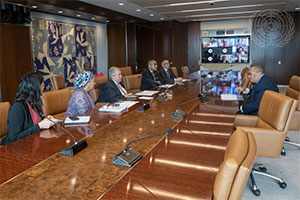 Secretary-General Meets with Members of Debt Expert Group. Credit: UN Photo/Eskinder Debeb
Financial crises are often defined by banking panics, recession, loss of market value, and deflation. Various financial crises at the turn of the 20th century, such as the Asian Crisis of 1997-1998 and the 2007-2008 Global Financial Crisis, have had immense impacts on the world economy. The COVID-19 pandemic also caused a financial crisis when mass lockdowns triggered staggering unemployment rates, a stagnation of economic growth, and led to the 2020 stock market crash. With the Russian invasion of Ukraine, the world has also witnessed a global energy crisis with shortages and increased prices in oil, gas, and electricity markets. According to UNCTAD’s World of Debt 2025, global public debt surpassed $100 trillion in 2024, with developing country debt growing twice as fast as developed economies since 2010. Burdens of debt servicing come with economic slowdowns and demands of austerity from lenders, with some economists arguing that this will lead to a new “lost decade” for the Global South. IPS brings you worldwide coverage of these financial developments and how we should manage these crises.

The Week with IPS

NEXT STOP - SDGs
Tracking global progress towards a sustainable world
Tracking global progress towards a sustainable world
