Languages
Friday, November 20, 2026



News and Views from the Global South
Labour
LABOUR-LATAM: Unions on the Decline as Unemployment Rises
International Labour Day this year encounters a Latin American union movement that is in full crisis as far is its ability to represent workers, and thrashed by the economic changes that are turning unemployment into an ever- expanding phenomenon.LABOUR-LATAM: Maternity Leave – On the Verge of Disappearing?
Several patients at the Argentine capital's Durand Hospital, some of them gravely ill, are persistent in their requests for physician Laura Fuxman to come to their bedsides. She tends to them and continues her rounds without a break in her long daily shift.LABOUR-COLOMBIA: Teachers Caught in the Crosshairs
The Colombian Federation of Educators (FECODE) is planning a march on Tuesday, International Labour Day, in defence of public education and the lives of teachers, 422 of whom were killed over the past two decades, and against the threats faced by thousands of the union's members.LABOUR-PERU: Scepticism Over Campaign Pledges to Create Jobs
As International Labour Day rolls around once again, trade unionists and workers in Peru are sceptical that presidential candidates Alejandro Toledo and Alan García will live up to their pledges to reduce unemployment, the most pressing social problem today.LABOUR-TRINIDAD & TOBAGO: Divided Movement Plans Separate Labour Day Activities
This year's May Day celebrations will find Trinidad's labour movement still in turmoil as dissident unions continue to squabble with the umbrella body to which they belong.LABOUR-MEXICO: Once-Powerful Union in Check this May Day
The Confederation of Mexican Workers (CTM), a dominant force during the 71 years of Institutional Revolutionary Party (PRI) rule, has accelerated in its downward spiral following a blow from the Judiciary, the movement's former ally, just in time for International Labour Day, May 1.LABOUR-CUBA: No Loud Demands to Be Heard in May Day Celebration
Although workers in Cuba would like better wages and full employment, like workers all over the world, those demands do not tend to be voiced in this socialist country's May 1st celebrations./CORRECTION/LABOUR-VENEZUELA: Workers Divided on May Day
Workers' organisations in Venezuela will celebrate this May 1, International Labour Day, in separate events, underscoring the challenges the government faces as it tries to promote reforms within a divided labour movement.LABOUR-VENEZUELA: Workers Divided on May Day
Workers' organisations in Venezuela will celebrate this May 1, International Labour Day, in separate events, underscoring the challenges the government faces as it tries to promote in a divided labour movement.LABOUR-BRAZIL: May Day No Holiday for Domestic Employees
"We don't have anything to celebrate on May 1, International Labour Day, because we will all be working that day, and the notion of an eight-hour shift is still a distant dream for most of us," is the lament of domestic workers across Brazil, the vast majority of whom are women.LABOUR-SOUTH AFRICA: Unions Debate Govt’s Privatisation Programme
Debate is raging in trade union owned companies, in South Africa, on whether they should take part in the state's privatisation programme.LABOUR-ENVIRONMENT: Unions Join Fight against Climate Change
Workers' unions from Europe and the United States are uniting to defend the Kyoto Protocol, the international accord dozens of countries support as a way to slow the process of global climate change, which labour leaders say would also contribute to creating more jobs.LABOUR: NAFTA Falling Short on Worker Rights
Mechanisms for protecting labour rights under the North American Free Trade Agreement (NAFTA) have fallen far short of their promise, largely because timidity on the part of three member governments, Canada, the United States and Mexico, according to a new report released here Monday by Human Rights Watch (HRW).LABOUR-FRANCE: Fears Of Retrenchment Grip Workers
Workers in France are heading for a rough time, as employers are announcing a series of restructuring exercises that involve retrenchment.LABOUR: Tourism Industry’s Wages Conspicuously Low
The tourism industry - hotels, catering, hospitality - employs three percent of the world's labour force, but pays wages that are 20 percent less than the average of the rest of the economy due to the high proportion of unskilled workers in the sector, reports the International Labour Organisation (ILO).LABOUR-VENEZUELA: Wave of Strikes Puts an End to ‘Social Peace’
A wave of strikes and protests that authorities in Venezuela blame on a campaign to create chaos and "destabilise" the government seems to mark the end of the relatively peaceful social climate that characterised the first two years of the government of Hugo Chávez.LABOUR: 4 000 Media Workers Laid-Off In Turkey
Up to 4,000 media workers have been laid- off in Turkey as a result of a recent 30 per cent devaluation of the Turkish Lira, which has hit the media industry the hardest.LABOUR-PERU: Trade Unions Fight for Lost Ground
Peru's caretaker government is under pressure from the trade unions, which are seeking to gain lost ground before the new president to be elected on Apr 8 takes office.LABOUR-SOUTH AFRICA: Skills Recruitment Drive Underway In Africa
South Africa's government talent scouts will scour the continent in the search for skills the economy lacks.LABOUR-VENEZUELA: Women Earn 20 Percent Less than Men
Venezuelan women have joined the labour market in large numbers, but they continue to earn 20 percent less than men with a comparable level of schooling who perform the same jobs.COMMODITIES-CENTRAL AMERICA: Coffee Sector in Crisis
Central America's coffee-growing sector, once the motor of the regional economy, is facing one of its worst crises in history, with depressed prices and threats of massive dismissals of workers.« Previous Page — Next Page »


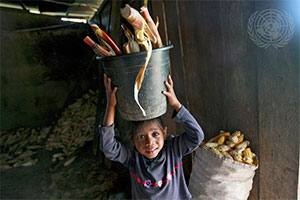 Timorese Girl with Fresh-Picked Corn. Credit: UN Photo/Martine Perret
A global common denominator is the need for a decent job. The economic realities of each country determine just how difficult it is to find one. Despite the labour movement's achievements, serious challenges persist: gender discrimination, child labour, worker migration, the digital divide and AI automation, evaporating pensions, unsafe workplaces, corporate pressure against union organising, negative impacts of trade agreements, and the precariousness of informal employment. The 2025 UN SDG Report identifies jobs and social protections as one of the six priority areas requiring urgent action, with progress either stalled or reversing in many developing nations.
In recent years, the fight to protect labour equality has taken on new dimensions with the rise of Environmental, Social and Governance standards. With the Social aspect aiming to promote equality and human rights, ESG principles have strengthened labour advocacy within corporate and governmental regulatory landscapes. In particular, ESG has become much more institutionalized in emerging economies such as Brazil and China. IPS follows the world’s workers as they confront these challenges - their setbacks and their successes.

The Week with IPS

NEXT STOP - SDGs
Tracking global progress towards a sustainable world
Tracking global progress towards a sustainable world
