
Saturday, November 28, 2026



News and Views from the Global South
Environment
Ecobreves – GUATEMALA: Park Rangers Wanted in El Petén
The Protected Areas Council, CONAP, in Guatemala has just 45 park rangers to cover the 90 posts for monitoring the vast preserves in El Petén, the country's largest department and richest in natural resources.Ecobreves – HONDURAS: Mining Activity Under Fire
Residents and authorities in 14 municipalities of western Honduras are demanding a reform of the mining law, saying it is an attack on the environment. They gave the government an ultimatum to remove the mining transnational Maverick from the Guiyasote ecological reserve.Ecobreves – BRAZIL: Plans Against the Greenhouse Effect
Projects to fight global warming by reducing emissions of greenhouse gases will be the focus of the second Latin American Symposium on Carbon Fixation, Apr. 21-24 in Curitiba, capital of the southern Brazilian state of Paraná.Greens United, but Their Color Has Faded
European environmentalists have created a regional Green Party with sights on EU parliamentary elections in June. But the Greens' political influence remains limited. Currently there are just two green parties -- in Germany and Latvia -- that form part of governing coalitions in Europe.New Offensive Against Asbestos
Labor authorities in Brazil are seeking a ban on the carcinogenic mineral that is used in more than 3,000 products, but the private sector is expected to put up a fight. SAMA, the only asbestos producer in the country, exported 140,000 tons in 2003.
Galápagos on the Brink
The famed archipelago is suffering the effects of political clientelism, unregulated economic activity and the institutional weakness of Ecuador, says analyst Javier Ponce in this exclusive column for Tierramérica.Ecobreves – CUBA: Snail Farming
A project to artificially raise Zachrysia guanensis, a land snail, is under way in Cuba's Viñales National Park, 150 km from the capital.Ecobreves – VENEZUELA: Tuna Industry Looks Out for Dolphins
The tuna boats of Venezuela and Mexico, regional leaders in the sector, are looking out for the dolphins that swim alongside the schools of tuna, according to the Venezuelan Foundation for the Sustainable and Responsible Tuna Fishing (Fundatún).Ecobreves – CHILE: Promises to Cut Air Pollution Risks in Santiago
The Chilean government has promised through Santiago metropolitan region leader Marcelo Trivelli that next year there will be no more "environmental pre-emergencies" declared in this city of five million inhabitants.DEVELOPMENT-UGANDA: Fishing Industry Gets a Facelift
It weighs up to 250 kilogrammes. The Nile Perch, popularly known here as ‘sabulenya’, is one of Uganda’s most consumed fish species after tilapia.ENVIRONMENT-PORTUGAL: New World Capital of Solar Energy
The sunny valley of Baldio das Ferrarías in southern Portugal, where the village of Ameraleja is located, is the spot that has been chosen for the construction of what is to be the world's largest solar energy plant.ENVIRONMENT: Transgenic Corn Growing in Mesoamerica
In the Mesoamerican region, where maize was domesticated some nine thousand years ago, Honduras is the only country that permits the commercial cultivation of transgenic corn varieties.SUSTAINABILITY-PAKISTAN: Water is Villagers’ Most Urgent Need
Residents in the Pakistani village of Pulosa here quickly identified water as their most urgent need, while preparing their area development plan with the help of a public interest group this month.ARGENTINA-PARAGUAY: Environmentalists Sound Alarm on Dam Expansion
The governments of Argentina and Paraguay have resolved to complete the binational Yacyretá hydroelectric dam on the Paraná River by 2007, operating at 60 percent of originally planned capacity.
Transgenic Corn Growing in Mesoamerica
Two thousand hectares of genetically modified corn are planted in Honduras with government approval. In the rest of the region -- birthplace of this grain -- there are reports that local varieties have been contaminated by transgenic corn.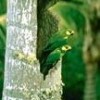
'Via Dolorosa' for Palm and Parrot
A campaign was launched in Colombia prior to the Christian Holy Week to prevent the depredation of a local tree and bird species, both of which are facing extinction. On Palm Sunday, thousands of the Catholic faithful continue to use the fronds of the wax palm, the tree in which the yellow-eared parrot makes its nest.Ecobreves – URUGUAY: Gasoline Additive MTBE Rejected
The Uruguayan research center for appropriate technologies, CEUTA, condemned that lead tetraethyl, previously used as an additive in some gasolines, has been replaced by MTBE, a known carcinogenic and contaminating substance that is banned in many countries.Ecobreves – PERU: Cyanide on the Loose
The Peruvian Ministry of Energy and Mining asked Congress to declare sodium cyanide a "controlled chemical input". Currently, it is marketed and transported without restrictions -- and last month killed five people.Ecobreves – MEXICO: Sheep Milk Recommended
Researchers at the Autonomous Metropolitan University of Mexico (UAM) say sheep milk should no longer be neglected, as it is an important source of protein, minerals and vitamins -- much richer than goat or cow milk.Ecobreves – GUATEMALA: Up With Avocados
Guatemala needs to foment wider production of avocados, a crop that is ignored despite its enormous potential, Cristian Smith, president of the Comité del Aguacate (Spanish for avocado), told Tierramérica.Ecobreves – COLOMBIA: Forestry Directory to Be Launched
Representatives of the private sector in the northeastern Colombian city of Medellin will distribute the first Directory of the Forestry Productive Chain, which includes a broad range of participants in the sector: industrialists, engineers, technicians, suppliers, financial institutions and research centers.« Previous Page — Next Page »


Through our global network of local writers, we are continuing our award-winning coverage of global and local environmental challenges, with a focus on the people for whom the ecosphere matters in a direct way: rural dwellers who have little means to protect themselves against adverse conditions; communities that need to switch to sustainable development in order to survive; poor women and children, who are the most vulnerable in natural disasters. Sponsored by the United Nations Environment Program (UNEP), the United Nations Development Program (UNDP) and The World Bank (WB), IPS also maintains the award-winning Tierramérica, a specialised information service on environment and development.

The Week with IPS

Tracking global progress towards a sustainable world


