Languages
Thursday, November 26, 2026



News and Views from the Global South
Global Geopolitics
FINANCE: Critics Press IMF on Social Spending
When Dominique Strauss-Kahn takes over as head of the International Monetary Fund (IMF) next month, he will confront demands for the agency to more actively support health and education spending in the world's poorest countries.BURMA: Fear Over the Country
Nights are no more the same for the 45-year-old Buddhist monk who lives in a monastery in the Myay Ni Gone area, close to the heart of this dilapidated city. Nor is sleep.
ENVIRONMENT-US: A Budding Market for Food Less Travelled
The scent of portobello mushrooms wafts through the air as two of the three co-owners of Roots prep for their morning customers.ENERGY: Report Challenges EU Subsidies for Biofuels
The European Union's support for biofuels may not be the most cost-effective way for the 27-country bloc to tackle climate change, a new study has concluded.HEALTH: Picture a Hunger-Free World
The scene within and outside the United Nations last week was strikingly dissimilar: while more than 140 world leaders were arriving in New York to wine, dine and address the General Assembly, a group of activists was demonstrating outside the U.N. compound for a hunger-free world.
HEALTH: Drug War Clashes With Fight Against HIV/AIDS
For more than two decades, the Vienna-based International Narcotics Control Board (INCB) has tried to discourage nations from developing harm reduction programmes and other HIV/AIDS prevention programmes.RIGHTS: UN Council Deplores Repression of Protests in Burma
The United Nations Human Rights Council approved a resolution Tuesday "strongly deploring" the violent crackdown on protesters in Burma over the last few weeks and urging the country’s military regime to engage in dialogue on fundamental rights and freedoms.POLITICS: U.N. Mission in Darfur Jeopardised by Attacks
The 15-member U.N. Security Council, which remains paralysed over the killings and military repression in Burma (Myanmar), joined hands Tuesday to condemn the "murderous attack" last weekend that killed 10 African Union (AU) peacekeepers in South Darfur, Sudan.HEALTH: The Quiet Scandal of 10 Million Deaths
A global coalition of governments and organisations has launched a new campaign to drastically improve pre- and post-natal healthcare in places like India, which alone accounts for a staggering 25 percent of the world's child deaths and 20 percent of maternal deaths.AFRICA: Aid For Trade Could Help Producers in Poor Countries
Agricultural exporters in poor nations need funds and technical assistance to comply with food safety norms in order to boost their share of world trade, according to World Trade Organization (WTO) representatives.
BURMA: UN Getting Nowhere With the Generals
Few foreigners are as qualified to talk about the mind and the manner of Burma’s dictatorship as Razali Ismail, a Malaysian diplomat who served five years as special United Nations envoy charged with facilitating political reform in that military-ruled country.CLIMATE CHANGE: Czech President Clashes with Environmentalists after UN Speech
"The recent rise in global temperatures has been very small in historical comparison, and its impact on man and his activities are basically negligible," Czech President Vaclav Klaus told a United Nations conference on global warming last week, causing domestic uproar.TRADE: U.S. Firms Up Spot as No. 1 Arms Supplier to South
Bolstered in part by major new arms agreements with Pakistan, the United States reclaimed its ranking as the developing world's biggest supplier of conventional arms in 2006, according to a new report by the Congressional Research Service (CRS).RIGHTS: 'No Safe Cities Without Justice'
The urban poor are the worst affected by crime, natural disasters and insecurity, says the Global Report on Human Settlements published by UN-HABITAT on World Habitat Day Monday.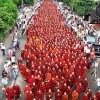
BURMA: China Has Much at Stake
Jarring against a dearth of official news about the turmoil in Burma, the ‘Southern Weekend’ - one of China’s more liberal official newspapers - has chosen to run a lengthy feature about an ethnic Chinese entrepreneur striking it rich in the jade business in that neighbouring country.HEALTH: Billions More Dollars Needed to Save Lives
A further 9.7 billion dollars agreed last week for a global fight against AIDS, tuberculosis and malaria may still not be enough.
Q&A: ‘China Holds the Key to Democracy in Burma’
Ever since he hijacked a Rangoon-bound Thai airliner to Kolkata in 1990, to highlight the brutality of its military rulers, Soe Myint has been the face of the Burmese resistance in India - a country with ambiguous policies towards its eastern neighbour and the plight of its people.HEALTH: UNAIDS Head Puts the Spotlight on Children and Teens
The executive director of the Joint United Nations Programme on HIV/AIDS (UNAIDS) is urging action as concerns the transmission of HIV to children through sexual abuse, incest and early teenage sex.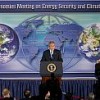
CLIMATE CHANGE: The Skunk at His Own Garden Party
After years of denial, the U.S. White House-sponsored summit on climate change ended Friday with President George W. Bush admitting that global warming was real and humans were responsible and asking for heads of state to join him at yet another summit next year (when his presidency ends).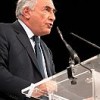
FINANCE: New IMF Boss Inherits Crises of Legitimacy, Relevance
Former French Socialist finance minister Dominique Strauss-Kahn is to head the International Monetary Fund (IMF) from November. He takes the helm amid deep division over how the agency is governed and its role in the global economy.RIGHTS-BURMA: UN Emergency Session to Study Crisis
The United Nations Human Rights Council will hold an emergency session next week to discuss the bloody crackdown on protests by the military regime in Burma, which has left an unspecified number of Buddhist monks and other demonstrators dead and injured this week and hundreds under arrest.« Previous Page — Next Page »


Is the world dominated by three great empires -- the U.S.A, China and the European Union? How much power do the great behemoths of the south -- India, Brazil, and South Africa -- wield? And where does Russia fit in that equation? Are we in the middle of a new Cold War? What are the implications of the armed conflict with Georgia? What about the new axis: Venezuela-Russia? And what role does Turkey play? What about issues like Climate Change and other global forces like the food crisis and the high energy prices? How is all this reshaping the world's forces? IPS looks for some answers.

The Week with IPS

NEXT STOP - SDGs
Tracking global progress towards a sustainable world
