Languages
Saturday, November 28, 2026



News and Views from the Global South
Africa
G8 SUMMIT: Debt Cancellation No Panacea for Benin – Analysts
Some may see it as a just reward for years of fiscal discipline. For others, it is a gesture that will ultimately do little to address poverty in Benin. What there is no disputing, is that the debt relief given to Benin last month by the Group of Eight (G8) is as much a source of controversy as satisfaction.G8 SUMMIT: Pop Diplomacy Takes Over
Intense negotiations began straightaway on the first day of the Group of Eight summit - not amongst the G8 leaders, but between pop stars and the heads of state.POLITICS-AFRICA: Sirte Looks to Gleneagles
The African Union ended its annual summit this week with an appeal for substantially more aid from the West and demands for two permanent seats on the United Nations Security Council.RIGHTS-EUROPE: Migrants Avoid Drowning, Only to Face Deportation
Leading human rights groups say European Union proposals to stop illegal immigrants entering the bloc from Libya are ''irresponsible''.G8 SUMMIT: Poverty Campaign Throws a Final Challenge
The Make Poverty History campaign threw down a final challenge to the industrialised world's leaders to end poverty and save lives as the Group of Eight summit got under way here Wednesday.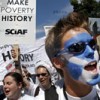
G8 SUMMIT: What if They Disagree to Disagree?
Every now and then helicopters have been flying towards the Gleneagles Hotel, carrying one or another of the G8 leaders whose three-day summit begins Wednesday.FRANCE: Recasting Colonialism as a Good Thing
France and other European countries are claiming, either officially or through historians, that colonialism was a positive thing.G8 SUMMIT: See Through the British ‘Brownwash’, Say Activists
Britain is painting a misleadingly flattering picture of its commitments to do more in the fight against poverty in Africa, a leading development group says.ENVIRONMENT-NIGERIA: The Downside of Being a “Benchmark for Eco-Tourism”
An initiative that aspires to turn a national park into what officials term a "benchmark for eco-tourism developments" may seem beyond reproach. If the conservation area is Yankari National Park in north-eastern Nigeria, however, it could well give pause for thought.
G8 SUMMIT: Behind This New Interest in Africa
Powerful western nations are committed to developing Africa but more as a market for their goods, a leading agricultural economist says.RIGHTS-RWANDA: A Mixed Verdict for Community Courts
It is not the place where you would expect to find justice in Rwanda: at the end of a bumpy dirt road leading to a shantytown of red mud-brick homes, where children sit idly on verandas.G8 SUMMIT: A Wristband and a Concert Aren’t Enough, Say Activists
"The politics of G8 got somewhat lost at Live 8," says Neil Williams, an activist with the British socialist coalition known simply as Respect, about the 10 concerts performed Saturday in 10 cities.G8 SUMMIT: More Aid Sought for African People, Not Gov’ts
A leading campaign group has called for a substantial part of increased aid to Africa to be channelled directly to people, rather than governments.G8 SUMMIT: Live 8 Emotion Imperfect but an Impetus
The film clip played at the Live 8 concert at Hyde Park in London was meant, of course, only briefly to look like more of the same: the malnourished African child trying to feed off a more malnourished mother; the predictable end to the clip with a close-up of what appeared like a dying child.G8-SUMMIT: “We Are Making Good Progress, Considering Where We Came From”
Demands for good governance and tough action on corruption could eclipse calls for increased aid to Africa when the Group of Eight (G8) leaders meet this week in Scotland for their annual summit, African academics and civil society groups fear.G8 SUMMIT: The Music Will Have Developmental Echoes
Long after the music dies down at the Live 8 concerts and the crowds go home, echoes will linger by way of questions whether star-studded shows like these are what Africa needs.TECHNOLOGY-KENYA: On the Way to Getting Wired
In 1961, there was just one to be had. By 1985, that figure had increased to 1,800 - and at the beginning of last year, it stood at about 520,000, according to government figures.G8 SUMMIT: Africa Needs Food Security, Not Experimental Crops
As world leaders prepare for the Group of 8 (G8) summit next week, a leading global consumer body is warning that genetically modified food is not the ''miracle solution'' to world hunger and malnutrition.DEVELOPMENT: Oil Booms End Up a Bust, Study Shows
The U.S. strategy to increase oil production from non-Middle Eastern nations in the least developed countries may serve consumers in Western nations, but is likely to add to those poor nations' burdens of debt and economic hardship, according to a new study released Thursday.POLITICS-DRC: Bullets, Not Ballots
The 45th anniversary of Congo-Kinshasa's independence from Belgium, Thursday, was supposed to have been the day the country held its first democratic election in over four decades. However, it was teargas and ammunition rather than ballot boxes which many citizens were confronted with.POLITICS: Malaria Push Would Double US Aid to Africa by 2010
Less than a month after rebuffing British Prime Minister Tony Blair's calls for a massive increase in aid to sub-Saharan Africa, Pres. George W. Bush announced plans to double annual U.S. aid to the world's poorest region by 2010 and launch new initiatives to cut the number of its malaria deaths by half and boost enrollment, especially of girls, in primary schools.« Previous Page — Next Page » *#*

The Week with IPS

NEXT STOP - SDGs
Tracking global progress towards a sustainable world
