Languages
Saturday, November 14, 2026



News and Views from the Global South
Education
RIGHTS-US: Big Brother Thriving in High School Classrooms
While authoritarian states in much of the world routinely jail journalists and others for expressing critical opinions, a high percentage of U.S. high school students believe the government should censor the press and that constitutional protection of free speech goes "too far".EDUCATION: Italian ‘Godparents’ Sponsor Children in Paraguay
Cristian Núñez, a young Paraguayan who has been "sponsored" by an Italian family since he was five years old, is about to see his dream come true: he will start studying at the university in Asunción, the capital of that South American country, this month, with the aim of becoming an electrical engineer.
EDUCATION-ZIMBABWE: A Dubious Report Card for Grade Zero
Hats a size too large for most of the small heads, formal school uniforms equally incongruous, they march on regardless - the vanguard in an effort to bring pre-schoolers into Zimbabwe's education system.DEVELOPMENT: Oil-Rich Trinidad Confronts Its Darker Side
It is considered the most economically well-off country in the English-speaking Caribbean.DEVELOPMENT-SUDAN: The South Starts Picking Up the Pieces
The roads are carpeted by thick layers of dust. Tanks, military trucks and the skeletal remains of buildings dot the landscape. Welcome to Rumbek: the newly-designated administrative capital of southern Sudan.
EDUCATION-SWAZILAND: AIDS Orphans on (Somewhat) Firmer Ground
In May last year, IPS reported that teachers in Swaziland were at loggerheads with government over the delicate matter of admitting AIDS orphans to schools free of charge. With the new academic year looming, has the situation improved?EDUCATION-KENYA: Time Now for Universal Secondary Schooling?
A recent statement by the Kenyan government that many students who graduated from primary school last year will not find places in the country's secondary schools has generated widespread concern.EDUCATION-CAMEROON: Private Trumps Public – For Better and For Worse
In 1993, the government of Cameroon passed a law allowing private tertiary education institutions to be established in the country. Now, almost a decade later, is this decision still viewed as the right one? That depends on who you ask.EDUCATION-AFRICA: Universal Schooling an Elusive Goal
A new report by the South African Institute for International Affairs (SAIIA) has highlighted the challenges and constraints facing education in Africa.EQUATORIAL GUINEA: A Classroom for the Mentally Disabled
The only classroom for the mentally disabled in the tiny West African nation of Equatorial Guinea is run by two non-governmental organisations, because for the government, the mentally handicapped do not exist, an activist told IPS in Spain.MALAYSIA: Student Activism, a Definite No – Say Authorities
Student activism and politics just don't mix in Malaysia - at least in the eyes of university authorities. And third year journalism student Soh Sook Hwa can bear testimony to that.CULTURE-VENEZUELA: New Compendium on Yanomami Language
When a Yanomami Indian dies, his or her name is not to be pronounced for some time, so as not to soil the memory of the deceased.U.S.: Foreign Student Numbers Drop
The number of foreign students studying in the United States has dropped for the first time in more than three decades, in part because of a perception those students are not welcome here.
ENVIRONMENT-SOUTH AFRICA: Making Greens Out of Blacks and Whites
A decade into democracy in South Africa, visitor figures for the country’s national parks still reflect a legacy of racial exclusion.EDUCATION: Quality Costs Money
Without education, no development is possible, but it is precisely underdeveloped countries that suffer the greatest dearth of quality education, due to the lack of funds. How can that circle be broken?IMMIGRATION-SPAIN: Barred from the Classrooms in Madrid and Valencia
Activists, teachers and politicians with the ruling socialist party in Spain are worried about a decision by authorities in schools in the provinces of Madrid and Valencia, which are governed by the centre-right Popular Party, to bar undocumented immigrants who have completed the 10 years of compulsory schooling from continuing their education.EDUCATION: Gov’ts Need to Do Homework in Key Goals, Says UNESCO
Even while millions of children continue to be denied schooling in the Asia-Pacific region, a U.N. report released Monday says that the situation could get worse if governments fail to address the gaps that plague even the most basic education programmes.EDUCATION-KENYA: Free Schooling – Good, but not Enough
By any measure, the enrolment of over a million extra children in Kenya’s primary school system over the past two years is a success story. Enrolment figures in the East African country burgeoned after President Mwai Kibaki introduced free primary education in 2003, when he took over as head of state from Daniel arap Moi.EDUCATION-ZIMBABWE: The Schools Soldier On
Wooden panels in the main hall still list the fading names of outstanding students who attended Milton Junior School in the southern Zimbabwean city of Bulawayo, during the last century.EDUCATION-KENYA: Mastering the ABCs is Not Always Child’s Play
Discussions about improving the level of education in Kenya often focus on the challenge of achieving universal primary education - or ensuring that girls are not discriminated against when it comes to schooling.EDUCATION: Low Marks for Mexico
The 33-student class taught by Alejandra Avendaño, a Mexican schoolteacher, includes children from four different grade levels, who are not benefiting from the experience.« Previous Page — Next Page »


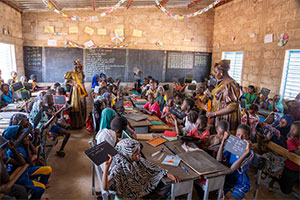 Two teachers work in a classroom in Forces Vives School in Dori, Burkina Faso. Credit: UNICEF/UNI978361
Safe and uninterrupted education is a fundamental right for all children. Education is paramount to global development, as it has been proven that investing in education – especially for girls and children – contributes significantly to economic growth and prosperity. Although more than 1 billion children go to school, many are subjected to conditions that are not conducive to a proper learning environment, including makeshift facilities, a lack of supplies, violence in classrooms, inadequate sanitation, untrained instructors, and widespread school closures. Since 2015, there have been immense gains in education with an increase of 109 million children in school. However, as of 2023, 272 million children are still out of school.
High poverty levels in developing countries also impede children’s access to a proper education. For example, from the early to mid 2000s, Sub-Saharan African nations witnessed a dramatic decline in trained teachers due to inadequate funding in the education sector. Furthermore, major cuts to United States international aid threaten an estimated 23 million additional children's access to education, as USAID‑funded school programmes across Africa and Asia face closure.
Various other factors contribute to the decline of education, notably hunger, which has increased as conflict and climate change interfere with global food production and dissemination. Meanwhile, certain social and cultural practices also impede children’s access to education, with gender inequality, discrimination, child labour, and child marriages preventing millions of children from attending school. Economic conditions such as the inaccessibility of higher education also affect disenfranchised communities across the world. In extreme situations, such as warfare where educational facilities are destroyed in their totality, notably in Gaza and Sudan, entire generations of children might grow up without access to education. Rebuilding educational infrastructure is a long and arduous process, especially when violence persists across generations, and this significantly stunts the development of societal prosperity and stability.
IPS is dedicated to telling the shocking truths about worldwide education through impassioned opinion pieces and comprehensive articles, highlighting global issues that impede worldwide education and the courses of action being taken by organizations such as UNICEF and Education Cannot Wait.

The Week with IPS

NEXT STOP - SDGs
Tracking global progress towards a sustainable world
Tracking global progress towards a sustainable world
