Languages
Tuesday, November 17, 2026



News and Views from the Global South
Poverty & MDGs

Q&A: "Sanitation Is a Political Orphan"
Last month, the Prince of Orange, Willem-Alexander of the Netherlands, and U.N. Secretary-General Ban Ki-moon joined forces to declare 2008 the International Year of Sanitation (IYS).
MEDIA-KENYA: For a Woman Candidate, It's Good To Be a Man
As with political candidates everywhere, women running in this month's general elections in Kenya are doubtless keeping a close eye on the media to see how they are being portrayed by news outlets. Then again, these women may simply be concerned about whether they are portrayed at all.AGRICULTURE-CUBA: Waiting for Announced Reforms
While saving up for the extra expenses of the year-end holidays, Cubans are hoping that 2008 will bring reforms, at least in agriculture, that will result in a more varied supply of food, at affordable prices.PAPUA NEW GUINEA: Waking Up Finally to the HIV and AIDS Threat
When the new government of Papua New Guinea (PNG) set up in August a separate ministry devoted to containing HIV and AIDS in this Pacific Island country, it reflected the enormity of the threat to its six million people.ENVIRONMENT: Pacific Islands Get Climate Change to Water Summit
It could have been a Pacific Islands summit on climate change. Of the nine heads of state attending the first Asia Pacific Water Summit (APWS), underway in this Japanese town, seven are from the islands and more concerned with global warming than anything else.GUATEMALA: Teaching With Two Voices
In the Xepanil village school in Santa Apolonia, to the west of the Guatemalan capital, 20 children are learning both Spanish and the Mayan indigenous language Kaqchikel. Their teacher, Marta Lidia Rodríguez, one of thousands of bilingual education teachers in this country today, walks an hour a day to get to the school.AGRICULTURE-ARGENTINA: Using Internet and Bicycles to Search Out Markets
Just 45 kilometres outside of Buenos Aires, a group of 20 families have set up a farming operation where they work in harmony with nature and without bosses, selling their products through a small network of consumers who appreciate the benefits of organic food and cooperative labour.CUBA: Machismo Not O.K. – But Not Yet K.O.’d
Gradually, more men in Cuba are declining to take on traditional masculine behaviour patterns, and women who oppose the machismo and sexism that still predominates are opening up ways of changing gender relations, beyond the effects of official measures taken to promote equality over the last 50 years.ENVIRONMENT-ASIA: ‘Talking Dirty’ on Sanitation Can Save Lives
Although 2.6 billion people in the world - two-thirds of whom are in southern or eastern Asia - are living without access to basic sanitation, the issue has been a poor cousin to water supply in terms of visibility and financing.BRAZIL: Sanitation for All…in 115 Years
Just 47 percent of the population of Brazil is hooked up to the main sewage system, and at the current rate of public spending on sanitation, universal coverage will be reached when the country celebrates its 300th anniversary of independence, in the year 2122.TRADE-AFRICA: ''Focus Should Be on Domestic Needs, Not Exports''
African states should address the needs of local markets and of their regions before looking at what can be exported globally, and not the other way round as is currently the case.
ENVIRONMENT-SOUTH AFRICA: Radioactive Water, the Price of Gold
Large gold-mining companies operating to the west of South Africa's commercial centre, Johannesburg, stand accused of contaminating a number of water sources with radioactive pollutants.
CLIMATE CHANGE: Forests, the Great Green Hope?
Expanding European forests absorbed 126 million tonnes of carbon dioxide from 1990 to 2005 - equivalent to 11 percent of European Union emissions from human activities - while a U.N. target to plant one billion trees mainly in Africa has been surpassed.SOUTHERN AFRICA: “Make the Issue of Water Attractive to the Authorities”
To tackle droughts in Southern Africa, one needs to think out of the box instead of pointing fingers at obvious causes such as lack of rainfall, experts said this week during the third Zambezi Basinwide Stakeholders Forum, held in Victoria Falls, Zimbabwe.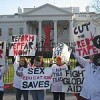
WORLD AIDS DAY: Ideology Trumping Health, U.S. Activists Say
On the eve of World AIDS Day Saturday, the U.S. Park Police arrested 40 demonstrators outside the White House as they chanted for sweeping changes to the George W. Bush administration's domestic and global AIDS policies.WORLD AIDS DAY-KENYA: Many Firms Still Ignoring the Bottom Line on HIV
HIV/AIDS cuts workers down in their prime, taking to the grave a wealth of training and experience that companies can ill afford to lose. Lower productivity, absenteeism from work and increased medical bills exact a further toll on the private sector - all of which begs the question: are employers being sufficiently active in helping to fight AIDS?WORLD AIDS DAY: Community Action Is Key to Prevention
The United Nations presented the call for nominations for the Red Ribbon Award 2008 to honour community leadership and action against HIV/AIDS in the Mexican capital Friday.WORLD AIDS DAY-EL SALVADOR: More People Testing Positive
The rise in new HIV/AIDS cases in El Salvador shows either that the government strategy to combat the epidemic is failing, or that a larger proportion of the population is being tested, depending on the respective viewpoints of non-governmental organisations and local authorities.RIGHTS: UN Spotlights “Massive and Systematic” Abuse of Women
Millions of women across the world are beaten, killed, bought and sold by men, yet the gruesome violence and cruel treatment they face every day rarely makes headlines in the global media.TRADE-EAST AFRICA: EPA Signed to ''Protect'' Small Farmers
The East African Community signed a framework agreement as part of the economic partnership agreement (EPA) talks with the European Union (EU) to ensure continued access to EU markets for African small farmers, says Juma Mwapachu, secretary general of the East African regional body.WORLD AIDS DAY: Catholics Snub Vatican’s Condom Ban
As millions of people plan to show solidarity with the struggle against HIV/AIDS on Saturday, a new multi-nation poll released in Washington by the group Catholics for Choice shows that a majority of Catholics around the world believe that - contrary to the edicts coming from Rome - "good Catholics can use condoms".« Previous Page — Next Page »


