Monday, August 3, 2026



News and Views from the Global South
ENVIRONMENT-SRI LANKA: Villages on Phosphate-rich Land Resist Mine
Feizal Samath
- Menike Gnanawathie, her face and clothes splattered with mud after working in the paddy fields, squats outside her home and declares with determination: “I won’t leave these lands.”
“This is all I have. This is my life. Phosphate or no phosphate, I will live, work and die in Eppawala,” says the young mother.
Like thousands of others at Eppawela, a quiet farming area about 250 km north of Colombo, Gnanawathie is fighting off attempts by the government to hand over a large chunk of land to an American firm to establish a phosphate mine.
The 425-million dollar project, proposed by the U.S-based Freeport McMoran Resource Partners, IMC Agrico and Japan’s Tomen Corporation, envisages a major new mine at Eppawala and a fertiliser plant near the eastern port city of Trincomalee.
The scheme covers an area of 56 square km of land and means re-locating some 12,000 villagers from 26 villages. Buddhist temples, schools and a large number of government buildings also face destruction, environmentalists say.
The government is determined to go ahead with the project but widespread opposition to the project from residents and Colombo- based environmentalists groups have delayed its plans and the agreement is currently in limbo.
Jagath Gunawardene, an environmental activist and lawyer, says that things are at a stalemate at present because Freeport McMoran appears to have got cold feet after the main opposition United National Party (UNP) held a protest rally at the site in March.
“The UNP, when in power from 1977 to mid-1994, objected to certain clauses in the McMoran deal (which had first come up at that time). The U.S company may be worried that the UNP may tear up the agreement, if it comes back to power,” he said.
According to some overseas reports, the U.S. firm has been accused of amassing waste matter which is toxic and radio active at its Florida phosphate site. It has denied these reports but in an interesting move last year, had amalgamated the company with IMC Agrico, a move seen by environmentalists here as an attempt to disguise the company.
A public interest action under fundamental rights laws, interestingly spearheaded by a leftist politician, Batty Weerakoon, whose party is backing the government, has voiced concern over the project.
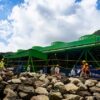
Eppawala is a phosphate-rich region that has brought wealth and prosperity to the area. But the very chemical that has sustained residents has now become a threat, forcing them to leave their traditional homelands and re-locate elsewhere, if the government has its way.
Phosphate-collection on a large scale began in 1971 when a group of 25 youths mined the land on a cooperative basis and sold it to small local companies. In 1979, the then government took over the area, set a state-run firm and began mining on a slightly larger scale. The produce was sold as single phosphate for use as fertiliser.
“There are seven phosphate hills in the area. Even the land on which my house is built is rich in phosphate,” said Sarath Dissanayake, media secretary of the Committee Set Up To Protect the Eppawala Phosphate Mine, scooping a handful of red soil with his hands.
The committee, led by Mahamankadawela Piyaratne, chief monk of the ancient Galkanda (Rock Mountain) Buddhist temple in the area, is in the forefront of efforts to stall government plans. Its continuous protest marches and demonstrations in the town and in Colombo, have drawn wide public and media attention.
Dissanayake said that the phosphate can be exploited over a 200 to 300 year period but the government wants to hand over the land to a foreign company on a 30-year lease. “It will fleece the area within 12 years, causing mass destruction such as desertification,” he warns.
He said that the project would force men, women and children to uproot themselves, leave their fertile lands and begin a new life elsewhere.
“The irony is that the American company will resort to large- scale mining of the phosphate, use modern technology to produce double-phosphate (a more richer and high-tech product) and then re-export it or re-sell it to Sri Lanka,” he said. “Why can’t we get this technology and do it ourselves?”
For the area’s humble farming community, the controversy over phosphate boils down to their daily meal of rice and curry. They grow rice and vegetables on acres of green-carpeted land, keep some for their own consumption and sell the rest. This is how their parents and grandparents eked out a living and how their children will do, too.
“How can I leave this land that was given to me by my father?” asked 28-year old Gamini Karunaratne, dusting dirt off his sarong at his field by the side of a lotus-studded tank.
Keerthi Jinadasa, 26, felt the same way. Married for just seven months, he and his wife have built a small wattle and daub hut in a corner of his parents’ land. They are thinking of starting a family. “Can we go to some strange place and start afresh,” he says.
 Print
|
Print
|
Editors' choice