Monday, September 7, 2026



News and Views from the Global South
HEALTH-DEMOCRATIC REPUBLIC OF CONGO: Children Die of Cholera
Moyiga Nduru
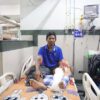
- A pack of pictures taken in Kisangani shows a row of thin children with sinking eyes lying in a cholera camp, with drips hanging above their beds to replace lost fluids.
Kisangani is the largest city in the east of the Democratic Republic of Congo (DRC), on the border with Uganda, Rwanda and Burundi.
“The situation is pathetic there. Everybody is scared of the cholera epidemic,” said a photographer, just back from the city.
The photographer, who was hired by a European non-governmental organisation (ngo), told IPS this week that the disease was claiming the lives of children more than any other group.
Confirming this, the United Nations Children’s Fund (Unicef) office in Kisangani reported that the epidemic — which escalated after heavy flooding in the region in late December — had claimed 231 lives and struck 1,235 people, the majority of whom are children.
“Some 80 percent of these children are about 12 years of age,” Unicef said in a statement.
The statement, made available to IPS on Wednesday, said the majority of cases are from the Kapelata camp — located some six kilometres from Kisangani. The camp is described as overcrowded with poor sanitation conditions.
According to Unicef, the cholera cases have been reported among children of the Mai-Mai ethnic group who arrived in Kisangani from Goma and Bukavu — both located in the east of the country. The camp was reportedly lodging up to 4,000 children.
The children are said to be receiving treatment at a cholera treatment site, some two kms from the camp, which the humanitarian community established after a request from provincial authorities.
Unicef says it has provided the site with a temporary reservoir so patients have access to potable water. The agency also says it has assisted cholera patients by supplying sachets of oral rehydration salts, foodstuffs, plastic sheeting and blankets through the provincial medical inspector.
These supplies were part of 13 metric tonnes of relief materials, valued at 57,000 U.S. dollars, which Unicef says it delivered to provincial authorities after flying the supplies to the area from Kinshasa on Dec. 25.
The problem in Kisangani has been caused by the unsettled state of the weather which has resulted in very high water levels in the Congo River and its tributaries (Aruwimi, Tshopo, Lomami, and Lulu), causing considerable damage to housing and crops in Kisangani, as well as in an yet unknown number of villages, some of which are only accessible by boat.
Reports say the provincial governor has described the flooding as the worst since 1963. Provincial authorities say the floods have damaged or washed away an estimated 9,952 homes in the six communes of Kisangani, rendering many families homeless.
The most affected villages in the region include Banalia (120 km north of Kisangani), Isangi (100 km west of Kisangani) and Ubundu (125 km south of Kisangani). Reports on Isangi indicate floods have displaced 2,749 people and the population has no access to potable water.
Cholera — caused by a bacterial infection acquired through ingesting contaminated water or food–has emerged as a serious health problem in more than half a dozen countries in eastern and central Africa since heavy rains began pouring throughout the region last October.
Unicef says it is working with authorities in the affected countries — including DRC, Burundi, Ethiopia, Kenya, Rwanda, Somalia, Sudan, Tanzania and Uganda — to provide medical and sanitation materials, train health workers in treating and preventing cholera and raise public awareness of precautions to take to prevent and recover from the disease.
DRC’s Unicef spokesperson, Mari-Claire Yaya, said the agency was doing all it can to combat the epidemic in Kisangani.
 Print
|
Print
|