
Sunday, October 18, 2026



News and Views from the Global South
Opinion
Zambia: An Uneven Contest, an Easy Win
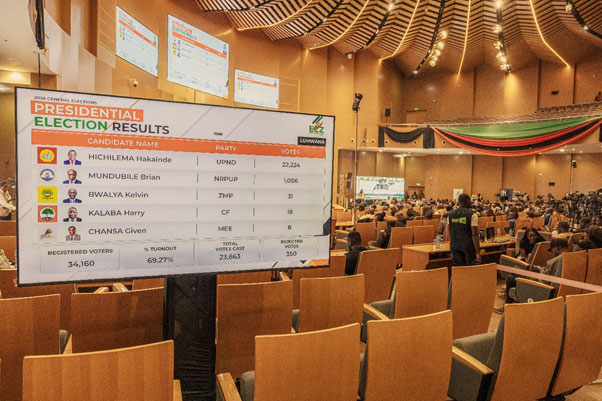
Partial presidential election results are displayed on a screen at the Zambian Elections results center in Lusaka on 17 August 2026. Credit: Gianluigi Guercia/AFP
- On 24 August, police sealed off access to Zambia’s courts, closed the day before the deadline for petitions to challenge the results of the 13 August presidential election. The judiciary’s top official cited security reasons, but the timing left little doubt that authorities meant to block the defeated candidate’s legal challenge.
Official results gave the incumbent, Hakainde Hichilema, 60.49 per cent of the vote, comfortably ahead of challenger Brian Mundubile’s 37.87 per cent. Some results from the concurrent National Assembly vote remain pending, but Hichilema’s United Party for National Development (UPND) has also won a commanding majority over Mundubile’s National Reconciliation Party for Unity and Prosperity, part of the opposition’s Tonse Alliance.
Mundubile rejected the presidential election result and vowed to contest it in court, but an election night police raid forced him into hiding. Officers killed former minister Mutotwe Kafwaya and arrested 11 other opposition figures, blaming an exchange of gunfire and accusing Mundubile’s party of possessing weapons and planning an insurgency.
Hichilema came to power in 2021 by comfortably defeating President Edgar Lungu, whose crackdown on civic freedoms led to a polarised and violent campaign. Hichilema promised democratic renewal, pledging to strengthen human rights and the rule of law. However, after some initial positive changes, he’s overseen a slide back to the kind of practices he once campaigned against.
Pre-election crackdown
Hichilema’s margin of victory suggests he’d likely have won anyway, but the ruling party stacked the odds further in its favour while penalising the opposition. European Union observers described an ‘uneven playing field’, with misuse of state resources in favour of the UPND, voter inducements including cash handouts, heavy pro-government bias in state media, self-censorship driven by restrictive laws and police restrictions on campaign events. They also flagged a heavy and intimidating military presence at counting locations, weak security in vote tabulation and counting and a six-hour suspension of counting on election night, after which local officials appeared to be taking instructions from Electoral Commission headquarters before announcing results.
Civil society had already raised concerns about the make-up of the Electoral Commission, believing some of its members were UPND supporters, and judicial independence, after Hichilema appointed numerous new judges from UPND stronghold regions.
In December, parliament approved a law changing the electoral system. It expanded the number of constituencies and introduced a more proportional system with reserved seats for women, young people and people with disabilities. Civil society’s objections centred on the lack of consultation and the speed of these major constitutional changes, which raised suspicions they were intended to benefit the UPND.
As the vote got closer, authorities blatantly targeted opposition politicians, including by using the draconian Public Order Act. Last October, police arrested 12 people, including an opposition member of parliament, when they took part in a meeting Mundubile was expected to attend at a private home, charging them with conduct likely to cause a breach of the peace and participation in an unlawful assembly. In February, police arrested 16 Tonse Alliance members on the same unlawful assembly charge.
Opposition politicians also faced arrest for what would once have counted as the normal cut and thrust of political debate. One of the weapons authorities used was the 2025 Cyber Security Act, which expanded their power to criminalise online commentary and criticism.
In January, police arrested opposition member of parliament Miles Sampa after he alleged by-election fraud. In February, they arrested National Democratic Congress leader Mambwe Zimba over a Facebook post depicting Hichilema in a coffin. In March, they arrested Socialist Party leader Fred M’membe over radio comments about Hichilema and the political controversy over funeral plans for Lungu, who died in 2025. All three spent time in detention before being released on bail.
The crackdown even reached an event that should have showcased Zambia for the right reasons. In April, just days before RightsCon, the world’s largest gathering on digital rights, was due to open in the capital, Lusaka, the government effectively cancelled it. They postponed it at too short notice for rescheduling. Over 2,600 people had planned to attend and some were already on their way. Authorities cited unspecified concerns about some speakers’ clearances and demanded more information on discussion topics. The government evidently didn’t want debate about issues it deemed controversial, including its human rights record. Zambian officials were also reportedly pressured by China, a key investor, over the planned participation of Taiwanese civil society representatives.
Time to restore freedoms
Zambians remain proud of their democracy, which has seen three peaceful handovers since multiparty elections returned in 1991. Hichilema should get democracy back on track by restoring all the freedoms that have been compromised. That starts with reversing regressive laws typically rushed through parliament with little consultation, including the Cyber Crimes Act and others that restrict online speech. The government must also commit to respecting media freedoms and letting the political opposition play its proper democratic role.
The government should replace the colonial-era Public Order Act. Hichilema vetoed its proposed replacement, the Public Gatherings Bill, passed by parliament in May. Civil society had raised concerns about the bill’s broad granting of discretionary powers to law enforcement officers and imposition of criminal sanctions. Zambia needs a law that allows peaceful protests and doesn’t criminalise organisers and participants. Civil society has also raised concerns about an NGO Bill that would grant the government extensive powers to regulate, suspend and dissolve civil society organisations. This bill must advance no further.
Three decades of peaceful transitions made Zambia a regional democratic beacon. Keeping it one requires a government that respects dissent, and a civil society free enough to make sure it does.
Andrew Firmin is CIVICUS Editor-in-Chief, co-director and writer for CIVICUS Lens and co-author of the State of Civil Society Report.
For interviews or more information, please contact research@civicus.org



 Print
|
Print
|




