
Tuesday, October 27, 2026



News and Views from the Global South

Eco-Demands Give Way to Money
- Environmentalists say the payment of more than a million dollars to four indigenous women who had opposed construction of the Ralco hydroelectric dam is a blow to democracy. The energy plant is to begin operations in 2004.
-
The agreement between the Pehuenche Indians, the transnational energy company Endesa-España and the Chilean government was announced Sep. 16 by President Ricardo Lagos, and immediately came under fire from former presidential candidate and ecologist Sara Larrain.
“It is a terrible precedent, putting environmental obligations and the protection of indigenous peoples at the mercy of politics and economic power,” Larrain, coordinator of the Sustainable Chile Program, told Tierramérica.
“This compensation constitutes the final step in one more case of violation of the rights of our original peoples, and was certified in his July visit to Chile by the United Nations rapporteur for indigenous peoples, Rodolfo Stavenhagen,” wrote Marcel Claude, activist with the non-governmental organization Oceana.
In contrast to the ire of the environmentalists, the government considers the arrangement an “investment in social peace”, which was able to defuse the conflict involving indigenous rights and the country's energy sector development.
Ralco, whose troubled history began in late 1992, is to begin operating in 2004, and with its output of 570 megawatts, would provide an 18-percent increase in the central energy network's supply for nine of Chile's 13 regions.
As a result of the agreement made with Berta Quintremán, Rosalía and Mercedes Huenteao and Aurelia Marihuán, the demands for electricity can be met, even after increasing 7.3 percent by the end of this year, says Rodrigo Iglesias, of the governmental National Energy Commission.
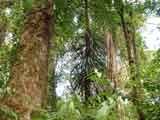
Along the upper Bío-Bío, the main river in central Chile, 500 km south of Santiago, the hydroelectric plant will alter a unique watershed with the construction of a dam that will hold a reservoir of 1.22 billion cubic meters of water, flooding an area of 3,400 hectares.
The upper Bío-Bío runs through the ancestral lands of the Pehuenche, a branch of the Mapuche Indians whose name comes from the 'pehuén', the giant pine tree that provides sustenance with its pine nuts.
First the Endesa-Chile subsidiary, and then Endesa-España were able to convince most of the 80 Pehuenche families living near the construction site to exchange their land for plots elsewhere.
But the four women, joint owners of 48.35 hectares, held out until the end, refusing to move.
“The Pehuenche communities were pushed into a corner until they were forced to negotiate,” said Larrain, who noted that in order to legalize the land exchange process in accordance with the 1993 Indigenous Development Act, the previous government of Eduardo Frei Ruiz-Tagle forced two directors and several board members of the National Indigenous Development Commission to resign.
The Inter-American Commission on Human Rights in February took up a claim against the Chilean government for “denial of justice” for the Pehuenche women Nicolasa and Berta Quintremán, and in April a Chilean court ordered a halt to the dam construction process.
That ruling apparently sped up government efforts to compensate the Pehuenche women.
Endesa-España will pay each of them 298,000 dollars and will give them 77 hectares of land. The government will have to take care of compensating 10 other families considered “indirectly affected” by the megaproject.
The latter reparations, 1.8 million dollars, will be paid “by all Chileans”, and represents “an unacceptable and unconsulted subsidy to Endesa-España, one of the biggest foreign companies operating in the Latin American energy sector,” said Larrain.
“On my desk are hundreds of signatures from citizens around the world asking the Supreme Court for justice,” says Claudio Escobar, of the group “No Ralco”, which was preparing a campaign in case the conflict reached the highest court.
Escobar recognizes the “sovereign will” of the four families that negotiated the accord, but condemned “the complicity of the government, which was sworn to defend indigenous rights.”
In the end, “the market easily defeated democracy,” he said.
A similar frustration occurred in June 1996, when Chilean activists joined the San Alfonso community, in the Santiago foothills, in a mobilization demanding that the Canadian transnational Nova change the route of a gas pipeline from Argentina that was to pass through the town.
After a year of conflict, and as a result of mediation by then-president of the Chilean lower house, Jaime Estévez, an agreement was reached between the local residents and GasAndes, the Nova subsidiary, so that the pipeline would maintain its course in exchange for economic compensation.
 Print
|
Print
|




