Tuesday, September 22, 2026



News and Views from the Global South
RIGHTS-ZIMBABWE: Media Environment Bodes Ill for 2005 Poll
Moyiga Nduru
- When two reporters and a lawyer traveled to Zimbabwe recently on a fact-finding mission, they found it a journey of the most arduous kind.
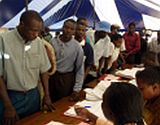
Recent elections in Zimbabwe have been problematic. Will the 2005 poll follow this trend? Credit: SAMSO
The aim of the team was to examine first hand the state of media freedom in Zimbabwe in the run up to parliamentary elections scheduled for March 2005.
“We did it under a very difficult condition and hostile environment,” said Fernando Goncalves, editor of the Savanah newspaper in Mozambique. He was addressing journalists at the launch of a 22-page report on the group’s findings, ‘Fact-Finding Mission to Zimbabwe: June 2004’. The event took place in South Africa’s commercial hub of Johannesburg on Wednesday, Aug. 4.
One day after the team’s arrival, Zimbabwe’s state-run media were calling for the closure of the local MISA office, noted Goncalves.
His colleague, Pamela Dube, editor of the Mokgosi newspaper in Botswana, used the work “chaos” to describe the state of the media in Zimbabwe. She told reporters that news outlets had become polarized along political lines.
“The battle lines is no longer the terrain of the political opponents – the media is the battle field…In the fight for dominance on the one hand and survival on the other, journalistic ethics are being compromised,” she observed.
Added Goncalves, “The political environment in Zimbabwe is extremely volatile and polarized. The two main political parties (the ruling ZANU-PF and opposition Movement for Democratic Change) each see their continued existence and dominance as only possible with the elimination of the other. This breeds violence.”
The MISA report accuses the state-controlled media of putting out hate messages against perceived political opponents.
“Violence seems to be encouraged by hate messages that are carried out in the state media, particularly the Zimbabwe Broadcasting Corporation (ZBC) and the country’s main daily newspaper, The Herald,” it says.
According to MISA, state media hardly mention activities carried out by the opposition. When they do, the reports are invariably filled with derogatory terms that portray opposition leaders and their supporters as unpatriotic, subversive elements who are seeking to instigate violence and overthrow the government.
One example cited was the coverage given to the Catholic Archbishop of Zimbabwe’s second largest city of Bulawayo, Pius Ncube. The cleric has been subjected to a campaign of vilification and ridicule because of his views on politically-motivated violence in Zimbabwe.
“Violence and intimidation is extensive to journalists and lawyers. Independent journalists are not allowed to cover certain events, while lawyers find it increasingly difficult to access their clients who would have been arrested on politically trumped-up charges,” the report notes.
According to MISA, Zimbabwe registered 102 attacks on the media in 2003 – the highest number in the Southern African Development Community (SADC). These included incidents of assault, imprisonment and legal threats.
The organisation says this has created a feeling of uncertainty amongst reporters – many of whom have also lost trust in each other. Journalists feel restricted, and find it difficult to hold the government accountable.
MISA’s report notes that reporters, from the state media in particular, have fallen into the habit of supporting authorities and ZANU-PF without question, at times even taking a position on factions within the ruling party.
In addition, MISA laments the closure of Zimbabwe’s only private daily newspaper, The Daily News, last year. Amongst other things, this has deprived independent voter education groups of a forum where they can place adverts that encourage Zimbabweans to register.
The closure took place under Zimbabwe’s draconian media law – the Access to Information and Protection of Privacy Act.
Basildon Peta, a Zimbabwean journalist based in South Africa, told reporters at Wednesday’s launch that “Zimbabwe, which is further tightening its media laws, has descended into totalitarianism comparable only to Burma (Myanmar).”
The government is reportedly also planning to acquire equipment for the purpose of monitoring internet communications.
In the absence of any privately-owned radio or television stations, the internet has become a popular source of news for Zimbabweans. It also serves as a valuable method of communication for many of the 3.5 million citizens who have left the country for political or economic reasons.
Rural voters who depend on the radio have been particularly hard hit by the lack of independent broadcast media, says Goncalves: “People in rural areas are so scared to listen to shortwave radio because of the consequences. They listen to it in the hiding or inside the house – not in the public – because of fear.”
MISA said shortwave radios are not allowed into the country by Zimbabwean authorities. This is largely to prevent the population from listening to a London-based radio station run by Zimbabwean nationals, SW Radio Africa – and another which broadcasts from within Zimbabwe: Voice of the People.
 Print
|
Print
|