
Saturday, October 24, 2026



News and Views from the Global South
ENVIRONMENT-INDIA: Neglecting Ancient Reservoirs Carries a Price
Soma Basu* - IPS/IFEJ
- The carved granite pagodas that dominate this town in southern Tamil Nadu state have earned it a place on UNESCO’s list of World Heritage sites. Less noticeable, though, are the vast reservoirs that once took care of the water requirements of this millennia-old cultural centre.
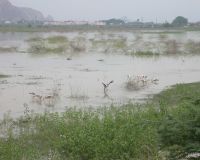
Vandiyur reservoir-turned-cesspool. Credit: Soma Basu
Ingeniously designed by native rulers and managed by local communities for centuries, the reservoirs and pools have fallen into neglect mainly due to large-scale extraction of groundwater and the construction of modern piped water systems.
But although the Madurai Corporation, an elected local body that looks after the city’s needs, is constantly busy replacing the old system with new pipelines fed by the nearby Vaigai River, the quality and quantity of water available to citizens leave much to be desired. There is also increasing reliance on bore wells that extract groundwater.
Some predictions say that in five to seven years, 80 percent of the city’s water will become polluted and unfit for human consumption. The neglect and abuse of the reservoirs and water bodies have also resulted in serious environmental degradation in the city and the surrounding rural areas.
“The environment continues to be a preoccupation of only ethically minded individuals. It is yet to become mainstreamed here,” explains S.V. Pathy, the founder-chairman of a non-governmental organisation (NGO) called Centre for Environmental Services, the city’s best-known watchdog on environmental matters.
For a decade now, Pathy has been trying to spread the message in the residential areas of the city that water availability is nearing total collapse and needs urgent steps towards better management. ”Rapid urbanisation has led to the drying up of traditional sources of water like the reservoirs, lakes and ponds,” he laments.
The irony is that Madurai’s water system had, for centuries, been considered a marvel of hydraulic engineering, based as it was on a series of big and small reservoirs that supported agricultural and other needs.
To make up for the shortage, groundwater is mined indiscriminately to a point where the water table has dropped, salinity has increased and residents are complaining of foul odours and sediments. “Pump culture has created havoc on the hydrological cycle. Everywhere nature is being unsettled and residents are forced to live in unhygienic conditions. Due to improper drainage, Madurai water is getting contaminated faster than imagined,” rues M. Ratnapati, a senior citizen.
This city of 1.7 million people lacks a water treatment plant. It has only eight water pumping stations to handle some 25,000 million litres of water, most of which feeds paddy and sugarcane – crops known for guzzling water – grown in the outlying areas.
Already water level at depths lower than 300 feet (91.4 metres), in any part of the city, has unacceptable levels of fluorides and dissolved salts that are harmful to human health.
While provision of drinking water supplies in most parts of the city is the responsibility of the Madurai Corporation, the shortages and depletion of ground water table have forced a situation where supply has had to be outsourced to private contractors and companies that further charge residents.
A 25 litre water jar is now available for 35 rupees (85 U.S. cents) but costs are predicted to rise to Rs.100 (2.5 dollars) by 2010. It is also projected that in three years’ time, the entire drinking water supply city will have to be privatised.
In fact, a recent study conducted by Neat and Clean Services, a local NGO, revealed that 90 percent of Madurai residents live in unhealthy and unhygienic conditions. “Given the tremendous water scarcity, people are unable to think about saving water when there is not enough for daily use,” explained Pathy.
Unfortunately, major reservoirs have simply vanished with even the Madurai Corporation guilty of encroachments. Over the years, the body has converted several ancient tanks into dwelling areas and in some cases even set up government buildings on the tank beds.
For instance, the ancient tanks at Sengulam and Tallakulam have been encroached upon by the District Court and the Corporation offices respectively. The centuries-old Koodal Alagar temple tank is lying in abysmal state despite some 12,000 dollars being spent on it recently.
In 2002 efforts were made to construct a rainwater harvesting structure around the 1.5 acre tank (.6 hectare) to collect rooftop rainwater. It was decided that 75 percent of the cost would be borne by the state government and the rest by beneficiaries – mostly the owners of 40-odd shops and businesses around the tank with a total rooftop area of 2.5 acres (one hectare).
According to N. Vaidyanathan, a retired public works department engineer who was a coordinator for the project, a normal rainfall of 850 mm ensures collection of 10 million litres of water. But after implementation of the project, only 60 percent of the tank’s total capacity of 15 million litres could be filled and the water level was coaxed up a few feet.
Since the Vaigai began drying up, water is being brought in from adjacent areas through channels. But even these channels too have been rendered dysfunctional thanks to rampant construction. The authorities are now exploring an alternate proposal of diverting rainwater from Dindigul town, about 80 km from Madurai.
These neighbouring wetlands are valued high in biodiversity and ecology but they are used for dumping domestic garbage, hospital wastes, drainage water, agricultural and industrial effluents. Many have turned into mosquito breeding grounds and although most are officially classified as “irrigation system tanks”, desilting is rarely done.
One of Madurai’s major reservoirs, the 700-acre (283-hectare) Vandiyur Tank, has become the dumping ground for no less than seven hospitals in its vicinity, making what little water is still available in it bio-hazardous. All kinds of waste – municipal, domestic, hospital, sewage – and effluents from industries like textile dyeing and marble polishing are drained into rivers and water bodies.
So lax is the level of regulation that fishermen grow hyacinth to reduce water levels in order to facilitate fishing, while farmers illegally raise crops like cucumber and brinjal (eggplant) on the still fertile beds. Yet, places like Vandiyur Tank continue to be visited by migratory birds.
City ornithologist, Badhri Narayan, says he has submitted a proposal to the authorities for half-a-dozen reservoirs ranging from 250 to 700 hectares to be converted into a bird refuge that may help promote tourism. “People are beginning to realise that water is wealth and rain the primary source of water.”
But rainwater harvesting has limits, given that over the past one decade this part of Tamil Nadu has 12 percent reduction in rainfall, turning the once perennial Vaigai into a seasonal river with just 65 days in the year when it is full of water.
”Without enough rain, how can we do rain water harvesting?” wonders Rajendran, chief of a rainwater harvesting committee. Many catchment areas have ceased to exist, he says. ”People should learn to trap water whenever and wherever it falls and also get motivated enough to revive the reservoirs and clean up the traditional water storages.”
(*This story is part of a series of features on sustainable development by IPS and IFEJ – the International Federation of Environmental Journalists.)
 Print
|
Print
|




