
Sunday, October 18, 2026



News and Views from the Global South
Q&A: “We Want Everybody to Come With a White Flag and Talk Peace”
Interview with Mohamed Ali Nur
- Reports that a remote-controlled bomb was used to attack an Ethiopian army vehicle Wednesday in Beledweyne, central Somalia, have served as another reminder of the volatility plaguing this Horn of Africa state.
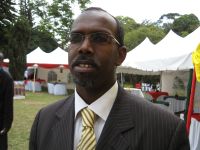
Somalia's ambassador to Kenya, Mohamed Ali Nur Credit: Joyce Mulama
Addis Ababa sent troops to assist the interim government of its eastern neighbour last year, in response to the growing power of the Union of Islamic Courts (UIC) – a system that emerged in the 1990s in a bid to restore order to Somalia’s capital, Mogadishu, and other areas. The country descended into chaos after dictator Mohamed Siad Barre was unseated in 1991, leaving Somalis at the mercy of faction leaders. Its current government was only formed in 2004.
The UIC was driven from Mogadishu in December by Ethiopian forces assisted by the United States, and has also been expelled elsewhere (both U.S. and Ethiopian authorities accuse the courts of having links with the Al Qaeda terrorist network – a charge the UIC denies). However, intense conflict erupted over subsequent months in the capital, pitting UIC supporters and clan militants against interim government forces and their Ethiopian backers. Certain Somalis are deeply opposed to the presence of Ethiopian troops in their country: the two countries have long had a troubled relationship, marked by a territorial dispute over the Ogaden region of Ethiopia.
While calm has since returned to Mogadishu, sporadic attacks continue in the city and other parts of Somalia: government buildings are amongst the targets – also Ugandan peacekeepers deployed in Mogadishu under the auspices of the African Union (AU). Some 8,000 AU forces are intended to replace the Ethiopian troops.
This violence notwithstanding, Somalia’s ambassador to Kenya, Mohamed Ali Nur, appeared positive in an interview with IPS correspondent Joyce Mulama.
IPS: Why the optimism?
Mohamed Ali Nur (MN): I just came from Mogadishu last week; I was there for four days. The city was very calm. What I saw is that the local people are volunteering to clean the city. I saw them cutting trees, cleaning streets: that shows that they are not afraid of coming out.
I think two things contributed to the calm. First, the prime minister and president’s willingness to talk to the elders of Mogadishu, telling them that they need to calm down and they need to work with the government. And it came out that the elders have talked to militias, and that they have stopped the fighting. Only the hard-line fundamentalists were isolated, and eventually they were defeated and left the city – and a lot of them were captured. The two things are: the dialogue by the government and defeat of those hard-line fighters.
IPS: Even so, attacks continue. Are there plans to hold talks with insurgents?
MN: Talks are coming up on June 14; the Islamists or Islamic Union Courts are welcome to participate as Somalis. If they want to come, they have to come through their elders – not as a group or as a party. And there is one other condition which is very important: they have to renounce violence. We want everybody to come with a white flag and talk peace and forgive each other, and talk about how to rebuild this country.
IPS: What are the latest developments as regards deploying more AU troops to Somalia?
MN: Nigeria, Ghana and Burundi are the ones who are ready to deploy peacekeeping forces to Somalia. We have talked to the governments, and the reason they say they are behind in deployment of troops is logistical problems, financial problems. That is why we are asking the international community to help us – to help those countries which are willing to send their troops. They need aircraft to bring them to Somalia.
IPS: There is deep antipathy towards Ethiopia amongst certain Somalis. Can your government gain legitimacy while it is backed by Ethiopian forces?
MN: When the Ethiopian troops came to Somalia, even Somali constituents in Mogadishu welcomed them. But there are small groups – fundamentalists, who have other agendas – who say Somalis do not like Ethiopians. Ethiopia is a neighbouring country, they came to help us. They are part of IGAD (the regional Inter-Governmental Authority on Development). I do not see this thing that our people do not like them. I do not share that opinion.
Another example (of good relations) is that on May 27 an Ethiopian embassy was opened in Mogadishu for the first time. The Ethiopian minister of foreign affairs was in Mogadishu for the inauguration, and an Ethiopian ambassador was appointed for the first time in 16 years.
IPS: What of allegations that the government is entrenching clan rivalry? It has been said that President Abdullahi Yusuf is favoring his Darod clan at the expense of the traditionally dominant Hawiye.
MN: That also has been exaggerated. If I am clan B and you are clan C, even if there was animosity and fighting years and years ago between the two clans, that does not mean that you and I cannot talk. The president is really doing a hard job from morning until night: he is talking to elders, Hawiye elders in Mogadishu. They are coming to him, hundreds of them, and he is sitting with them and talking. This shows his statesmanship. I think certain enemies are putting some other picture on this issue. He (the president) is from another clan, but he is the president for the whole country.
 Print
|
Print
|




