
Saturday, November 14, 2026



News and Views from the Global South
ENVIRONMENT-ARGENTINA: Sad Tale of the Tercero River
Claudia Mazzeo* - Tierramérica
- Argentina’s polluted rivers are not limited to Buenos Aires. Wastewater dumping is devastating the second largest river of the central province of Córdoba, the Ctalamochita, or Tercero River.
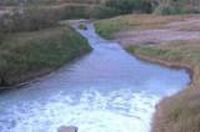
Waste discharge into a tributary of the Tercero River Credit: Colegio Universitario de Periodismo
The Tercero River watershed begins near the Champaquí mountain – the highest in the province, standing nearly 2,800 metres – in an area where total rainfall varies from 0.6 to 1.0 metre a year.
With an average flow of 27.17 cubic metres per second, the river basin extends across 3,300 square kilometres and is one of Córdoba’s principal watersheds.
The Ctalamochita – from the indigenous “ctala” and “mochi”, the names of two types of tree abundant in the region, the Celtis tala and the Schinus molle, respectively – flows directly into the Paraná, which in turn flows into the River Plate (Río de la Plata).
Numerous tributaries feed the upper Tercero, providing the strong volume of water used to produce energy and for irrigation.
Along its middle stretch, the water is used mainly to supply a population of about 55,000, and the lower Tercero for irrigating crops. But the river is also a recreational resource, with attractive beaches and fishing spots.
Although the contamination of the Ctalamochita had become evident in the early 1990s, a study by the sciences department at the University of Córdoba, through an agreement with the province’s water and sanitation agency, DiPAS, offers a detailed diagnostic showing that factories and water purification plants play a leading role.
The study was presented by engineer Nancy Larrosa, of the Higher Institute for Water Resources Research and Services, at Argentina’s national water congress earlier this year.
It entailed nine monitoring campaigns conducted since 2004, which covered the entire length of the river, from the Almafuerte resort to the town of Saladillo. Fourteen sampling stations were set up in areas where there is industrial and sewage discharge, water uptake for purification, and beaches, including the most populous areas: Villa María (87,000 people), Río Tercero (43,000) and Bell Ville (32,000).
The physical, chemical and biological parameters studied were compared with the national standard, set by DiPAS in its Decree 415.
The researchers found that all of the pollution indicators showed increases downriver. The phosphorus level surpassed the maximum allowed, of 25 micrograms per litre, in the entire river except at the Almafuerte resort beaches, nearer the headwaters.
According to the experts, this nutrient can be found in the water as a result of domestic and industrial effluents, or from the dissolving of phosphate compounds present in the sediments of bodies of water.
The highest concentrations of phosphorus were found downriver from the discharge sites of the Villa María and Bell Ville sewage treatment plants. There, also, they found an increase in the biological demand for oxygen, a parameter for measuring the concentration of organic contaminants, and of Escherichia coli bacteria.
Aluminium levels also surpassed the allowable limits in all areas monitored, except at the Almafuerte and Río Tercero resorts. The further downstream, the higher the alkalinity and hardness of the water, as well as the higher the presence of chlorine, sulphate, sodium, potassium and calcium.
“This indicates different levels of contamination related both to industrial and sewage discharge,” said Larrosa.
The study indicates that when the river flow diminishes to less than 10 cubic metres per second, the concentrations of arsenic rose to close to the maximum allowable limit.
It also highlighted industries located in Bell Ville, Villa Nueva, Monte Leña and Ballesteros, which dump their waste into the river. All of the industries, as well as the water treatment plants (14 in all), violated Decree 415, which led to deadlines, fines, and in some cases a ban on discharging wastewater.
“The complementarity of our work with that of DiPAS turned out to be strategic. The university doesn’t have any policing power,” Larrosa pointed out.
The principal industries in those cities produce dairy products, explosives and paper products. There is also a meat-packing plant.
Much of the economy of the city of Río Tercero is based on its petro-chemical and mechanical industries. They produce chemicals ranging from nitric acid and hydrogen peroxide to herbicides and pesticides. Among its 21 factories are Petroquímica Río Tercero, Fábrica Militar Río Tercero and Atanor.
In October 2005, DiPAS fined the military manufacturer Fábrica Militar Río Tercero for the poor quality of its effluent. The same factory made the news Nov. 3, 1995 for an explosion – which was later discovered to be intentional and related to arms smuggling – that killed seven people, injured more than 300 and destroyed three neighbourhoods.
On Aug. 6, it made the headlines again when a boiler exploded at its ammonia plant, causing a hydrogen gas leak. It triggered panic among nearby residents because the 1995 explosion is still fresh in their memory and its effects still visible in the zone’s eucalyptus trees.
Twelve years after that first blast, “the municipal government did not set up an effective, independent monitoring and control system. The neighbours still lack a citizen plan to deal with chemical emergencies,” says a report by scientist Raúl Montenegro, winner of the Right Livelihood Award (often called the Alternative Nobel) and president of the Argentine Environment Defence Foundation.
A toxic gas leak on Jun. 12 killed two workers at the Petroquímica Río Tercero plant. A month later, 40 machine operators were hospitalised for exposure to ammonia.
As in other Argentine cities, the mechanisms for sanctions and warnings show their weakness, because it is cheaper for the companies to pay fines than to invest in safety and more environmentally friendly technology.
Another area of concern, said the scientific sources consulted by Tierramérica, is that the quality of underground water sources in the southern area is deficient due to high natural levels of arsenic and fluoride – which makes it all the more important to preserve the Ctalamochita as a clean, safe source of water.
(*Originally published by Latin American newspapers that are part of the Tierramérica network. Tierramérica is a specialised news service produced by IPS with the backing of the United Nations Development Programme and the United Nations Environment Programme.)
 Print
|




