
Monday, September 21, 2026



News and Views from the Global South
Q&A: 'EU Needs to Do More for Palestinians'
Interview with Luisa Morgantini, Vice-President of the European Parliament
- The European Union has definite responsibilities in the Palestine crisis, and must now carry them out, says Luisa Morgantini, Vice-President of the European Parliament.
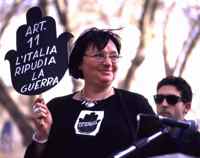
Luisa Morgantini Credit:
Morgantini welcomed the adoption by the European Parliament Thursday of a resolution on the humanitarian situation in Gaza. The resolution calls on Israel "to fulfil its international obligations under the Geneva Conventions to guarantee the flow of humanitarian aid, humanitarian assistance and essential services, such as electricity and fuel, to the Gaza Strip."
Excerpts from the interview:
IPS: You have described the situation in Gaza as "collective punishment…"
Luisa Morgantini: I've been in Gaza recently, and I saw how the Strip is overwhelmed by a serious humanitarian crisis due to the raids and the closure imposed by the Israeli Army. The massive devastation of public facilities and private homes, the disruption to hospitals, clinics and schools, the denial of access to proper drinking water, food and electricity, and the destruction of agricultural land create a real catastrophe for civilians.
Furthermore, the blockade on the movement paralyses the economy and contributes to an extremely high rate of unemployment, while the health system is under severe pressure.
The European Union has to demand with force to the Israeli Government the full respect for human rights and international law in the whole area.
IPS: Are there any differences between the EU and the United States' view on recognition of Hamas, the group that won the Palestinian Authority's general legislative elections in 2006?
LM: Of course there are some differences. The EU recognised them as legitimate elections, and held democratically. No doubt that this recognition should have implied recognition of the Palestinian government as well. This has not been possible due to the U.S. imposing their view of Hamas as a terrorist force.
Actually, choosing to go to elections, Hamas did choose to enter democratic life, and offered to suspend military actions.
The point is that differences (of view) have been just whispered rather than expressed through political actions; though continuing to give economic support to Palestinian people, EU has practised a form of ostracism towards the elected government of Hamas.
Unfortunately, it has applied ostracism even to the Government of National Unity supported by all the Palestinian political parties.
IPS: You mean those views different to those of the U.S. have not been 'acted' upon…
LM: It's the eternal problem with the EU. Though an economic giant and the major donor for developing countries, it has weak political authority and lets its judgement get befuddled by U.S. views.
It is clearly a contradiction to say that the elections are democratic and then refuse the results. It's double standards.
IPS: Some observers say that there's no more room for hope in Palestine, given that it has no land, and many people continue to leave the territories as refugees.
LM: The vision of 'two peoples, two states' becomes steadily weaker. The Palestinian state that was supposed to exist in those territories occupied 40 years ago could only see colonies growing instead of its structures. Those colonies have taken away Palestinian land. And now, in the last four-five years this separation wall dividing Palestinians from Palestinians, giving new land to Israel, and removing fertile land from Palestine people.
An example is the little village of Belain in Ramallah district, where for three years young Palestinians and Israelis hold non-violent expressions to say 'no' to the wall. Sixty percent of the fertile and cultivated land in this little village is on the other (Israeli) side of the wall, as is the case in many other villages deprived of land and water.
Moreover, Palestine territories are fragmented by Israeli checkpoints throughout villages. The result of this fragmentation policy is that Palestinians in Gaza cannot meet their relatives who live only a few kilometres from there, in Hebron.
Israel has operated the politics of segregation for millions of Palestinians who still live in the occupied territories. Given such fragmentation, it's hard to believe in a viable Palestinian state that is able to coexist with Israel. The truth is that every day land is devoured by the colonies. Two days ago we came to know that the land of some villages around Jerusalem has been confiscated to host 3,500 new apartments of colonies.
IPS: How can peace penetrate – as a will, not just hope – in the conscience of people who have grown up amidst violence and hate?
LM: There are some extraordinary experiences that give me hope. I am thinking of the Parent's Circles, groups of parents and relatives of Palestinian or Israeli people who have been killed by suicide attacks by Palestinians or by Israeli soldiers. They are some 600 families who work together to stop violence, persuaded that making peace implies recognition that each part has its own rights.
Or the Combatants for Peace, a group of former Israeli soldiers and former Palestinian militants, who ask for peace and ask to stop military occupation.
Peace can penetrate, I'm sure. It's up to political leaders to both preach and to act peace. But to me each part has its own responsibility, I am not putting on the same level the President (of the Palestinian National Authority) Mahmud Abbas and the Israeli government: they have different responsibilities. Then, there are the extremist Palestinian groups, who continue to shoot Israeli civilians. But these are extremist groups, they're not the Authority and not the Israeli Government.
I think that if Israel wanted peace, if it really accepted to return occupied territories, then peace would be possible. Meanwhile, I am confident and full of hope, thanks to those extraordinary Palestinian and Israeli people who continue to work together.
IPS: You met some of them in Perugia last week, attending the United Nations of the People meeting and then joining the peace march Perugia-Assisi.
LM: Yes, I met Bassam Aramin (founder of the group Combatants for Peace), who was detained in an Israeli prison for seven years when he was a young militant against occupation. In January, his daughter Abir, 11 years old, was killed by an Israeli bullet in the school garden. A rapid enquiry by the Israeli authorities stated that the child had been killed by a stone.
In Perugia, he was with a group of Israeli soldiers and for his loss he did not demand revenge, all he's asking for is justice. He is an amazing example of a Palestinian who has not missed his humanity, despite this long-lasting strategy of dehumanisation.
 Print
|
Print
|




