
Friday, November 20, 2026



News and Views from the Global South
ENVIRONMENT: Are Alaska's Energy Riches Blowing in the Wind?
Barbara Maynard* - IPS/IFEJ
- Eight hundred kilometres west of Anchorage, on the coast of Kangirlvar Bay off the Bering Sea, sits the Yup'ik Eskimo community of Toksook Bay.
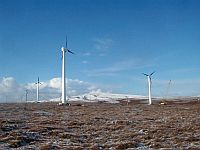
Three wind turbines outside of Toksook Bay, Alaska. Credit: AVEC
The skyline is relatively flat around Toksook Bay, but recently some new features rose above the tundra. In 2006, three 100-kW wind turbines, each 32 metres tall, started providing power to this community of 600 people.
Today, over 20 percent of Toksook Bay's electricity comes from the wind, according to Brent Petrie, key accounts manager with Alaska Village Electric Cooperative (AVEC), which owns and operates the project.
Hundreds of kilometres from anywhere, supplies reach Toksook Bay, and more than 200 other Alaskan villages and towns located off the road system, by boat or airplane. Most of these communities get electricity from diesel-powered generators, an energy source that is becoming more difficult to afford.
"Our fuel bill in 2002 was 1.5 million dollars," said Brad Reeve, general manager of Kotzebue Electric Association (KEA), a non-profit cooperative that provides power to the 3,100 residents of Kotzebue, 41 kilometres north of the Arctic Circle. "Last year it was 4.3 million dollars."
Electricity rates of 40 to 50 cents per kWh are typical in rural Alaska; in comparison, rates in Anchorage are closer to 12 cents per kWh. As villages like Toksook Bay look for alternatives, it's no surprise that they are turning to wind power. About 100 Alaskan communities, especially those on the coast, have strong wind resources.
Alaska has tried before to tap the wind. In the early 1980s, when the state was awash in oil money, over 140 wind projects sprung up across the state, but little power was generated, thanks to poor planning and immature technology. Reeve cited one example of a turbine destined for Kotzebue that was never erected because the foundation was installed next to an airstrip.
Today, better-organised projects are demonstrating that the power of Alaska's strong and steady coastal winds can be economically tapped. Reeve has been installing wind turbines, a few at a time, outside of Kotzebue since 1997. Including this year's installation of three new turbines, the KEA wind farm now hosts 17 turbines, the largest such facility in the state.
Five to seven percent of the town's electricity is generated by wind. In a typical year, that results in 90,000 gallons of diesel fuel that KEA does not have to purchase. Those numbers should go up as the three new turbines go online. With diesel running 2.50 dollars per gallon, the price Reeve quoted in October, the savings add up.
St. Paul, an Aleut community of 460 located on St. Paul Island, 482 kilometres west of the Alaska mainland in the Bering Sea, has also had a wind turbine spinning since 1997. Owned by TDX Power, the 225-kW turbine provides about 40 percent of the power used by an 80,000-square foot industrial airport facility. At times, the wind provides more electricity than the facility can use; the excess is used to heat the building. Ron Philemonoff, chairman of TDX Power, said the project was financed through a private lease-buyback programme, and paid for itself in seven years.
The idea, for now, is not to replace diesel systems, but to supplement them. By integrating wind and diesel, the systems allow the turbines to generate power when the wind is blowing; the diesel generators take over when the wind is still.
"There are months in St. Paul when the diesels don't come on," said Ian Baring-Gould, a senior engineer with the U.S. National Renewable Energy Laboratory. He said the technology exists for wind to meet 60 to 70 percent of the power needs for communities with a good wind resource.
A handful of other western Alaskan communities have also incorporated wind turbines into their power plants with varying success. A project in Wales, a community of 140 people southwest of Kotzebue, was troublesome because the turbines were retrofitted onto an existing diesel system. Both Reeve and Baring-Gould agreed that the turbines have operated well, but integration with the old diesel caused problems.
What impact, if any, the Alaskan turbines are having on birds is an open question, but no impacts have been documented yet. The projects at St. Paul, Toksook Bay and Kotzebue are all located inland, which should help to avoid contact with marine birds. However, inadequate data make it difficult to judge.
"I would say that we just don't know enough to say one way or another yet," said Ellen Lance, wildlife biologist with the Endangered Species and Ecologic Services branch of the U.S. Fish and Wildlife Service in Alaska. "We're hoping that through partnerships with developers, we'll learn as we go."
Adapting wind technology for Alaska's extreme climate has been challenging.
Keeping the systems cool can be an issue in warmer climates; in Alaska, modifications had to be made to ensure that lubricants and other parts would function in the extreme cold. Installing foundations in permafrost, especially in areas where it is melting, is tricky and can add to installation costs, according to Petrie. However, the successes in St. Paul, Toksook Bay and Kotzebue have shown that bringing wind power to Alaska is technically feasible.
"The technology is not the obstacle," Baring-Gould said. "The technology is a challenge but it's not an obstacle."
The economics, however, can be problematic. Not only is it expensive to ship the equipment to and work in the remote environment, but also the medium-sized turbines required by small communities are not in high demand elsewhere.
"There are very few companies in the whole world that are making the smaller turbines now," said Chris Rose, of Renewable Energy Alaska Project, a non-profit organisation working to increase the use of renewable energy in the state. "Unless or until there is a bigger market for the smaller turbines, they are always going to be more expensive per installed kilowatt."
As a result, wind projects can cost 5 to 10 times more per kilowatt than larger projects built in less remote locations free from permafrost, according to Meera Kohler, CEO of AVEC. Complicating the economics further, a state subsidy called the Power Cost Equalisation partially defrays the high costs of rural power. While the programme has helped villages keep the lights on even in the face of rising diesel prices, it also provides some disincentive to invest in programmes that can lower future energy prices.
Legislation making its way through the state legislature might tip the economic scales toward incorporating more wind and other renewable energy projects. House Bill 152, if passed, will create a renewable energy loan and grant fund. Passage of the bill, and adequate funding of the programme, could signal a new direction in Alaska's energy policy.
"It's an exciting time, especially in Alaska," Baring-Gould said. "It is cost-effective, we know that. Technically, it is feasible and it's being done. Now it's more of a policy question of what they want to do as a state, and what we want to do as a nation."
**The writer lived in Alaska from November 2004 to June 2006 and twice visited communities on the western coast.
(*This story is part of a series of features on sustainable development by IPS and IFEJ – International Federation of Environmental Journalists.)
 Print
|




