
Saturday, October 3, 2026



News and Views from the Global South
SERBIA: Too Late, Billboards Show a Way
Vesna Peric Zimonjic
- The Serbian government has began an unusual billboard campaign to mobilise its people under the slogan ‘Kosovo is Serbia’ ahead of crucial developments that might lead to independence of the southern, ethnic Albanian populated province.
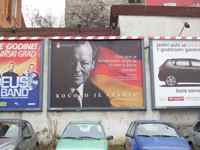
A billboard in Belgrade Credit: Vesna Peric Zimonjic
The aim is “to show that the country cherishes Western values, but also to show how one should deal when national interest is at stake,” the Serbian Ministry for Kosovo said in a statement.
Britain’s World War II leader Winston Churchill is shown cigar in hand, alongside a quote defying Nazi Germany: “We shall defend what is ours. We shall never surrender.” Former German chancellor Willie Brandt is seen saying many years before reunification: “What is inseparable should remain and grow as one.”
Former French president Charles De Gaulle is presented saying: “One day the tears will dry out, hatred will die down, and battlefields will be levelled, but our homeland will remain.”
The Arts and Crafts advertising agency that has put up the billboards says the intention is to “remind people it is ok to defend your national interest.” Agency owner Dragoslav Bokan explained in an interview with pro-government daily Politika that the underlying message was “that one cannot sit still when his country is being torn apart.”
The southern Serbian province Kosovo, populated by two million ethnic Albanians, but cradle of the first Serb medieval state, is sailing towards independence. It has been under United Nations (UN) administration since 1999.
Serbia fiercely opposes the independence, even though only some 100,000 Serbs live in Kosovo, mostly in the northern areas.
Serb Prime Minister Vojislav Kostunica has said that “Serbia will never recognise the independence of Kosovo, and it considers all future decisions in such direction null and void.” He refused the offer of quicker access to the European Union in place of a softening of its stand on Kosovo. “There will be no giving in to blackmail or trade-offs on Kosovo,” he said.
The Serbian government has opened an office in the northern Kosovo town Mitrovica, where most Serbs reside. The river Ibar splits the town into the Serb populated north and the ethnic Albanian populated south. The Serbian move was strongly criticised by the UN administration in Kosovo as a breach of UN resolutions.
Most analysts see it as a sign that Serbia is mulling the partition of Kosovo, something not often mentioned in public, but which is being considered by Western diplomats as well.
“Partition of Kosovo is the reality in the field,” analyst Ivan Vejvoda told IPS. “What needs to be found is a legal definition of what already exists in Kosovo. I believe that the partition will be long lasting and that the international legal experts can find a solution for it.”
Milan Nikolic, head of the independent Centre for Alternative Studies, says “opening of the office is a sign that the Serbian government is preparing us for the scenario of partition of Kosovo.” In an interview with the largest circulation Blic daily, Nikolic said that “the northern part of Kosovo, in such a case, should have at least some institution ready for Serbs.”
Partition of Kosovo has not figured as a proposal in the internationally sponsored negotiations, but the option has been mentioned by several diplomatic missions visiting Belgrade.
“After so many efforts in negotiations, we’re waiting for someone to put it on the table, either Serbs or Albanians,” a senior Western official told IPS. “We opt for pragmatic solutions.”
In the meantime, not many Serbs are moved by the billboards.
“Kosovo was lost to Serbia back in 1999, and the more the government insists on it the more we become aware of that fact,” Belgrade teacher Ivana Djordjevic commented to IPS in front of one of them. “What the government is so slow to do is to improve our living standards. Kosovo is just an efficient mask for their failure in that direction.”
 Print
|
Print
|




