
Thursday, October 1, 2026



News and Views from the Global South
PAKISTAN: Bulldozers Poised to Raze Afghan Refugee Camp
Ashfaq Yusufzai
- "We are shifting to a rented house in nearby Cherat village after being here for 20 years. We have to leave because my shop has been demolished," said an agitated Afghan refugee, Gul Wali, in the sprawling Jalozai refugee camp, 35 km east of this border city in Pakistan.
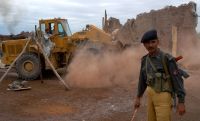
A Pakistani soldier oversees demolitions at the Jalozai Afghan refugee camp Credit: Ashfaq Yusufzai/IPS
Pakistani officials had set an Apr. 15 deadline for the voluntary repatriation of Afghan families from Jalozai. But most are reluctant to leave, citing lawlessness, joblessness, poor education and health facilities at home as reasons. Last July, the Pakistan government had demolished the largest Afghan refugee camp, Kacha Garhi, in Peshawar.
The United Nations High Commissioner for Refugees (UNHCR) says only 99 families (6,397 persons) have left for Afghanistan from Jalozai camp, since Mar. 15, under its voluntary repatriation plan.
But in Jalozai, at least 5,000 families (35,000 persons) seem to have vacated their mud-plastered homes. Authorities have demolished 5,000 of the total 17,000 houses in the camp and plan to level the rest by May 20.
It appears that a majority of camp residents who have left Jalozai have moved, like Gul Wali, to rented houses in nearby localities.
Jalozai, set up in the early 1980s by the United Nations, was home to an estimated 88,000 refugees from Afghanistan. Millions of Afghans, fleeing successive years of war, famine and drought, crossed into Pakistan and Iran.
More than two million Afghans recently registered with the government under a UNHCR programme that grants them temporary resident status in Pakistan for three years. The UN’s agency for refugees has urged Pakistan to rethink a plan to repatriate 2.4 million Afghan refugees by end-2009.
Nine of the 24 refugee camps in the North West Frontier Province (NWFP) and Federally Administered Tribal Areas (FATA), which share a border with Afghanistan, have closed.
"We had a very good business of carpets (in Jalozai), but now we are left with nothing," said Noor Jamal, 56. After 14 years in the camp, he is moving to Peshawar. "We have already got a shop in the Pawaka locality," he confided.
Jamal’s two sons are doing well in school and he would like to raise them here. If he were to go back it would destroy their future, he told IPS.
The NWFP government has disconnected electricity to the shops and markets, and is turning the screws on the refugees who remain in Jalozai to pay up the roughly 10 million rupees of unpaid dues owed to the electricity department.
"We cannot pay this huge amount. It’s too much. It’s a tool to force us out," lamented Dost Mohammad, a camp elder. According to him, rents in villages adjoining the refugee camp have shot up and refugees are finding it hard to find houses to rent.
The government has informed all Afghan refugees who do not wish to leave Pakistan that they can relocate to new refugee camps established in distant Dir and Chitral, NWFP, 150 km and 425 km respectively from Peshawar, which will remain open up to 2009. But community elders have rejected the offer as unviable.
According to an UNHCR official who did not want to be identified, each person who voluntarily returns to Afghanistan is paid 100 dollars on arrival in their country. An estimated 29,800 refugees – including Afghans from Jalozai and two camps in Balochistan province – have repatriated since Mar. 15.
The decision to shut down Jalozai was taken at a jirga (tribal assembly) called by the Commissioner Afghan Refugees and 50 Afghan elders from the camp on Sep. 5, 2007. The refugees agreed to voluntarily vacate the camp by Apr. 15, 2008.
Rasool Shah does not want to return to Afghanistan at this time of the year. "The summer season has already set in and it would be extremely harsh to live in Afghanistan without electricity," he confided. Shah’s shop in Jalozai was demolished on Apr. 16.
Shah, who is now selling fruit on a hand-cart in Peshawar’s Nasir Bagh locality, said he has sought temporary shelter in his uncle’s house and was looking for a house for his nine-member family.
According to him, his elder brother who went back to Khost province under the UN repatriation plan, was now repenting his decision.
Shah’s 11-year-old daughter, Naseema, wants to stay in her adopted country. "I would never leave Pakistan. I have studied here and want to continue my education here, and learn English," she said in an interview.
Abdul Ghafoor, 45, a truck driver echoed her feelings. Life was hell in Afghanistan, he said. The re-emergence of the Taliban in Afghanistan’s southern provinces has triggered another round of internal and external displacements.
However, Ghafoor was not worried about losing his home in Jalozai because the owner of the truck he was driving has provided him a house in a village near the camp.
The independent Human Rights Commission of Pakistan (HRCP) has urged the government not to violate refugees’ rights and international norms on the protection of refugees. Pakistan is not a signatory to the U.N.’s 1951 Refugee Convention.
 Print
|
Print
|



Pictures for this story
This story includes downloadable print-quality images -- Copyright IPS, to be used exclusively with this story.


