
Friday, October 2, 2026



News and Views from the Global South
COLOMBIA: Death Cannot Defeat Life in War-Torn Guaviare
Constanza Vieira
- Halfway along the 28-km stretch of road between the towns of San José and El Retorno in the war-torn south-central Colombian province of Guaviare, there is a young “ceiba” tree that emerged after a venerable old ceiba tree, which had grown there for decades, died.
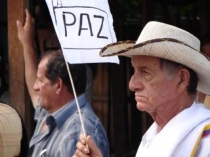
Jonás, in Puerto Concordia, asks for "peace". Credit: Natalia Orduz
That was 12 years ago, in 1996, when Carrillo was leading massive marches in southern Colombia against police spraying of the coca crops of local farmers.
The protests died down when the government of then president Ernesto Samper (1994-1998) signed agreements sought by the local communities, under which the farmers promised to abandon coca (the raw material of cocaine), even though it offered them a bigger profit margin than traditional crops.
The farmers were seeking support for a gradual and voluntary replacement of coca crops with legal alternatives, as part of what they hoped would be a comprehensive development plan that would enable them to insert themselves into the legal economy, by means of access to credit and markets for their products, for example.
Under the agreements, the government also pledged that it would not eradicate coca plantations smaller than three hectares.
But it failed to live up to the commitments it assumed. And Carrillo was just one of numerous community leaders killed as a consequence of the protest marches.
The displacement of coca farmers from the country’s most fertile regions has continued since then, with many of them heading towards the Amazon jungle, which extends southward from Guaviare. In the rainforest, they clear land – and many plant coca again.
The U.S.-financed Plan Colombia, launched in 2000, was initially presented as an anti-drug trafficking strategy. But in 2002, at the urging of the government of President George W. Bush, the focus changed and it was increasingly referred to as a counterinsurgency plan.
Drug crops were declared a military objective, with spraying mainly carried out in areas under the control of the Revolutionary Armed Forces of Colombia (FARC), an insurgent group that emerged in 1964 from the still smouldering embers of a civil war that officially ended in 1957.
The U.S. and Colombian governments consider the FARC a “terrorist” group and “the largest drug cartel” in the Americas. But in 2006, Colombia’s Attorney-General’s Office recognised that the origins of the rebel group lay in conflicts over land that date back to the mid-20th century.
The FARC argues that it taxes all economic activities in the territory under its influence, which also includes the buying and selling of cocaine paste.
In the view of rightwing President Álvaro Uribe, who has governed Colombia since 2002, any farmer who grows coca is a “drug trafficker,” even though small coca growers earn a modest income, and legal alternatives would condemn them to extreme poverty.
The main goal of Uribe, Bush’s chief ally in Latin America, is to defeat the FARC. Colombia is the third-largest recipient of U.S. military aid in the world, after Israel and Egypt.
The central tool used to eliminate drug crops is still aerial fumigation, although manual eradication is increasingly relied on. Both mechanisms are used in the context of military counterinsurgency operations.
These practices end up forcing peasant farmers off their land, because their food crops tend to be destroyed along with the coca bushes.
Many believe that the real aim of the authorities is to clear these areas of local people who might be sympathetic to the guerrillas.
As a result, the rural communities are deprived of their livelihoods from one moment to the next, which gives rise to a general sense of insecurity and vulnerability, Walter Kälin, the U.N. Secretary-General’s special representative on the Human Rights of Internally Displaced Persons, said in January 2007.
Since 1985, nearly four million Colombians have been forcibly displaced from their homes by the civil war and aerial spraying, according to the Consultancy on Human Rights and Displacement (CODHES), the leading non-governmental source of information on the question, which bases its estimates on Catholic Church statistics.
COCA SPRAYING – A FAILED STRATEGY
“Intensive aerial herbicide spraying of coca crops in Colombia has backfired badly, contributing to the spread of coca cultivation and cocaine production to new areas of the country and threatening human health and the environment,” says a report released early this year by the Washington Office on Latin America (WOLA).
The study, “Chemical Reactions: Fumigation – Spreading Coca and Threatening Colombia’s Ecological and Cultural Diversity”, which was drawn up in conjunction with the Bogota-based Institute of Studies for Development and Peace (INDEPAZ), says that “fumigation is part of the problem.”
“The aerial spray operations tend to reinforce rather than weaken Colombian farmers’ reliance on coca growing, prompting more rather than less replanting, thereby contributing to coca’s spread into new areas of the country,” it states.
Since 1998, some 202,300 hectares were sprayed with herbicides in Guaviare, a southern Amazon jungle province of 53,460 square kilometres, according to Adam Isacson, an analyst at the Washington-based Centre for International Policy.
But, with 9,477 hectares of coca – the figure provided last year by the U.N. Office on Drugs and Crime (UNODC) – Guaviare is still one of the four Colombian provinces with the greatest coca cultivation.
More than half of Guaviare’s 96,000 inhabitants are concentrated in and around San José del Guaviare, the provincial capital.
San José, where 20,000 counterinsurgency soldiers are deployed at a nearby military base, is no longer the “coca capital” of Colombia.
But one out of every four people in Guaviare have been displaced from their rural homes by the armed conflict, compared to a national average of eight out of 100. And 14,000 of them have fled to the town of San José.
“In the context of the national figures on forced displacement, that doesn’t sound like much, but it has had an enormous impact on the city,” San José Mayor Pedro Arenas, who stood out as a vocal opponent of coca crop spraying while serving as a member of the lower house of Congress from 2002 to 2006, told IPS.
THE WHITE CARAVAN
Arenas was one of the organisers of the “White Caravan” that called for peace and negotiations of a humanitarian exchange of hostages held by the FARC for imprisoned guerrillas. The mobilisation had the backing of 70 social organisations from around the country.
In buses and all-terrain vehicles, around 400 people from different regions drove the 479 kilometres between Bogotá and El Retorno along heavily militarised roads through war zones on the third weekend of May.
El Retorno, a small town of 2,500 to the south of San José, was the site of the unilateral release by the FARC of six hostages early this year.
The six former politicians formed part of the group of 45 hostages, including former presidential candidate Ingrid Betancourt, who have been held for years in remote jungle camps by the rebel group with the hope of swapping them for imprisoned insurgents.
Besides Arenas, the organisers of the White Caravan included the city governments of Calamar, Miraflores and El Retorno, in the province of Guaviare; the municipalities of Mapiripán and Puerto Concordia in the central province of Meta, both of which border on Guaviare; Villavicencio, the capital of the enormous province of Meta; and Bogotá, the Colombian capital.
After Villavicencio, 86 km south of Bogotá, the Caravan enters the vast Orinoquia savannah, which is crisscrossed by rivers lined with gallery forests in which native palm trees stand out. Farther along, the landscape shifts from level to slightly rolling terrain.
In Puerto Concordia, a town of 1,500 in southern Meta, just north of San José del Guaviare, Adriana Villarreal, an activist in her mid-thirties, tells IPS that “no one is helping us.”
As the Caravan arrives, she holds up a placard that reads “Welcome to Puerto Concordia”, signed by “the displaced”.
Villarreal is the head of the Life and Hope Association. “As long as there is life, there is hope,” she says, explaining the name of her organisation.
The group represents 137 families displaced from different parts of the country since 1999. A recent count showed that each family has at least three children, says Villarreal.
Later, she leads this reporter away from the crowd, towards the banks of the Ariari river, where she says “people might soon be displaced from the other side of the river, because they’re spraying. There are only guerrillas over there. On this side, all of the groups are present.”
By “all,” she means far-right paramilitary militias that work in collusion with government forces and armed drug trafficking gangs.
“We want peace for our country. We are united with your noble cause,” Puerto Concordia Mayor Luis González says, welcoming the Caravan.
Listening to the mayor is 80-year-old Jonás, who holds up a white sheet of paper glued to a stick, which reads, simply, “PEACE”.
“The worst problem is the poverty,” he tells IPS.
THE SHRINKING AMAZON
On the other side of the wide Guaviare river can be seen the edges of the world’s largest tropical rainforest, the Amazon jungle, as the air becomes more humid.
“Here we are, watching all of you go by. No one ever comes through here. We’re all alone out here,” a soldier posted on a curved, heavily-guarded 940-metre bridge that runs into the province of Guaviare, told IPS.
Stretching away from the foot of the bridge is a naval base. Two Piranha speedboats are patrolling the river. Sandbags force our vehicles to drive slowly in a zigzag pattern.
Until recently, the Amazon jungle started here. Today, only small patches of rainforest can be seen here and there, in the middle of large pastures where a handful of cows graze.
The road narrows as we enter Guaviare. San José is just up ahead, and in the blink of an eye, the Caravan, which was one-kilometre long since it pulled out of Puerto Concordia, doubles in size.
In San José, it looks like the entire town has come out to receive the Caravan.
“Things are moving again in San José del Guaviare, after 12 years of inactivity,” says Mayor Arenas who, like so many other residents, is determined that the name of his town should no longer be synonymous with “coca” and “war,” and that the town should become “a territory of peace and reconciliation.”
A rainbow of colourful signs, as well as live music, welcomes us. One of the innumerable hand-painted signs carried by the people lining the streets reads, in green, red, yellow and blue letters, “We Demand Freedom, by Dancing”. Couples of all ages dance on either side of the street as the Caravan slowly drives by.
“We have defeated the fear for the first time. We have thousands of victims in this region,” says Arenas in the town’s central square, as he calls on the Attorney General’s office and international human rights bodies to step up their presence in the area.
On the way south from San José to El Retorno, the Caravan passes the Joaquín París army base. From the road can be seen powerful U.S. radars, installed since 2000.
Some 20 Blackhawk and Huey U.S. combat helicopters, used by Plan Colombia, are stationed here, along with two mobile brigades.
To the west, in Barrancón, is a special forces school where Colombian troops are trained by U.S. army Green Berets.
In 1997, two planeloads of paramilitaries armed to the teeth were flown in to a military-guarded airstrip in San José from their stronghold in Urabá in the north, and drove along this road to commit one of the civil war’s most grisly mass killings, in the town of Mapiripán. At least 30 local townspeople were hacked to death there with machetes, or disembowelled and decapitated with chainsaws, over the space of six days.
Because of the complicity of the armed forces, the case was brought to the Inter-American Court of Human Rights, which handed down a ruling against the Colombian state in September 2005.
The Mapiripán massacre was the paramilitaries’ way of announcing their arrival in Guaviare.
Over the next two years, “between four and seven bodies on average appeared every day at the same spot on the side of the road – killings that have never been investigated,” Giovanni Gómez, a regional lawmaker for Guaviare who like Mayor Arenas belongs to the independent Partido Verde Opción Centro (centrist green party), told IPS.
Ciro Castilla, an adviser to the San José city government who held the post of provincial ombudsman from 1995 to 1997, said that between 1997 and 2003, more than 5,000 civilians were killed in Guaviare.
“San José del Guaviare was full of military troops, but the displaced were being killed anyway. The only way to explain this is that there was collusion (between the killers and) the security forces,” Gómez told IPS.
Townspeople say the killings virtually stopped in 2006, after a visit by President Uribe in October 2005, when prominent local leaders denounced the widespread human rights violations in a live TV broadcast.
After the broadcast, both Gómez and Arenas were “declared military targets for speaking out,” said the regional legislator.
In 2006, a local paramilitary chief apparently demobilised with his troops, after negotiating an agreement with the government. Since then, “things have been calmer. The killings have been ‘selective’ or targeted,” said Gómez.
The victims now are mainly demobilised paramilitary fighters who know too much, or who run drug and weapon dealing businesses – activities in which the paramilitary militias are heavily involved. Meanwhile, extortion has decreased, and community leaders from surrounding villages can travel more safely to San José.
“The White Caravan has helped the people of Guaviare break the silence and free themselves from fear and from the oppression of the paramilitaries and guerrillas,” Gómez added.
HOW TO WIPE OUT A POLITICAL PARTY
The Patriotic Union (UP), a leftwing party that emerged in 1985 from peace talks between the FARC and the government, won a landslide victory in the 1986 elections in Guaviare, taking seven of the nine seats in the regional legislature.
But the UP was only active in Guaviare until 1994. Its members began to be killed off in 1987, until “the party was completely wiped out,” said Gómez. Today, it is difficult to find one single survivor of what was once the strongest party in the region.
The UP attempt at a political solution was cut short nationwide. The extermination of the party at a national level is the focus of the largest collective lawsuit ever faced by the Inter-American Court.
Today, most of Guaviare is a conflict zone. When the army withdraws from a certain area, the guerrillas move in.
But there is no longer any coca growing near San José, and in El Retorno, people are considering switching over to cattle ranching.
The stretch of road between San José and El Retorno is marked by the scars of the armed conflict. “That hill is a cemetery,” a taxi driver tells IPS on the way back from El Retorno to San José, pointing to a nearby hill.
Next to a school near the road there are graves where people killed by the paramilitaries are buried, says the driver.
Passing the young ceiba tree, the driver, who has lived in Guaviare for only five years, merely says that there was “heavy fighting” around the tree, years ago.
And as we approach San José, he remarks that all of the land in front of and on one side of the military base belongs to Guaviare Governor Oscar López.
 Print
|
Print
|




