
Friday, September 25, 2026



News and Views from the Global South
Q&A: "There Are No Negotiations Between Syria and Israel"
Interview with Mohsen Bilal, Syrian Minister of Information
- "There are no negotiations between Syria and Israel in Istanbul – what is happening is an indirect exchange of messages via Turkey, to explore ways towards a possible negotiation," Syrian Information Minister Mohsen Bilal told IPS.
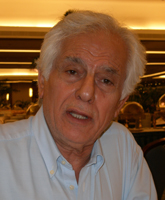
Syrian Information Minister Mohsen Bilal. Credit: Baher Kamal/IPS
"Palestine must have its own sovereign state, with Jerusalem as its capital, with the inalienable right of the Palestinian people to self-determination, and the right of return to their country of all Palestinians," Bilal said.
A surgeon by profession, Bilal studied medicine in Italy and specialised in liver transplants in the United States, before becoming a lawmaker and then his country’s ambassador in Spain. In an interview with IPS Middle East Director Baher Kamal, he discussed the situation in the Middle East.
IPS: What stage have the Syrian-Israeli negotiations reached now that both parties have agreed to hold a fourth round before the end of this month?
MOHSEN BILAL: What negotiations do you mean?
IPS: The talks that began six weeks ago in Istanbul with mediation by Turkey, where three rounds have already been held…
MB: There are no negotiations. This is an exploratory phase, looking at the possibility of renewing talks to create a platform for eventual negotiations. There is an indirect exchange of messages through the Turkish mediator – whom we trust to sound out the Israeli government – because Israel changes its methods frequently, and we are accustomed to the non-fulfilment of its promises.
Therefore, what is happening in Istanbul is a preparatory phase, preliminary to renewing the true peace process that began at the Madrid conference in 1991, and on the basis of the principles established at that conference: exchanging land for peace. Those principles are clearly stated in Resolutions 242, 338 and 425 of the U.N. Security Council.
IPS: What are Syria’s non-negotiable premises in an arrangement with Israel? Would it accept a demilitarised Golan, under the supervision of an international peace force?
MB: Syria will go [to negotiations] for the complete recovery of the Golan Heights and the total and unconditional withdrawal of Israel to within the Jun. 4, 1967 [immediately prior to the Arab-Israeli War] borders. What it requires from Israel is its full, indisputable and non- negotiable willingness to withdraw completely and return the whole of the Golan Heights, without conditions or quibbling, to full Syrian sovereignty.
IPS: Why is Syria insisting on the participation of the U.S. in the future negotiations, rather than, for example, the U.N. Security Council?
MB: We insist that for serious negotiations in the process of recovering the Golan Heights, the presence and sponsorship of the U.S. is necessary. The U.S. sponsored the Madrid peace process from Oct. 1991 to the year 2000.
The process came to a halt only because, at the last minute, [Ehud] Barak [then prime minister and now Defence Minister and leader of the Labour Party] did not make up his mind to say "Yes" to withdrawal to the 1967 borders. Now [the Israelis] have decided to return to the Madrid process.
The U.S. has proclaimed itself the sole power in a unipolar world. In fact, the policies of the George W. Bush administration have brought the entire world to a crisis. They have undermined the United Nations. Deep down, no one agrees with these policies.
There is another vital reason, and it is the organic relationship between the U.S. and Israel. Bush told the Israelis from the podium in the Knesset [Israeli parliament]: "you are no longer six million, you are 306 million [the combined populations of the U.S. and Israel] strong."
IPS: Is there a timetable for the peace process? Will it be launched under the Bush administration?
MB: This administration is finished. Any peace process will be after the November presidential elections in the U.S.
IPS: Syria affirms that its peace process will not be at the expense of the Palestinian process…
MB: Naturally. Syria works on behalf of the main cause of the Arab nation: the Palestinian cause. There will be no peace in the Middle East until a sovereign and independent Palestinian state is established, with Jerusalem as its capital, with the right to self- determination of the Palestinian people, and with the refugees having the right of return.
In Syria alone there are half a million refugees, and another 400,000 in Lebanon. There are nearly six million Palestinians living outside Palestine. They all have the full right to return to their land.
Syria’s view is that all these processes should go forward in parallel. You cannot isolate one process and manipulate it. Some Arab countries signed agreements with Israel to end the war and establish peace. Have they achieved peace in the region this way? On the contrary, things have become more complicated. So there are no individual solutions.
IPS: Suppose an arrangement on the Golan Heights was achieved before the Palestinian question was settled. Would the agreement be implemented, or would it be postponed until the Palestinian process was concluded?
MB: Everything is part of a context. Any success in the Syrian or Lebanese or Palestinian process should potentiate the possibilities for success in the others. We will not be drawn into an Israeli or U.S. game of playing one process against another.
IPS: After years of tensions, relations between France and Syria are going through a honeymoon period and President Bashar al-Assad is to visit Paris in mid-July.
MB: The French have returned to what should have been normal. [Former] President Jacques Chirac had a negative attitude towards Syria, inappropriate for relations between states. France and the European Union now seem to understand that in order to get the Middle East peace process into gear, they have to meet with Syria.
President al-Assad will make a state visit to Paris on Jul. 12, participate in the summit meeting of the Union for the Mediterranean on Jul. 13, and then attend the parade and celebrations for the French national holiday on Jul. 14. What is happening now is normal.
IPS: What would happen if there were an Israeli or U.S. attack on Iran?
MB: Iran is a key country in the Middle East. Its nuclear programme is for civilian purposes. Iran has never spoken about nuclear weapons. Syria is absolutely against nuclear weapons and, in fact, has deposited a document with the Security Council asking for a U.N. resolution declaring the entire Middle East a nuclear weapon-free zone, including those possessed by Israel.
IPS: Yes, but what if there was an attack?
MB: To think of attacking Iran is a threat to the future of the region and of the world.
IPS: You have just visited Cuba and Venezuela.
MB: I went to [Venezuela’s] Isla Margarita to take part in the Seventh Meeting of Information Ministers of the Non-Aligned Movement (NAM). It was an important gathering, attended by 43 ministers, 11 deputy ministers and other high-ranking officials from the 118 NAM member countries.
I met with Venezuelan President Hugo Chávez and his Foreign Minister Nicolás Maduro. Before that I was in Havana, which has the rotating presidency of the NAM, and met with Cuban President Raúl Castro, Foreign Minister Felipe Pérez Roque and the head of international relations in the governing Cuban Communist Party, Fernando Ramírez.
I was shown friendship and solidarity with Syria, and a firm willingness to strengthen our already close relations.
 Print
|
Print
|



Pictures for this story
This story includes downloadable print-quality images -- Copyright IPS, to be used exclusively with this story.


