
Wednesday, September 23, 2026



News and Views from the Global South
REFUGEES-ZAMBIA: Making a Home For Themselves
Danstan Kaunda
- Zambia is home to over 90,000 refugees, many of whom have been in the country for up to 15 years. A voluntary repatriation programme is now drawing to a close, but many of the refugees will likely remain in a country where they have established themselves.
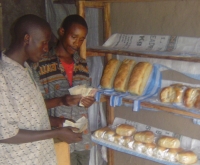
With assistance from UNHCR, refugees have set up fish farms, poultry, and even a bakery at the Meheba camp. Credit: Danstan Kaunda/IPS
But some of the refugees no longer want to return to their native countries. Mushata Bobo, a Congolese refugee at Meheba refugee camp in Solwezi town, in northwestern Zambia says, "Children have been born here in this camp. They are now in secondary school. Why should we go back?"
The U.N. refugee agency will close the voluntary repatriation programme in the next two years. In the 2006 and 2007 season, 74,000 Angolans and 7,000 Congolese refugees where repatriated back to their country of origin.
The UN- humanitarian agencies are hoping to assist some 26,000 Congolese and other refugees return home in 2008 and 2009. The international Organisation for Migration will facilitate transportation while World Food Program will provide food to the returnees.
The Zambian government has yet to decide what status will be given to those who remain behind when the UNHCR's voluntary repatriation programme closes down in 2010. Latest statistics show that there are over 15,000 refugees at the Meheba camp alone.
Kelvin Shimo, UNHCR programme officer for Zambia, said services such as food and other support in education have at times been inadequate.
"Funding is one of the major difficulties we face in the period that the refugees have lived in the country. But I believe this also a responsibility of the international community to be much involved as well," Shimo said.
Meheba camp is the largest refugee camp in the country, covering an area of 720 square kilometres. It was opened in 1971.
The UNHCR and U.S.-based non-governmental organisation FORGE (Facilitating Opportunities for Refugee Growth and Empowerment) have been engaged in training refugees in subsistence agriculture skills. They have also provided cash loans to encourage economic self-sufficiency.
The refugees are involved in various programmes such as fish farming and rearing livestock. Each family is allocated 2.5 hectares of land, together with agricultural tools and seeds. They are expected to grow their own food such as cassava, maize, sweet potatoes and a variety of vegetables.
Others refugees have taken small loans from FORGE project to start business ventures.
Kjerstin Erickson, FORGE project manager, told IPS that the project has being successful in the past five years they have been operating in the refugee camps.
"Our small loans are about K 500,000 each (about US$ 140). Now, however, we’ve switched to giving out agro-loans, in which we give out bags of fertilizer during the planting season and are repaid in maize after the crops have been harvested," Erickson said. "It is envisaged that the refugees grow enough food to sustain themselves and sell the surplus food."
FORGE is running 25 projects with 162 staff members working in the three refugee camps in Zambia.
"Business is okay," said Kundo Ndumbe in an interview. He is one of the beneficiaries of the FORGE project at the Meheba camp, "I now own a bakery and I have been able to pay back the loan I got."
Now with the community in the area near the camp growing due to the increasing mining activities, the refugees at the camp are encouraged to produce more agriculture products to supply to the mine community.
The Lumwana Copper Mine (LCM), eight kilometers from the Meheba refugee camp, will be the biggest copper and uranium mine in Africa when it opens later this year. It will employ over 1000 workers directly. Other sectors are also expected to develop within the area.
Erickson said with agro-loans, the main risk is the changing weather patterns and the growing conditions. "We have found-out that refugees can be very reliable when given the right tools, education, and support."
As the voluntary repatriation comes to an end in 2010, the UNHCR will focus on resettling for those refugees who will remain.
"Our goal will be to protect and re-settle those refugees. As UNHCR, we think re-settling them is primarily a tool we can use to protect them (refugees)," Shimo told IPS.
The UN refugee agency and some international donors have developed a Strengthening Protection Capacity Project aimed at protecting refugees. It will also assist Zambia to revise the refugee legislations to meet international standards for protecting refugees.
"Some sections in this project will be a systematic monitoring and improvement of detection conditions of refugees and asylum-seekers, as well as helping with legal representation for refugees and asylum seekers before mobile courts," said Shimo.
 Print
|
Print
|



Pictures for this story
This story includes downloadable print-quality images -- Copyright IPS, to be used exclusively with this story.


