
Friday, September 25, 2026



News and Views from the Global South

ARGENTINA: Illegal Embankment Continues to Harm Wetlands
Marcela Valente* - Tierramérica
- The government of the northeastern Argentine province of Corrientes has been unable to enforce the ruling of the district's highest court, which nearly a year ago ordered the removal of a 30-kilometre embankment that is damaging the valuable wetlands ecosystem known as the Esteros del Iberá.
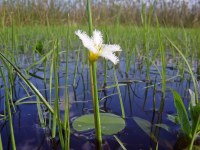
Native flora in Argentina's Esteros del Iberá wetlands. Credit: Edwin Harvey
The area is habitat to a hundred fish species, 40 kinds of amphibians, 60 reptile species and 345 species of birds, as well as mammals like the aguará-guazú or maned wolf (Chrysocyon brachyurus), the Neotropical river otter (Lontra longicaudis) and the Pampas deer (Ozotoceros bezoarticus).
The reserve is shared by the provincial government and private landowners. The authorities control most of its water resources, while most of the land is privatised and used for livestock and forest industries, farming and tourism.
Residents of Paraje Yahaveré, negatively affected by the unauthorised earthworks, filed the lawsuit in 2005, with legal consulting financed by the Conservation Land Trust, a foundation of U.S. millionaire ecologist Douglas Tompkins.
After a series of appeals, they won the case, and in November 2007, the Corrientes High Court ordered the demolition of the earthworks. When the first lower court ruling had been issued, the embankment was just 1.5 km long. Since then, it has been expanded to a length of 30 km.
The court established that if the company did not proceed with the demolition, the task would be left in the hands of the provincial government's water and environment institute, ICAA, which has power over management and policy in the reserve.
But enforcing the legal decision has not been easy.
"The ruling is in the process of being implemented," but there have been "delays," Patricia McCormack, attorney for the plaintiffs, told Tierramérica.
"The verdict has been handed down, but it has to be defined how and when the embankment is to be demolished, and for that we return to the first instance (lower court), and there is no deadline there," she said.
The courts are now "giving a foothold to the claims" of the company and ICAA "in safeguard of due process." "The timeframes of justice are slow, but if we don't complete the formalities they can ask to annul the entire process," said McCormack.
Attorney Juan Delsín, ICAA legal manager, told Tierramérica that the provincial body "has the will to comply with the ruling…We already have the documents for the direct contracting of demolition works and we are waiting for the executive branch to authorise the expense," he said.
The cost of demolition is about 500,000 dollars, which will be charged to Forestal Andina, said Delsín. In any case, it could take 90 days for the work to actually begin once it is established who will carry it out.
The Fundación Ambiente y Recursos Naturales (Environment and Natural Resources Foundation), Vida Silvestre (Wildlife) and other local environmental groups and the federal government’s Forest Directorate last week accompanied a demonstration by Paraje Yahaveré residents involving a horse parade to demand compliance with the ruling.
The groups have organised an online campaign, "No to the Embankments – Save the Iberá", to send e-mails to the Corrientes Ministry of Production, which oversees ICAA.
In spite of the problems, the verdict set a precedent in environmental jurisprudence, according to McCormack. "It's the first time that the courts have issued an order of this kind," she said.
Andrés Nápoli of the Fundación Ambiente y Recursos Naturales agreed that the sentence is unique. "It is the first time in Latin America that a judicial ruling has ordered the demolition of an illegal construction of this type due to its environmental impact," he said.
(*This story was originally published by Latin American newspapers that are part of the Tierramérica network. Tierramérica is a specialised news service produced by IPS with the backing of the United Nations Development Programme, United Nations Environment Programme and the World Bank.)
 Print
|
Print
|




