
Friday, October 9, 2026



News and Views from the Global South

Trade Opens Environmental Window on Peru
- Ecologists await Peru's revision of controversial environmental standards that contradict commitments made in the Free Trade Agreement with the United States.
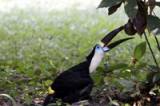
Red-billed toucan, Ramphastos tucanus, in the Amazon jungle of Tambopata, Peru. - Photo Stock
The decree, which in June modified the Forestry and Wildlife Act, leaves 45 million hectares out of the Forestry Heritage protection system. That land constitutes 60 percent of Peruvian forests. Excluding it contradicts the FTA forestry annex.
That was one of the 10 observations issued by the Office of the U.S Trade Representative, Susan Schwab, in a meeting with delegates of the Peruvian government earlier this month in Washington, according to Sandro Chávez, president of the non-governmental Ecological Forum (Foro Ecológico).
It was a point of concern particularly for the U.S. authorities, Chávez told Tierramérica, as was the elimination of the National Forestry Commission, which ensured citizen participation in forest management and which was stipulated in the previous law.
At the meeting, the U.S. delegates stated that in order to implement the free trade agreement a public consultation mechanism for forest issues was essential, he said.
Decree 1.090 is one of the 99 adopted by the Executive branch in exercising the legislative faculties Congress granted it in order to implement the FTA.
The 10 observations of the U.S. Office were based on challenges from the Ecological Forum, which is an umbrella group of non-governmental organizations from the two countries, Chávez said.
Sources from the U.S. embassy in Peru told Tierramérica that, on Oct. 20, Lima sent a letter responding to the concerns of the U.S. Trade Representative, but the details were confidential.
Peru's Foreign Trade and Tourism minister, Mercedes Aráoz, who sent the missive, assured Tierramérica that it is a matter of “conversations that we need to polish” as part of the implementation of the trade agreement. “The United States only sent me comments, suggestions and questions about how such-and-such things are going to be done. Nobody has said 'we are frustrated'; those are comments of some non-governmental organizations that have interests,” she said. “But if we have to make changes, they will be made,” Aráoz added.
The new prime minister of Peru (head of the Cabinet), Yehude Simon, has recognized that some of the decrees should be reviewed.
The orders for implementation of decree 1.090, which the Executive branch is drawing up, could be just the time to do so.
“We hope that not only are small changes made in the implementation orders, but also that Congress overturns the decree” and proposes a new law, environmental legislation expert Alberto Barandarián told Tierramérica.
The governmental Ombudsman's Office (People's Defender) stated last week in a report that the decree “would debilitate the mechanisms that ensured sustainable use of forest plantations” and would not guarantee the protection of virgin forests.
“The measures adopted in decree 1.090, (in addition to) the inexistence of standards to ensure their application only in appropriate forestry areas that have already lost their forest cover, could promote deforestation of virgin forest in order to boost the number of hectares that qualify for the conditions,” says the report. The Ombudsman's report was made at the request of Róger Nájar, president of the Environment and Ecology Commission of Andean, Amazonian, Afro-Peruvian Peoples of Congress, which is promoting a new forestry bill.
According to Barandarián, the decree also weakens the Constitution and the Organic Law of Regional Governments because it removes their powers in favor of the forestry concessions oversight body.
Another aspect that worries environmentalists is that the decree opens the possibility that illegally cut timber that is seized could be subject to direct awards, sold and legalized. The Ombudsman's Office warns that Article 41 of the decree “would permit the legalization of timber of controversial origin, which could be an incentive to illicit actions.”
Chávez noted that as of 2009, timber trafficking will be blocked by the United States because of a ruled adopted by the northern powerhouse that will require certificates of origin of all imported lumber products.
Of the 99 decrees approved for the implementation of the FTA, 25 are linked to agriculture and most are aimed at boosting big investment, activist Laureano del Castillo, of the Peruvian Center for Social Studies, told Tierramérica.
“Here they are promoting corporate interests over those of the communities or small owners,” he said.
Another decree, 1.064, which overturned the Land Law, is an incomplete regulatory mechanism for defining agricultural lands and eliminates the previously required agreement from communities and rural producers before initiating mining or oil drilling projects.
“The U.S. observations are proof that things have been poorly done,” sociologist Alejandra Alayza, coordinator of the Peruvian Network for Equitable Globalization, told Tierramérica.
“The mechanism for implementing the FTA itself opens the way for overturning and modifying those decrees that affect the communities and environmental management,” she said.
On Oct. 28, Amazonian authorities and lawmaker Nájar will hold public hearings in the northern city of Iquitos to call for a repeal of decree 1.090 and of other regulations.
 Print
|
Print
|




