Wednesday, October 21, 2026



News and Views from the Global South

Using Science and Thinking Small to Relaunch Biofuels
- Innovation aimed at promoting small-scale crop-based energy and research intended to speed up production of the second generation of biofuels are Brazil's central tactics to revive what has been waning international enthusiasm for ethanol and biofuel.
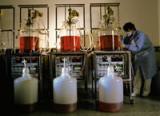
Bio-energy research using a molecular reactor. - Photo Stock
Scientists around the globe have been researching alternative viable energy sources for some time now. Brazil, which stood out in 1975 with its National Fuel Alcohol Program and in 2005 for its pioneering National Biodiesel Program, is wielding new strategies in its global offensive for fuels based on distilled agricultural products.
Scientific progress is opening space for agro-fuels to become a new commodity to conquer the global market.
To achieve it, Brazil is investing in research that could be the answer to concerns about the negative effects of crop-based fuel production on food supplies and prices, and on the conservation of its jungles.
The National Economic and Social Development Bank (BNDES) joined the United Nations Food and Agriculture Organization (FAO) and the Economic Commission for Latin America and the Caribbean (ECLAC) to carry out the study, “Sugarcane-Based Bioethanol: Energy for Sustainable Development.”
The research says that to produce some 50 billion liters of sugarcane ethanol per year uses crops from 15 million hectares, that is, one percent of the land area currently farmed on the entire planet, estimated at 1.5 billion hectares.
This represents an average yield of 3,300 liters of ethanol per hectare, which only proves Brazil's leadership in this sector, as that country produces an average of 6,600 liters per hectare. The best Brazilian ethanol refineries even reach output of 7,500 liters per hectare, according to the National Union of Sugarcane Industries.
The yields should become greater with second-generation ethanol, made from cellulose. The process makes use of various types of organic waste, like sugarcane pulp. In five to 10 years, output could reach 13,000 liters per hectare, which could alleviate pressure to farm new land, according to some studies.
It is not yet known if the sector will be dominated by big investors, which could cause social disintegration by pushing small farmers off their land, or if there will be space for an inclusive process that generates income for smaller producers and improves their living conditions.
The answer could also lie in technology, which provides ways to produce fuel on a smaller scale, appropriate for family farms. This is the purpose of Intelligent Social Fuel Refineries (USI).
They are small biological refineries developed by the USI industrial director, Orci Ribeiro, who learned everything he knows from hands-on experience.
With such a refinery, a small farmer can produce ethanol from sugarcane, sweet potato, manioc or sorghum, said Ribeiro, who also developed an ethanol-fueled electrical generator so that far-flung rural communities can produce their own electricity.
This solution awoke much interest at the First International Exposition held here Nov. 17-21, where six fuel distilleries were sold to Colombia, and a partnership agreement was signed with the Movement of Small Family Farmers of Brazil.
Another innovation presented at the expo was a mobile biodiesel distillery, which can be transported on a truck. It was designed by chemist Diego Luiz Nunes, professor at the Federal University of Minas Gerais.
We are in a period of transition, says Nunes. “Solid fuels are more efficient, and little by little we should adopt them for mass transport vehicles,” he told Tierramérica.
Examples are the Eletra bus, which runs with a combination of biodiesel and electric battery, and was exhibited at the expo along with the already known Flex motor vehicles, the Ipanema plane, as well as tractors, motorcycles and other vehicles adapted to run on fuel alcohol.
Ethanol and biodiesel have the advantage that they can be distributed through the existing global system, as pointed out by the president of the fuel division of Brazilian oil giant Petrobras, Alan Kardec Pinto, speaking at the International Conference on Biofuels, held in conjunction with the expo.
“The energy matrix needs to be diversified. Oil is going to run out,” Kardec told the delegations from 92 countries.
Environmental and social activists, government authorities and business owners have insisted on the need to analyze the entire production cycle of crop-based fuels.
“We can work together,” said the director of the African Fund for Biofuels and Renewable Energies, Thierno Bocar Tall, expressing the optimism of representatives from African countries.
Lúcia Melo, president of Brazil's Center for Strategic Management and Research, said her country can and should attract more research centers, post-graduate courses and foreign companies to evaluate fuels that would be appropriate for resolving social, economic and environmental problems.
The Brazilian government insisted that national technology is viable, reduces emissions that cause climate change and is based on renewable raw materials, without competing with food production.
The federal government's Cabinet chief, Dilma Rousseff, assured that agro-ecological land-use zoning of the country would be carried out with citizen participation, protecting the Amazon, the vast Pantanal wetlands, and other valuable ecosystems. However, it is not clear that it will be done in a timely way, nor that it will be respected by the private sector.
The environmental risks of monoculture for producing biofuel and the need to reduce consumption in general were highlighted by environmental and other non-governmental organizations.
The critics of the current dominant production model convened a parallel meeting where they released a report from the Brazilian Institute of Social and Economic Analyses (IBASE) that points out the risks of contamination from the use of fertilizers and smoke pollution from burning off sugarcane fields, and the danger of worsening the illegal labor relations that exist on many large farms — long-standing problems of rural Brazil.
 Print
|
Print
|