
Tuesday, October 27, 2026



News and Views from the Global South

“Environmental Key Lies with Young People”
- Civil society members gathered in Nairobi, hosted by UNEP, called for involving young people in the official delegations that negotiate environmental agreements, like the climate change treaty, says Argentine activist Cecilia Iglesias in this Tierramérica interview.
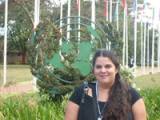
Cecilia Iglesias in Nairobi. - Courtesy of Iglesias
Iglesias, 32, has a degree in environmental sciences and has worked for more than a decade on global projects of the United Nations Environment Program (UNEP) that involve children and young people, such as GEO and the Tunza Strategy, adopted in 2003 to involve youth in environmental efforts.
Nearly 10 years ago she set up “Argentina EcoPibes”, a website with 750 pages of content in Spanish for children. The site receives around 80,000 visits per month from people in 30 countries.
She has won international awards for her “environmental leadership”, and in 2005 the World Bank and other institutions recognized the EcoPibes website for its success in applying information technology.
Iglesias works from a small apartment in Buenos Aires, where she lives with her two young children, surrounded by books and computers. The children “are not only the most vulnerable to environmental harm, but they are the ones who tomorrow will be making the decisions that affect the planet,” she says.
Iglesias was in Nairobi, Kenya, for the UNEP Global Civil Society Forum, Feb. 14-15, prior to the 25th session of the UNEP Governing Council-Global Ministerial Environment Forum, Feb. 16-20.
Civil society representatives presented their concern about the impact of the current economic crisis on the environment and the reduction of development aid. However, many see opportunity arising from the situation.
Meanwhile, the ministers debated how to confront the main environmental challenges in the middle of a global depression. But they did so “behind closed doors,” said Iglesias.
In Buenos Aires first, and later in Nairobi, Iglesias spoke with Tierramérica.
TIERRAMÉRICA: What is the objective of Latin American participation in the UNEP events?
CECILIA IGLESIAS: To influence the decisions about the administration of UNEP and its work plan for the coming years on priority issues, and to influence the Forum of Ministers.
TIERRAMÉRICA: What are those priority areas?
CI: Climate change, disasters and conflicts, ecosystem management, environmental governance, toxic substances and waste, efficient use of resources, and sustainable production and consumption.
TIERRAMÉRICA: Who participated in the Civil Society Forum?
CI: Regional representatives, academics, youths, non-governmental organizations, entrepreneurs, local governments, workers, indigenous people and women. The representation of indigenous and peasant organizations was very scarce.
TIERRAMÉRICA: What are the Latin American concerns?
CI: There were many discussions about climate change. For a while there has been work on how governments and UNEP are preparing to finance and carry forward efforts for climate change adaptation. Each organization has its priorities, which are turned towards reaching a consensus that expresses this concern.
But the discussions of the governments about this were behind closed doors. It is a shame that the demands of civil society were not heard. We hope that the governmental bubble meant that they were able to speak openly. But the first reports that have arrived from our region's delegates are that there was too much left to talk about.
TIERRAMÉRICA: Is there concern about the Initiative for Regional Integration of South America?
CI: Yes, and it's very strong. It involves a series of regional infrastructure projects that would have a great environmental impact. This year there was a manifestation of civil society's deep concern about the initiative. The problem is in convincing the ministers to consider those worries.
TIERRAMÉRICA: And what are the probabilities of success?
CI: Well, because of that we also proposed the issue of governance. They spoke of the need to create strong institutions, nationally and globally, that can carry out the agenda that responds to the challenges ahead.
TIERRAMÉRICA: What about the reaction to the impacts of the global financial crisis?
CI: Since November, at the Latin American forum held in Buenos Aires, everyone was already concerned about how it is going to affect development assistance. There was even specific dialogue about the crisis, but we don't yet have clear answers.
However, the final message was optimistic. Many are suggesting that the crisis is an opportunity to expand the principles of a green economy. It's more hopeful to propose alternatives when there is a widespread perception that something didn't work out. Today it is clear that we need a Plan B.
TIERRAMÉRICA: What is the outlook for young people?
CI: In that regard we achieved something very important, which the approval of the UNEP strategy for the next six years. Our hope is to incorporate youth in the government delegations for international negotiations, especially for climate change. The achievement could have been greater, but we have a lot to be proud of.
Our region began the debate, the youth representatives from the rest of the world supported us, and Argentina made it possible for them to be heard. It was the only moment in which the Forum was applauded for its support. I fee very satisfied about that.
Also, Latin America stated the need to ensure the full participation of children and youth from different groups, but especially indigenous, rural and handicapped, in the various activities of the Tunza Strategy.
 Print
|
Print
|




