
Saturday, October 10, 2026



News and Views from the Global South
CUBA: Old Havana Reaches Out to Hearing Impaired
Patricia Grogg
- An innovative programme in Old Havana has given the hearing impaired greater access to the historical and cultural wealth of the restored historic city centre.
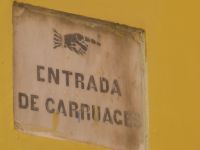
Sign on a wall in Old Havana. Credit: Diana Cariboni/IPS
The idea emerged in early 2008, as part of Rutas y Andares (Routes and Pathways), a programme that offers Cuban families thematic walking tours through Old Havana in the summer months of July and August, with specialist guides providing information on the many sites of historical and cultural interest in the old city.
Old Havana, which was declared a World Heritage Site by UNESCO (the United Nations Educational, Scientific and Cultural Organisation) in 1982, has been the focus of an extensive restoration project led by the City of Havana Historian’s Office.
A Cuban sign language interpreter would accompany tours that included hearing impaired visitors. “But we realised that something special had to be done for them,” said Gispert. “From the start, they showed a great deal of interest, asked a lot of questions, but the interpreting slowed down the tours.”
That need gave rise to Cultura entre las Manos, which offers monthly historical tours for the deaf. The project also holds debates on cultural, historical and social issues with the participation of experts and sign language interpreters.
“I am delighted with the idea; I don’t miss any of the meetings,” Roberto Mesa told IPS, with the help of interpreter Carmen Salgado, head of the sign language interpreting degree programme at the University of Havana. “The tours and the issues discussed include us in the life of this country,” he added.
“My mother is a literature teacher, and I read a lot. But Cultura entre las Manos is just for us, something prepared specifically for the deaf. There is always someone interpreting. And issues of interest to us are discussed,” said Mesa, a 45-year-old graphic designer and father of two adolescents who are not hearing impaired.
The history of hurricanes in Cuba, archaeology, the global economic crisis and its impact, historical clothing and styles, national monuments, the economy, society and politics in China, history and current events in telecommunications, and stamp collecting are some of the subjects of the talks.
Gispert said the issues were suggested by the hearing impaired community, organised in the Cuban National Association of the Deaf, which sponsored Cultura entre las Manos, along with the University of Havana.
The programme also offers beginner’s courses in Cuban sign language. In addition, it provides closed captioning – an optional display of dialogue, actions, sounds or other elements as text on the screen – for the radio and TV programmes produced by the Havana Radio station, in order to give access to the hearing impaired, on TV and the internet.
Havana Radio is the office of the city historian’s radio station.
Another aim of Cultura entre las Manos is to produce visual communication materials in sign language for schools and the sign language interpreting degree programme.
In Cuba, where the literacy rate stands at 99.8 percent, according to UNESCO, most hearing impaired people can read and write, although they communicate by sign language.
The Havana Radio project is also contributing to the continued development of Cuban sign language. During the class-like tours, agreement is sometimes reached about how to name something, for example historical or cultural concepts, for which no specific sign exists.
One of the objectives of the Cuban National Association of the Deaf, which groups more than 20,000 hearing impaired people, is integration in society “with equal rights and duties, conditions and opportunities.” It also works to eliminate communicational barriers that stand in the way of a normal life for people with hearing problems.
 Print
|
Print
|




