Wednesday, October 21, 2026



News and Views from the Global South
Colombia’s Peace Process Sans Chávez
- Late Venezuelan leader Hugo Chávez played a key role in the current attempt to negotiate peace in Colombia. Along with Cuban President Raúl Castro, he confidentially urged the FARC guerrillas to agree to Colombian President Juan Manuel Santos’s secret proposal for peace talks.
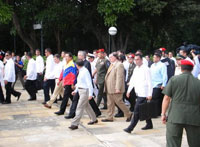
Presidents Santos and Chávez at a 2010 Colombia-Venezuela summit en Santa Marta, Colombia. Credit: Constanza Vieira/IPS
For years, the late Venezuelan president and Cuba’s Fidel Castro had argued that armed struggle was a thing of the past. And Raúl, Fidel’s successor, took the same stance.
Chávez,who governed Venezuela since 1999 and died on Mar. 5, also provided the logistics to transport the FARC’s negotiators abroad incognito during the preliminary talks, when Santos decided that the contacts should no longer take place in Colombia.
Getting the two sides together “was the hardest past,” according to political scientist Ronal Rodríguez, a professor and researcher at the Venezuela Observatory of the private University of Rosario, in Bogota. Once that was achieved, Norway and Cuba assumed the role of guarantors and Venezuela apparently took a backseat, as a facilitator, along with Chile.
.“In that case, as he has specifically stated, he will continue along the lines followed by President Chávez in this matter,” Serpa said. “We Colombians hope that Venezuela will continue to help, and continue creating conditions so we can make peace…and that whatever the outcome of the elections, Venezuela will continue cooperating towards that end.”
Rodríguez said that in any case, “Venezuela has already played the most important role it could play with respect to peace in Colombia, by getting the FARC to have the confidence and trust to sit down at the table for peace talks.” “The challenges that lie ahead mainly concern the negotiating parties, so Venezuela’s role will not be as important as it has been up to now,” he said.
But he said that if Maduro is elected, it would “give continuity to the process” and would give the FARC confidence regarding Venezuela’s presence as one of the guarantors that the peace talks would continue to move ahead.
He said, however, that if opposition candidate Henrique Capriles won the elections, Venezuela’s support for the talks would continue, because for Venezuela, Colombia’s peace process “is a structural, state question that goes beyond the differences between Chavismo and the opposition.”
Rodríguez noted that Colombia’s decades-long armed conflict “has already had a contagion effect across the border in Venezuela,” which suffers “kidnapping, extortion and all those dynamics that the armed actors (from Colombia) have brought.”
Like the FARC, a smaller rebel group, the National Liberation Army (ELN), has also been active in Colombia since 1964. And far-right paramilitary groups, which were partially dismantled in 2006 after closed-door negotiations with the Colombian government, are another actor in the conflict.
“As in the case of all borders during wars, cross-border routes are sought for smuggling arms, provisions of all kinds and financing by means of legal and illegal operations,” former minister Camilo González, director of the Institute of Studies for Development and Peace, told IPS.
González added that “not only has business activity been affected, with negative effects for local residents, traders and producers on both sides of the border, but in several Venezuelan states, the insecurity associated with the presence of the FARC or the ELN has had an impact on many sectors.”
According to accounts gathered by IPS along the border in November, remnant or regrouped paramilitary bands are also active in the Venezuelan border cities of Ureña, San Antonio and San Cristóbal, the capital of the state of Táchira, where they extort local traders and businesses.
González said that “Venezuela in the post-Chávez era will continue collaborating with the peace process in Colombia,” because putting an end to the armed conflict “is in the interests of all sectors of society in Venezuela.”
“I think there will be continuity,” said Carlos Velandia, known as “Felipe Torres” when he was a member of the ELN national leadership. Now he is dedicated to research and consulting on peace.
His arguments are based on Maduro’s close involvement “in the construction of Venezuela’s willingness to support a political solution to the conflict” and the fact that “the conflict has leaked across the border, and also affects Venezuelan territory.
“And the only way to put an end to it is to negotiate peace here in Colombia,” he added.
“The presence of foreign forces is disturbing Venezuela’s democratic stability,” Velandia said.
In Venezuela, he said, “there are factions in the military that want to fully live up to the constitutional mandate to defend sovereignty and territorial integrity. And it’s really hard for a member of the military to see foreign forces in his country and look the other way.”
That means that “Venezuela has no alternative other than supporting a political solution in Colombia, because its security and tranquillity depends on that,” the former guerrilla said.
 Print
|
Print
|