
Friday, October 9, 2026



News and Views from the Global South
Turtles Change Migration Routes Due to Climate Change
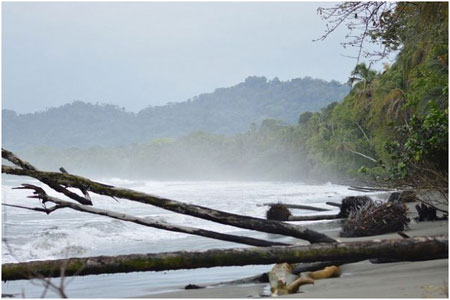
Waves and high tides are eating away at the beaches in Costa Rica’s Cahuita National Park, where the vegetation is uprooted and washed into the sea. Credit: Diego Arguedas/IPS
- The critically endangered hawksbill sea turtle has few sanctuaries left in the world, and this is one of them. But in 2012 only 53 nests were counted on the beaches of this national park in Costa Rica. And there is an enemy that conservation efforts can’t fight: the beaches themselves are shrinking.
For centuries, the over eight km of beaches in Cahuita have provided a nesting ground for four species of sea turtle: the leatherback sea turtle (Dermochelys coriacea), the green sea turtle (Chelonia mydas), the loggerhead (Caretta caretta), and the hawksbill (Eretmochelys imbricata).
But the erosion of the sand and the rising sea level have reduced the size of their breeding grounds and the number of turtles who come to lay their eggs in this national park in the southeast Costa Rican province of Limón after migrating across the Caribbean sea.
“Many turtles now go to the beaches outside the park, in places we have no control over, which makes them more vulnerable,” the park administrator Mario Cerdas told IPS.
In the three years he has run the park, Cerdas has seen a drop in the numbers of turtles coming to nest.
The Cahuita National Park covers 1,100 hectares of land on a swampy peninsula and 23,000 hectares of ocean, including the country’s most important coral reef.
It was created in 1970 as a national monument, and in 1978 was declared a park to protect the fragile ecosystems.
The turtles’ change of destination, to beaches outside the park, is not the only concern. In sea turtles, gender is determined by the temperature of the sand on the nesting beaches, with cool beaches producing more males and warm beaches more females.
As a result of climate change, heat is increasing in Central America, which means that more females than males are born.
“This could be acceptable for the population up to a certain point, but if the gender ratio gap becomes too big, there could be problems,” said Borja Heredia, a scientist with the secretariat of the Convention on the Conservation of Migratory Species of Wild Animals (CMS).
And this is just one of hundreds of cases where climate change is affecting migratory species.
 Print
|
Print
|




