
Saturday, October 17, 2026



News and Views from the Global South
Armed Conflicts
African Institutions in Plan to Stabilise Food, Fuel and Fertiliser Amid Mideast War
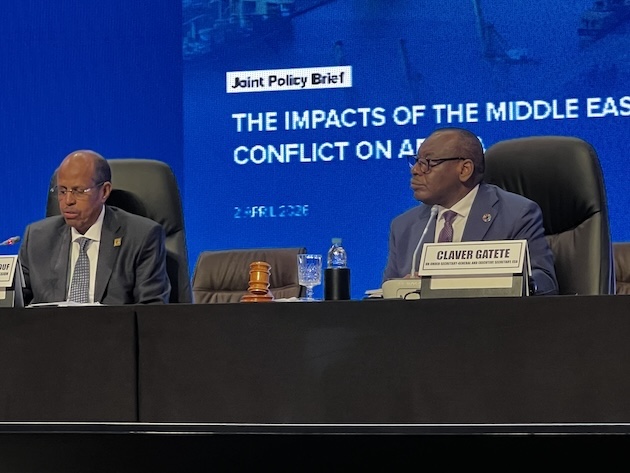
The African Union Commission and the Economic Commission for Africa announce an emergency plan to respond to the impacts of the Middle East conflict. Credit: Busani Bafana/IPS
- Fearing the Middle East war could drive millions into hunger and cripple economies, Africa’s leading institutions are drafting a strategy to mobilise domestic and “innovative” finance and harness national competitiveness to stabilise food, fuel, and fertiliser supplies.
The African Union Commission (AUC), the Economic Commission for Africa (ECA), the African Development Bank (AfDB) and the UN Development Programme (UNDP) are creating a plan to cushion countries from energy shocks triggered by the Middle East war.
Since February 2026, fighting between Iran, the United States, Israel, and their Gulf allies has disrupted oil, gas, and fertiliser supplies, with prices surging after the collapse of peace talks. Oil prices have topped $100 a barrel, hitting African countries that import more than 38% of their petroleum from the Gulf region.
A ‘Perfect Storm’ for Food Security
ECA’s executive secretary, Claver Gatete, underscored the urgency.
“We are seeing a crisis where fuel is affected and fertiliser is affected and that means food prices will go up,” said Gatete. “The impact will be severe.”
Gatete noted that the war threatens food security, especially in Sub-Saharan Africa, where over 80% of fertiliser is imported, risking higher farming costs and reduced yields. With the planting season underway in many countries, farmers are in fear of a sharp rise in input costs because of disruptions to global fertiliser and fuel markets. Africa is a major importer of fertilisers, mainly nitrogen and phosphate.
“This moment calls for decisive action, to protect people now, but also to accelerate Africa’s long-term push towards energy security, food sovereignty, and financial self-reliance,” Gatete said.
According to a policy brief issued jointly by AUC, ECA, AfDB, and UNDP, the war that has triggered trade shocks could soon become a cost-of-living crisis across Africa as a result of high fuel and food prices.
The proposed joint strategy is divided into immediate, medium and long-term responses.
- Short term: Activate contingency import financing, pooled fuel procurement, emergency food corridors and diversified fertiliser sourcing, backed by international and regional lenders. Countries will deploy targeted social protection for the vulnerable, avoiding broad subsidies that risk fiscal strain.
- Medium term: Bolster energy security, social protection and intra-African trade via the African Continental Free Trade Area (AfCFTA). Protect and rebuild fiscal space through strong domestic resource mobilisation, targeted social protection, and buffers. Build African financial safety nets by deepening domestic capital markets, reforming the African financial architecture, and developing shock-response instruments such as crisis facilities and debt-service swaps.
- Long term: The African Union will champion the Continental Crisis and Resilience Compact for energy and food security, financial safety nets, and trade autonomy. Operationalise the African Financial Stability Mechanism (AFSM) via reserve pooling, reallocated SDRs and liquidity backstops. Strengthen AU mechanisms for geopolitical unity, multilateralism, and non-alignment; diversify partnerships; and craft continental fuel and fertiliser strategies.
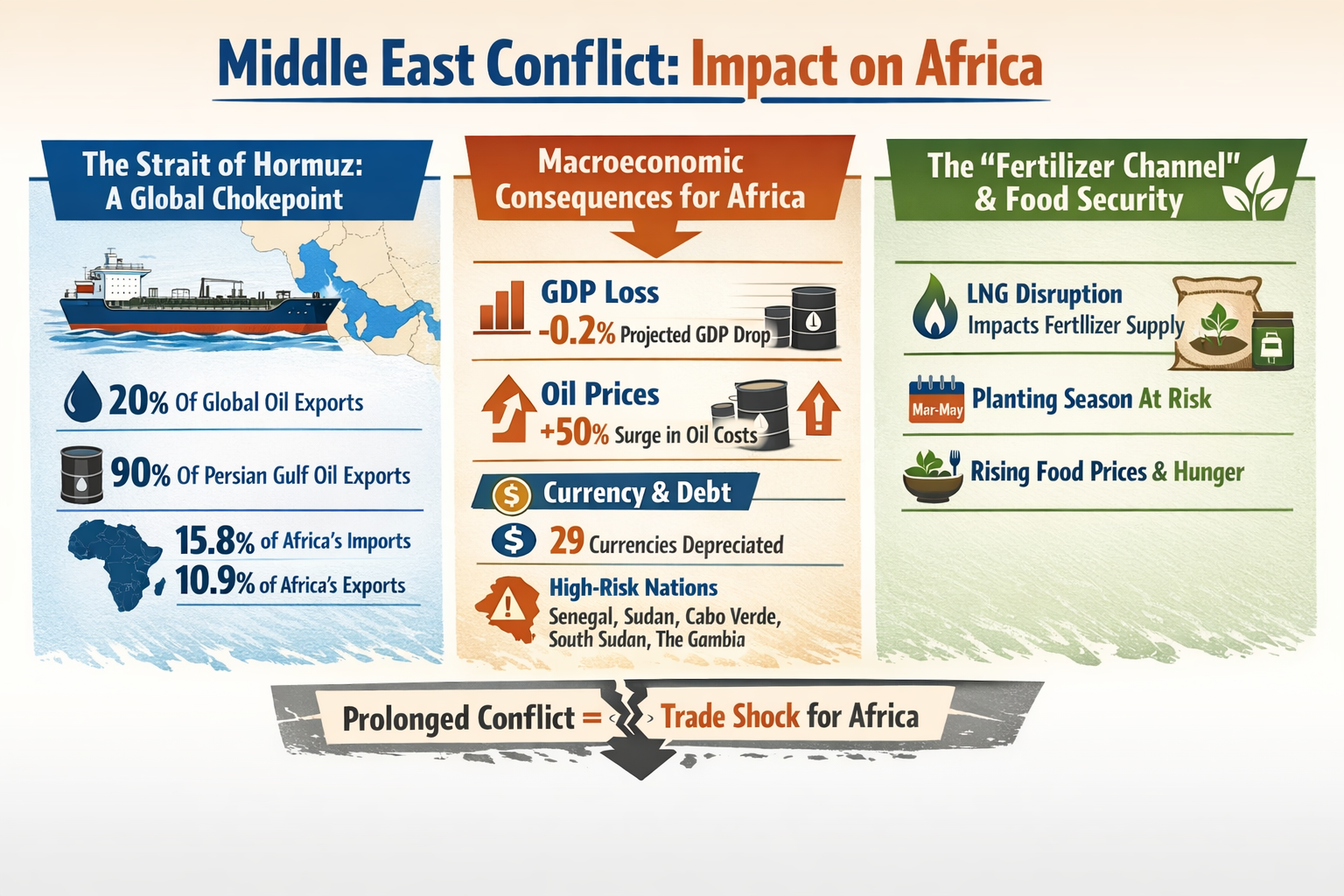
African institutions crafting an emergency response plan to counter the impact of the Middle East war. AI-generated graphic/Busani Bafana
Under the plan, the ECA will handle macroeconomic coordination, debt analytics and a continental dashboard tracking trade, inflation, debt services, and reserves.
The AfDB will provide countercyclical financing, trade guarantees, and emergency support for energy, fertiliser, and food chains. In addition, it will support reforms to Africa’s financial architecture. The UNDP has been tasked with leading country vulnerability mapping and digital targeting systems for social response.
Beyond the direct cost of commodities, the war is affecting remittances, a vital lifeline for millions of African households. Approximately 6.5 million Africans live and work in the Middle East, and they send home about $26bn annually, Gatete noted.
African Union Commission chairperson Mahmoud Ali Youssouf said the continued escalation of the war worsens global instability, with serious implications for energy markets, food security, and economic resilience, particularly in Africa, where economic pressures are mounting.
“One of the solutions should be and must be a financial solution and we would rely on our financial institutions on the continent – AfDB, Afreximbank and African Finance Corporation (AFC) – to come up with a contingency plan with regard to the necessary resources for our countries.”
The currencies of 29 African countries have already depreciated, and this trend is increasing the local currency cost of servicing external debt and making imports more expensive, according to a report by the African Development Bank.
The brief warned that, for some African countries, the fertiliser channel may be even more consequential than the oil shock. Disruptions to Gulf liquid natural gas (LNG) supply would affect ammonia and urea production, raising fertiliser costs and constraining supply during the crucial March–May planting season.
“This would put further upward pressure on food prices and hit vulnerable households hardest, with significant negative impacts on food security in Africa,” the brief said.
Call for Debt Relief
The policy brief also calls for a “moratorium on debt services” to provide governments with the fiscal breathing space to absorb the shock.
Youssouf said there is a case for African countries to push for a new allocation of Special Drawing Rights (SDRs) from the IMF, similar to the support provided during the Covid-19 pandemic.
“Our crisis response is not for development finance institutions alone,” said Kevin Urama, Chief Economist at the AfDB, highlighting that the AfDB, Afrixembank and other African financial institutions always come up with a crisis response facility.
“This moment demands leadership within Africa and from its partners,” stressed Ahunna Eziakonwa, UN Assistant Secretary-General and Director of UNDP’s Regional Bureau for Africa. “With the right mix of policy choices, financing tools, and political resolve, Africa can weather this shock and emerge more resilient, more self-reliant, and better positioned to shape its own economic future.”
The World Trade Organization (WTO) has warned that the ongoing Middle East war will affect global trade with risks to food security through the disruption of fertilizer supplies.
Sustained increases in energy prices could increase risks for global trade, with potential spillovers for food security and cost pressures on consumers and businesses.
Opportunities Amid Conflict
The brief noted that while the Middle East war is generating economic risks for Africa, a few countries may see short-term gains through higher commodity prices, trade diversion, and re-routed logistics. For example, Nigeria stands to benefit from higher oil prices and the export expansion of the Dangote Refinery, while Mozambique, South Africa, Namibia, and Kenya could gain from increased traffic through their ports.
IPS UN Bureau Report


 Print
|
Print
|



Pictures for this story
This story includes downloadable print-quality images -- Copyright IPS, to be used exclusively with this story.


