
Tuesday, October 20, 2026



News and Views from the Global South
Ocean Health
Global Shipping Reforms Cast Shadow Over Tanzania’s Fishing Communities
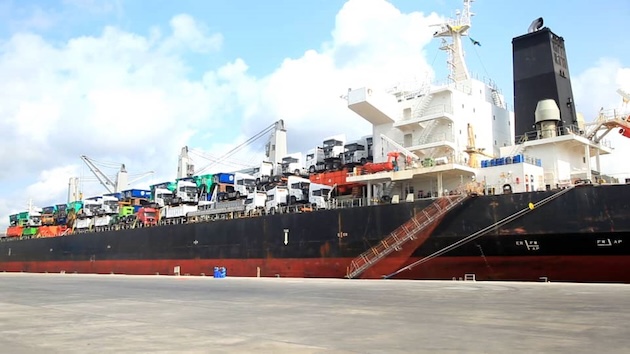
A roll-on/roll-off cargo vessel loaded with trucks sits docked at the Dar es Salaam Port — a reminder of global shipping’s vast scale. As policymakers meet in London this week, the industry faces mounting pressure to cut its carbon footprint and steer toward cleaner, more sustainable fuels. Credit: Kizito Makoye/IPS
- At dawn, as the sun rises across the Indian Ocean, Venance Shayo perches on the edge of his boat, hauling in a net. The sea gently ripples under the breeze and the sound of revving engines.
Barefoot, the 56-year-old pulls the net into the boat as flashes of silver pounce in the tightening mesh.
For Shayo, fishing is a way of life defined by the tides, weather conditions, and instinctive ritual he had known since his boyhood.
For years, he says, the ocean followed a clear pattern, with predictable currents and steady catches. Now, that certainty is fading.
On the horizon, a cargo ship emerges through the haze, its steel hull cutting the current and dwarfing the scattered fishing boats. Shayo pauses to watch it pass.
“They pass here every day. The fish don’t move like they used to – some, like kolekole, have completely disappeared,” he says.
For fishing communities, the changes are difficult to explain. Marine experts say they reflect strain on the ocean ecosystem—driven by warming waters, increasing shipping traffic, and invasive species on ship hulls.
Shipping accounts for three percent of global greenhouse gas emissions – a significant contributor to climate change. Efforts to reduce that footprint are becoming urgent in countries like Tanzania, where coastal livelihoods depend on marine ecosystems.
For fishermen like Shayo, the connection between what they see and decisions in plenary halls can be blurry. That distance may soon narrow.
Thousands of kilometres away in London, negotiators debate new rules that determine how ships like the one Shayo sees operate.
Industry leaders and negotiators are gathering at the International Maritime Organization (IMO) headquarters for talks seen as a turning point for the polluting shipping industry.
At its centre is the Net-Zero Framework (NZF) to cut greenhouse gas emissions from global shipping while introducing the world’s first sector-wide carbon price.
The negotiations take place in two stages: technical issues under the Intersessional Working Group, followed by political decisions at the Marine Environment Protection Committee.
What is decided here could shape global shipping for decades – determining whether it shifts to cleaner fuels or remains anchored in fossil energy.
“This week’s ISWG-GHG meeting must continue filling in critical details on components of the NZF,” said Delaine McCullough, President of the Clean Shipping Coalition. “Member states must use these coming days to build out key guidelines to allow for adoption later this year.”
The proposal follows IMO’s 2023 strategy, which targets net-zero emissions around 2050, but questions remain unresolved.
Negotiators debate how emissions will be measured, how adopters of cleaner technologies will be rewarded, and how revenues – estimated at $10–12 billion annually – will be distributed.
“Pricing GHG emissions is the linchpin for enforceability,” McCullough said. “The fee sets a clear and predictable price signal and generates funds to ensure no countries are left behind.”
The carbon pricing has become the most contentious.
A bloc of oil-producing nations, alongside the United States, is pushing to weaken or remove carbon pricing provisions. Others — including the European Union, African countries, and small island states — argue that without it, the framework risks being ineffective.
“The IMO Net-Zero Framework is a test of whether international cooperation can survive in an era of increasing geopolitical pressure,” said Em Fenton of Opportunity Green. “A majority of nations want this to succeed.”
Global shipping faces a turbulent moment. Conflict in the Middle East has pushed up fuel prices and exposed the industry’s reliance on fossil fuels.
“The disruption of the Strait of Hormuz has already cost the industry 11.2 billion euros,” said Fanny Devaux of Transport & Environment, calling fossil fuel reliance “a massive economic liability”.
Fuel accounts for up to 60 percent of voyage costs. As prices rise, so do the costs of global trade – from food imports in Africa to consumer goods in Europe.
For Tanzania, which relies on maritime trade, such shocks quickly reverberate in the markets.
Yet experts see opportunity amid crisis.
“Alternative propulsion such as electricity or e-fuels offers the only viable escape from the geopolitical premium of fossil fuels,” Devaux said.
In Dar es Salaam, the link to daily life is not always visible.
Shipping emissions contribute to ocean warming, which alters fish migration. Noise pollution disrupts marine ecosystems. Biofouling – the accumulation of organisms on ship hulls – spreads invasive species that compete with native fish.
These pressures reduce fish stocks. For Shayo, this means longer hours and smaller catches.
“If the fish go further, we follow,” he says. “But fuel is expensive. Sometimes we come back with nothing.”
Experts warn that without stronger environmental safeguards, such pressures will intensify.
“The Life Cycle Assessment guidelines must include sustainability criteria that account for biodiversity and human rights impacts,” McCullough said.
In other words, the London talks are about the future of ocean life, not just carbon.
For the shipping industry, the transition ahead will require substantial investment – in alternative fuels such as ammonia and methanol, in new ship designs, and in port infrastructure.
“Global regulation will give the industry the certainty it needs to make critical investments,” said Jesse Fahnestock of the Global Maritime Forum.
As the sun rises, Shayo pulls in his net. It is lighter than he had hoped. He sorts through the catch — tilapia, crabs, prawns, sardines, and one unfamiliar fish.
Fishermen have always adapted. But adaptation, they say, has its limits. If fish stocks continue to decline, if costs continue to rise, and if the ocean continues to change, livelihoods built over generations may begin to unravel.
The decisions being debated in London will not immediately alter the tides along Tanzania’s coast. But over time, they will influence whether ships become cleaner and less disruptive, whether investment flows into sustainable technologies, and whether the industry breaks from its reliance on fossil fuels. They will also help determine whether communities like Shayo’s can continue to depend on the sea.
IPS UN Bureau Report


 Print
|
Print
|



Pictures for this story
This story includes downloadable print-quality images -- Copyright IPS, to be used exclusively with this story.


