
Saturday, October 24, 2026



News and Views from the Global South
Youth
Addressing the Mental Health of Ukrainian Children living on Frontlines of War
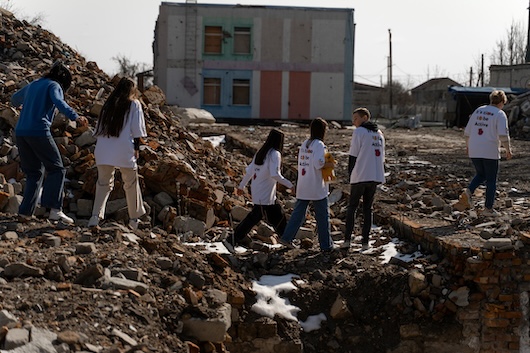
Children involved in the UActive visit a school in the Mykolaiv region that Russian forces destroyed. It cannot be rebuilt. Credit: UActive
- “What’s important is to make sure that you can immerse yourself in an environment that is positive for your mental health and wellbeing,” says Olena*.
Olena, from Ukraine’s Kharkiv region, was just 12 when Russia’s full-scale invasion of her country began on February 24, 2022. Over the last four years she has seen all her close friends leave the small town she lives in, most to move abroad, and experienced deadly bombings by Russian forces on her home town.
Meanwhile, much of her schooling in that time has been online because the permanent threat of shelling makes it unsafe for authorities to keep her school open.
She admits all this has taken a toll on her mental health.
“I had the most devastating experience when my town was bombed and some people were killed. The sound of explosions and drones causes constant tension still,” she tells IPS.
“I miss having all my friends here. Before the war, we used to spend so much time together – walking around the city, celebrating each other’s birthdays, and simply sitting somewhere and talking for hours. Now many of them are abroad, building new lives. I’m happy they are safe, but I deeply miss the feeling of unity,” she says.
“And for almost four years we [kids in the town] have been studying online. We see our classmates much less, and simple things like chatting during breaks or working on group projects feel like something from another life. We grew up faster than we expected.”
Olena is just one of millions of children in the country whose lives have been upended by the conflict.
As the full-scale invasion goes into its fifth year, research shows the devastating effect it has had on Ukrainian children, displacing millions, plunging many into poverty, and exposing them to the loss of loved ones and other trauma. Meanwhile, 1.6 million have had their education disrupted due to displacement, facility damage, and insecurity. According to UNICEF, one in three children are unable to attend in-person school full-time and more than 1,700 schools have been damaged or destroyed. The Save the Children group has said that Ukrainian children missed 20 percent of lessons during the last academic year alone because of frequent air raid warnings.
Meanwhile, Save the Children has estimated that over a million children have spent hundreds of days with either no or limited face-to-face teaching as schools have moved to online learning for security reasons since the start of the war. This came not long after schools had finished lengthy periods of online learning implemented during the Covid pandemic, meaning some children have had little in-class learning since 2020.
All this has taken a huge toll on the mental health of children and adolescents, local and international groups working with kids in the country have said.
According to UNICEF, a third of households have reported children displaying signs of psychosocial distress.
“Children’s mental health is increasingly under strain. The constant fear of attacks, displacement, endless sheltering in basements, and isolation at home with limited social connections have left children and adolescents struggling,” Toby Fricker, UNICEF Ukraine Chief of Advocacy and Communication, told IPS.
This has been expressed in a variety of emotional and physical expressions of symptoms, mental health experts have said.
These include irritability and emotional instability, particularly among adolescents, and social withdrawal.
“It can be said with sad certainty that since the start of the full-scale invasion of Ukraine by Russia, which is now in its fifth year, the most common issues observed among adolescents are increased anxiety, fear, and chronic stress related to a constant sense of danger and uncertainty. Many teenagers experience emotional exhaustion, sleep problems, difficulties with concentration and learning, as well as decreased motivation,” Daria Lavrenko, a psychologist in the Kyiv region who works with children aged 12 to 18 who have been displaced from regions near the frontlines, told IPS.
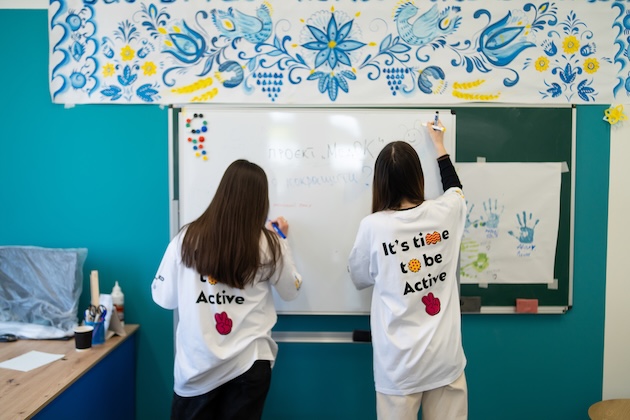
Children participate in UActive programmes which include rebuilding infrastructure damaged in the war. Credit: UActive
“Manifestations of social isolation and difficulties communicating with peers have also become quite common, largely due to prolonged distance learning, frequent air raid sirens, and the loss of a familiar school environment. In addition, adolescents often show deep grief reactions due to the loss of relatives on the frontline or as a result of Russian attacks on civilians. Increased irritability, emotional instability, and difficulties with emotional regulation are also frequently observed, which are natural psychological responses to the prolonged traumatic experience of war,” she said.
But severe somatisation of symptoms, including facial tics, involuntary head movements, and speech disorders, have also been frequently reported. Sleeping disorders are common, especially among young children.
“These are common reactions when the body is suffering the consequences of mental health strain,” Viktoria Kondratyuk, a psychologist who works with the humanitarian group War Child on projects in Ukraine, told IPS. “It affects the immune system, weakens it, and that’s why you see so many [children] getting sick, especially in the winter],” she added.
Since the full-scale invasion, the Ukrainian government has moved to increase provision of mental health support through the approval of key legislation and the implementation of a nationwide mental healthcare programme.
At the same time, NGOs are working with regional administrations and local communities to improve public access to mental health services and psychosocial support, including providing informational and educational activities and integrating psychosocial support into existing social and educational services. It is hoped this will expand access to assistance for vulnerable groups and greater support for children and adolescents.
However, problems with access to such services, and recognition of mental health problems by those affected, mean many children are not getting the help they need, experts say.
“Many teenagers who experience psychological difficulties as a result of the war do not receive the help they need in time. This is partly due to limited access to specialists in certain regions where infrastructure has been damaged or where there is a shortage of mental health professionals. At the same time, attitudes toward mental wellbeing remain an important barrier,” said Lavrenko.
“Some teenagers avoid seeking help because they fear judgement, do not want to appear ‘weak’, or believe that their experiences are not serious enough. In addition, prolonged life under the conditions of war changes how young people perceive their own emotions. Many painful feelings—such as fear, anxiety, and helplessness—may be minimised or suppressed as the psyche attempts to adapt to constant danger and maintain the ability to function. This is a natural psychological defence mechanism; however, it can also lead to children and adolescents remaining without the support they need for long periods of time.
“Furthermore, adults do not always immediately notice or correctly interpret children’s emotional difficulties, as they themselves are often exhausted by the ongoing traumatic reality of war,” she said.
Lavrenko added that a different approach needed to be taken to mental health care given that Ukraine has been at war for so long.
“Under current conditions, improving adolescents’ mental health cannot be limited only to traditional approaches to psychological care. Ukraine is living through a full-scale war for a fifth year, and in this context, support for mental health often comes from things that are considered a normal part of life for teenagers in other countries: the ability to study consistently, communicate with peers, participate in extracurricular activities, think about the future, and make plans for their careers. This is why it is extremely important to create and expand programmes aimed at addressing educational losses and restoring opportunities for adolescents to socialise,” she said.
IPS spoke to a number of teenagers in different parts of Ukraine about mental health and access to services for them and their peers.
While not all have accessed specific mental health services, some said they had and that it had helped them. Some said they felt there was adequate access for them to psychosocial services, but others said it was woefully lacking, especially in schools where they felt it should be either discussed in classes more frequently or even taught formally as a subject.
“Teachers rarely discuss this in schools – it needs to be made part of the curriculum,” Andrej*, 16, from the Kyiv region, told IPS.
However, all of them pointed to the benefits of the kind of programmes referred to by Lavrenko.
The teenagers who spoke to IPS were involved in one such programme, UActive, in which children participate in initiatives helping rebuild towns and cities damaged by fighting.
They all said the project had given them a sense of purpose and hope for the future.
“Being part of UActive became a source of hope. It reminded me that even in dark times we can build something meaningful. Through our meetings and projects, I felt unity, support, and real motivation to act instead of just worrying,” said Olena.
“Some special sessions organised by UActive orientate toward working with different aspects of mental health… encouraged me to seriously analyse my mental health and seek support when I need to,” Nadezhda*, a teenager from Kyiv, told IPS.
Organisations involved in projects for children in the country told IPS that programmes focused on child mental health could have a profound effect on improving child wellbeing.
“For adolescents, civic engagement helps them connect with their peers and find a sense of purpose amid the uncertainty of war. UNICEF’s UPSHIFT programme is one example of this, where we train youth teams and equip them with the skills they need to lead and implement projects that support the needs of their communities. Such activities also provide a sense of purpose at a time when they feel like they have little control over their lives and the situation unfolding around them,” said Fricker.
However, while both the children and organisations which spoke to IPS said access to such programmes and other forms of psychosocial care are key to helping children at the moment, they also believed that ultimately the best way of improving child mental health would be for the war to end.
Even then, though, experts believe that even after an end to the fighting, people will be struggling with mental health problems related to the conflict for many years to come.
“When a child lives for years in an atmosphere of danger, loss, instability, and constant stress, it inevitably affects the development of their psyche, their sense of safety in the world, and their ability to trust in the future. In terms of long-term consequences, some teenagers may continue to experience heightened anxiety, difficulties with emotional regulation, challenges in relationships, or uncertainty about their future for many years even after the war ends,” said Lavrenko.
She added though that there was hope that with proper action now, some of the worst long-term effects among children might be mitigated.
“It is important to remember that the human psyche has significant potential for recovery, especially when adolescents receive support, a stable environment, access to education, and opportunities for socialisation. This is why it is extremely important to invest in programs that support children and adolescents now, helping them gradually regain a sense of safety and build a healthy future,” she said.
*Names of all children have been changed for security reasons.
IPS UN Bureau Report


 Print
|
Print
|




