
Thursday, October 8, 2026



News and Views from the Global South
Opinion
Africa’s Golden Future
Credit: The African Development Bank Group
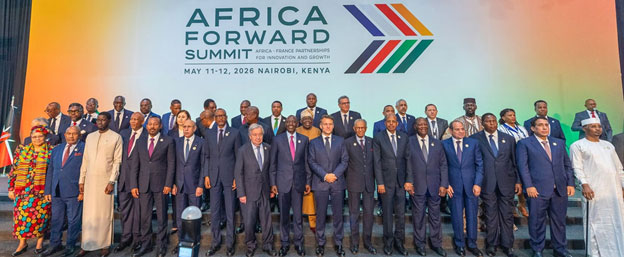
Excerpts from remarks by Kristalina Georgieva, Managing Director, International Monetary Fund (IMF), at the Africa Forward Summit, Nairobi, May 11-12.
- It is very appropriate that this Africa Forward Summit is being held in Kenya. Two weeks ago, a Kenyan marathon runner, Sabastian Sawe, did what had been considered impossible: by running a marathon in under two hours! What we have set ourselves here is also a marathon—and we must show the same resilience and perseverance that Mr. Sawe did.
Because Africa is not just another region. It is the future; it is where the world will acquire its next growth engine.
And it must do so in a more complex and uncertain global environment, when imbalances are growing yet again. Export-led economies reduce the space for Africa to integrate into global supply chains. At the other end, countries with large deficits absorb a disproportionately large share of financial resources, limiting the availability of capital for the rest of the world.
But the most dramatic imbalance is in demographics—between aging and youthful societies, with capital mostly in the first group and growth potential in the second.
What should the countries of Africa do to build resilience against a world of more frequent shocks and secure the bright future that this continent so richly deserves?

Kristalina Georgieva
This requires action at home and stepped-up support from Africa’s partners.
At home, building economic and social resilience must be grounded in strong institutions and sound policies, creating the conditions for private sector-led growth. From credible macroeconomic policy to decisive steps against corruption and reforms to slash red tape, countries need to work to win investors’ trust.
Africa also has to speed up trade and economic integration. Just eliminating tariff and non-tariff barriers in line with the continental free trade area can increase income per capita by more than 10 percent—with more purchasing power the continent becomes more competitive.
And Africa must deal decisively with the burden of debt. Restructure or reprofile when debt is unsustainable; avoid non-productive borrowing; and shift the balance from debt to equity as much and as quickly as possible. For this, it is paramount to develop deeper, more diversified capital markets.
Under France’s G7 presidency we have made the issue of global imbalances a priority for our work. Africa benefits when the Fund advocates for fair treatment. To reflect our firm belief in Africa’s growth potential, we have also pursued multiple reforms to expand our support for the continent.
First, we put our money where our mouth is. We have vastly expanded our concessional lending for Africa, from $8 billion pre-COVID to $36 billion today. Thanks to the SDR channeling of $109 billion, which President Macron and leaders from Africa championed, we can deploy substantially more concessional lending. To put it simply, thanks to the SDR channeling we can do more as ODA does less.
And we make sure our financing unlocks support from our development partners and helps attract private funding.
Second, we reformed how we do our programs—as a genuine partnership with our members. We don’t just talk the talk on country ownership; we walk the walk—we listen, we adapt, we show flexibility when warranted.
There are many good examples across Africa of homegrown reform programs that we support, of countries maturing in their policy choices—Benin, Côte d’Ivoire, Egypt, Ethiopia, Ghana, Morocco, Rwanda, Zambia, to name a few.
And yes, good policies pay off. Closing half the gap vis-à-vis emerging market economies in areas like regulation and governance can raise sub-Saharan Africa’s output by up to 20 percent within a decade.
Third, we pursue reforms of the international debt architecture, with our efforts extending to the Global Sovereign Debt Roundtable, our new debt playbook for country authorities, the London Alliance, and proactive use of our good offices to help forge consensus.
Lastly, at the IMF we are delivering more voice and representation for Africa in our governance and resource allocation. We have established a third African chair at our Board and a strong focus on the continent in our work.
Our members are committed to addressing underrepresentation in the 17th quota review. And we work with regional institutions—the African Union, the African Development Bank, the Economic Commission for Africa—to ensure their deep local knowledge helps us better serve our members.
In this world of rapid transformations and repetitive exogenous shocks, there is much that individual countries cannot control. But you can, as they say here in Kenya, keep your own house “spick and span.”
You control your policies, you define your future, and your value proposition—which we will help amplify to the relevant audiences, the rating agencies included.
With the people of Africa in the front seat and we, as partners, firmly with them, I am confident that this continent will achieve its golden destiny.
IPS UN Bureau


 Print
|
Print
|




