
Monday, October 26, 2026



News and Views from the Global South
Women's Health
For Pakistan Rising Fistula Cases Make SDG 3 Goal Elusive
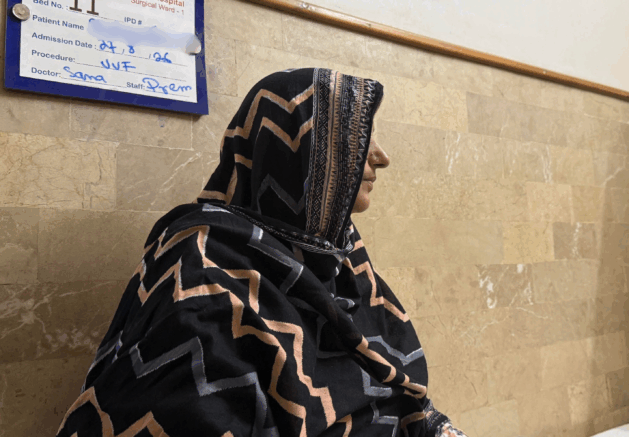
Shehnaz Ali from Rahim Yar Khan, Pakistan, has been living with a fistula for 16 years. Credit: Zofeen T. Ebrahim/IPS
- “You’re living a life drained of joy,” is how Shehnaz Sher Ali describes her “perpetually wet and stinky” existence. “I wouldn’t wish it on my worst enemy,” says the 35-year-old, who travelled by bus for more than 12 hours with her husband from their village in Rahim Yar Khan, Punjab, changing diapers whenever possible to keep the smell from reaching the fellow passengers.
For 16 years, she had lived with urine dribbling, unaware that it was treatable with a relatively simple surgical procedure.
She developed an iatrogenic fistula—caused by a surgical injury during a Caesarean section—and is among the estimated two million women living with untreated obstetric fistula worldwide.
Shehnaz got married at the age of 18 and conceived soon after. At full term, her obstetrician suspected a complication for which she underwent a Caesarean section, but the baby was stillborn. The doctor then told the young couple she would not be able to conceive again.
That was not all. She soon realized she was leaking urine.
The doctor assured her it would stop within weeks. It never did, despite three months in hospital trying to repair the leak.
“After spending so much on my operation, being told I could never have children, and then living with the urine leakage, my husband divorced me. I was damaged goods, a liability, and he didn’t want to spend any more money on me.”
She returned to her parents’ home and, a few years later, married Ali, twice her age and already married with three daughters.
“He knew about my condition but married me because he needed someone to care for his paralyzed wife and their three daughters.”
But now, her life is beginning to change.
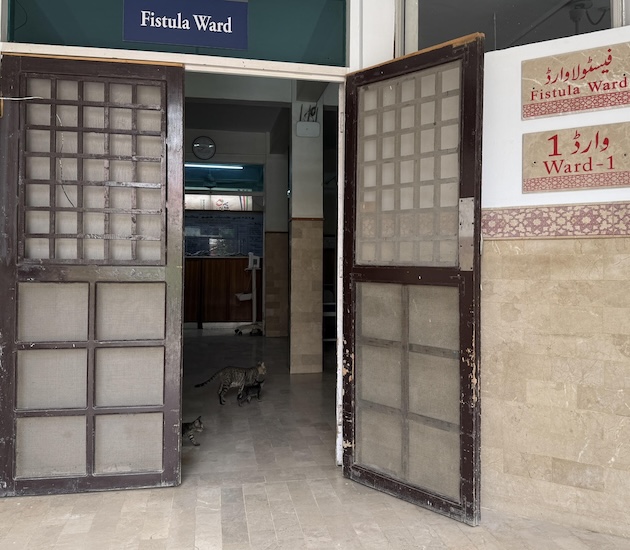
Fistula Ward at Kooh Goth Hospital, where cats are allowed to roam free. Credit: Zofeen T. Ebrahim/IPS
Center of Hope
She is being treated at the best facility for treatment of fistula—the Koohi Goth Women’s Hospital (KGWH), run by the Zafar and Atia Foundation Charitable Trust (supported by numerous Pakistanis both abroad and within the country), in Karachi’s Landhi neighborhood.
“A relative found out about it a month back, and my husband brought me to it immediately,” she said.
Dr. Shershah Syed, who founded KGWH, was Pakistan’s first gynaecologist and obstetrician to train in genital tract fistula (both rectovaginal and vesicovaginal fistula) repair. He describes these as among the “worst and most devastating childbirth injuries” a woman can endure.
In 1993, Syed trained at Addis Ababa Fistula Hospital under renowned surgeons Dr. Reginald Hamlin and his wife, Dr. Catherine Hamlin, who provided free obstetric fistula repair in Ethiopia. Two years later, as medical superintendent of the government-run Sobhraj Maternity Hospital, he began actively repairing fistulas.
Since KGWH began operations in 2007, it has treated “more than 3,200 women and trained 30 master trainers,” said Dr. Sajjad Ahmed Siddiqui, its fistula project manager.
In 2025, UNFPA’s Asia-Pacific office designated KGWH a Regional Center of Excellence for fistula care after it trained surgeons from Bangladesh, Nepal, and Afghanistan. It was already the national referral and surgical training hub.
“We want to treat 800 women annually while providing psychosocial support, literacy, and skills training to help them reintegrate and become economically empowered,” says Dr. Jameel Ahmed, sexual and reproductive health specialist at UNFPA Pakistan. “But with global funding constraints and rising iatrogenic fistula cases, we are unsure how much reintegration support we can provide.”
KGWH’s work has also extended beyond its walls.
Syed, who is a medical advisor to the Fistula Foundation, organizes free surgical camps with the help of trained surgeons in remote Sindh government hospitals, bringing treatment to women from nearby villages.
In January, he travelled to Kabul with four female surgeons, where they set up a fistula repair camp and provided refresher training to Afghan female surgeons.
“In five days, the women surgeons repaired 20 fistulas,” said Syed. “There is a great need there, but with relations between the two countries at their lowest, it is difficult for us.”
Before the Taliban takeover, 30 to 35 women from remote provinces of Afghanistan would travel to Pakistan each year for treatment. That has now ended.
Today, there are 11 fistula repair centers across Pakistan equipped with 88 trained surgeons, and in the last decade, these centers have treated over 7,800 women for fistula.
Globally, about 50,000–100,000 new cases of vesicovaginal fistula occur each year, with 80% in developing countries, mainly in Asia and Africa, according to UNFPA. “In Pakistan, we estimate that up to 5,000 cases of fistula occur annually; iatrogenic fistula is one type,” explained Ahmed.
Back in 2007, when UNFPA began addressing obstetric fistula caused by obstructed labor in Pakistan through the Pakistan National Forum on Women’s Health, it believed that improved reproductive healthcare and more facility-based births would help reduce the incidence of this devastating condition.
Some Progress, But Not Enough
“To some extent, there have been significant improvements in maternal mortality and morbidity since then,” said Ahmed.
The progress is reflected in World Health Organization figures: Pakistan’s maternal mortality ratio fell from 276 deaths per 100,000 live births in 2006 to 155 in 2024. Neonatal mortality declined from 52 to 37.6 deaths per 1,000 live births over the same period, while the stillbirth rate fell from 39.8 per 1,000 births in 2000 to 27.5 in 2024.
But Syed remains unimpressed. Despite these gains, the toll is still “not acceptable” to him. Every day, 675 babies die before reaching one month of age, and 27 mothers die from preventable complications, amounting to more than 246,300 newborn and 9,800 maternal deaths a year. Pakistan also records more than 190,000 stillbirths annually, WHO figures show.
All these put Pakistan’s achievement of SDG 3—which deals with sexual and reproductive health—at risk.
And there is another worrying development.
As Pakistan made progress in tackling obstetric fistula, another form was emerging—one caused not by obstructed labor but by medical intervention itself. “We observed women developing fistulas following Caesarean sections or hysterectomies in health facilities—iatrogenic,” said Ahmed.
Syed is particularly concerned about this kind. “In most childbirth cases, I find surgical intervention unnecessary. Too often, the decision to intervene is a ‘personal’ one, driven by greed and ‘ease’ rather than ethics.”
“We have irrefutable proof that most of the injuries happen due to surgical error during C-sections, hysterectomies, or repair of ruptured uterus and bladder,” says Siddiqui.
UNFPA has found that a staggering 70% of fistula cases in Pakistan result from surgical injuries. “We tried to plug one hole two decades back, through improved facility-based births, and realized there was a bigger one at hand that happened in facilities that needed to be plugged now,” said Ahmed.
Dr. Pushpa Srichand, 75, has spent more than five decades as a gynaecologist and has treated some 2,200 fistula patients in hospitals, along with countless more at free surgical camps. “It is a disease of the poor; I promised myself I would never charge these women,” she said. Even after retiring from government service and joining Isra University, she made free fistula treatment a condition of her appointment.
A recent seven-year prospective study by Isra University found a 56% rise in iatrogenic fistula among gynaecological patients between 2017 and 2024. Of the 2,190 women treated for obstetric and other gynaecological complications, some 1,358 had iatrogenic fistula.
“This is a huge and extremely concerning number,” said Srichand, sharing her findings at a UNFPA national consultation that brought together regulators, medical bodies, and provincial health officials to discuss the rise in iatrogenic fistula and ways to prevent it.
Earlier research points to a similar pattern. A two-year study at Lady Willingdon Hospital, Lahore, from January 2007 to December 2008, found that 54% (33 of 61) of referred fistula cases were iatrogenic. A 2004 report from the same hospital, by contrast, found that 79% of fistulas were obstetric. The 2008 study concluded that “gynaecological surgery is being performed by untrained hands in the periphery.”
Another study at the Pakistan Institute of Medical Sciences (PIMS), Islamabad, covering almost 12 years to June 2018, also found a rising trend in iatrogenic urogenital fistula. It concluded that the trend underscored the need for better safety standards in both obstetric and gynecological surgery.
The same was concluded at the UNFPA consultation, where doctors largely blamed inexperienced and unskilled practitioners.
“They make wrong diagnoses, perform faulty surgeries, and leave patients with lifelong complications,” Syed told IPS on the sidelines of the event.
“A C-section, for instance, is a relatively straightforward procedure,” he pointed out, but in incompetent hands, even this can go terribly wrong. “It requires a very special kind of negligent expertise to get this wrong,” he said sarcastically. He also blamed the superiors for the errors of their juniors. “They never taught their juniors properly, and many C-sections and even normal births are carried out by those without adequate training, resulting in these grave mistakes that women suffer lifelong. The worst part is there is no accountability.”
For women like Shehnaz, such medical errors are not simply complications—they can reshape an entire life.
For years, she saw her suffering as punishment for some inexplicable sin. The treatment, she says, is “Allah telling me that I have finally atoned for it.”
“When I go home, the first thing I will do is cook a large pot of biryani and distribute it among the poor, in gratitude to Allah for giving me a second life,” says Shehnaz, her face beaming after her first successful operation.
Dr. Sana Ashfaque, who carried out an “extremely complicated, four-hour-long surgery” to repair Shehnaz’s holes, is hopeful she has plugged the leak for good. “But we will keep her for another two weeks just to be sure everything is in place; she’s come from far and it may not have been easy for her to come back to us.”
After 16 years of waiting, four hours was a small price to pay for a second life.
Note: This article is brought to you by IPS Noram in collaboration with INPS Japan and Soka Gakkai International in consultative status with ECOSOC.
IPS UN Bureau Report



 Print
|
Print
|



Pictures for this story
This story includes downloadable print-quality images -- Copyright IPS, to be used exclusively with this story.


