
Monday, October 26, 2026



News and Views from the Global South

Samsø Island, Beyond Fantasy
- A small Danish island in the North Sea is experimenting with a model of energy production and consumption that could provide some answers in the fight against climate change.
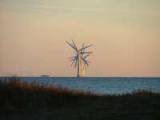
A view from the island of Samsø of wind turbines in the North Sea. - Courtesy of the Samsø Energy Academy
Samsø is an island of 114 square kilometers with just over 4,000 people, located in the Bay of Kattegat, in the North Sea, some 120 km west of Copenhagen.
Its much-deserved reputation as model of sustainability is due to the fact that it uses wind turbines and solar panels to generate all of the energy its inhabitants consume.
Since 1997 when Samsø won a national competition to become a prototype community in the use of renewable energy sources, the Samsingers, as its people are known, revolutionized all aspects of their daily lives in order to contribute to greater efficiency.
The effort has such a broad scope that even milk production is part of the energy system.
At the time of milking, cow's milk has a temperature of about 38 degrees Celsius and has to be cooled immediately to three degrees. Some dairy farmers in Samsø connected a heat transfer mechanism to the collection tank to prevent the warmth from the milk from dissipating in the air – instead it is used in heating their homes.
So far, despite their inventiveness, the farmers have not resolved the problem of methane and other greenhouse gases generated by the bovine digestive system. But they are studying the system used on a model farm on the Jutland Peninsula, which recycles the gases and waste from raising pigs and uses them as energy sources and fertilizer to grow tomatoes.
Although the transfer of heat from the milk to household heating is just a small component in the Samsø community's energy system, it illustrates how hard the Samsingers are willing to work towards living in harmony with nature.
The centerpiece of the system are 11 wind turbines, which generate an average of 28,000 megawatts annually. That's enough to meet the community's electricity demands, supply the island's entire public transportation system, and have a surplus of 10 percent to sell to other regions of Denmark.
The income from those sales is reinvested in the local renewable energy system.
It's not that the Samsingers have given up their cars and other usual modes of transport. For example, the three ferries that communicate the island with the continent consume 9,000 liters of petroleum per day. Even so, Samsø sells more clean energy to the continent than it purchases in fossil fuels.
The community is willing to experiment with electric cars. “The distances here are very short, less than 50 kilometers,” said Søren Hermansen, director of the island's Energy Academy and pioneer in the local environmental revolution.
“If the battery of an electric car can store up energy for, say, 120 kilometers, then that would mean we wouldn't have to sell our clean energy and we would use it here,” Hermansen told Tierramérica.
Farmers have adapted their tractors and other vehicles to consume ethanol or other fuels distilled from locally grown plants, like canola. Samsø also has four generators that run on the combustion of straw, which is abundant on the island. The generators are especially efficient because they produce both heat and electricity. Many homes have installed solar panels, geothermal heating, and boilers fueled with biomass or wood treated to eliminate carbon emissions.
In addition to the renewable energy sources, also of great importance is the Samsingers' effort to reduce their consumption of electricity.
Jytte Nauntoft, owner of an electrical appliance shop in Tranebjerg, the island's largest town, told Tierramérica that all households have the usual appliances of the European lifestyle, from refrigerators to washing machines to televisions. “But because electricity is so expensive, people here buy the most basic and most efficient models,” she explained.
This complex system of energy production and improved efficiency has brought the island from being 100 percent reliant on petroleum and coal in 1997, at the beginning of the experiment, to being energy self-sufficient in 2003, utilizing only renewable sources. Since 2007, the system itself has not produced greenhouse gases.
The certification of the energy balance was entrusted to the Danish governmental energy agency and to Planenergi, a consultancy, co-authors of the 2007 evaluation.
The achievements are evaluated according to energy density, which measures the ideal quantity of energy generated per unit of area. In Samsø's case, the density should be at least two watts per square meter.
“Samsø reached that density by the end of 2008,” Hermansen told Tierramérica.
The great success of the experiment has meant frequent visits by officials from foreign governments, environmental experts, journalists and students from around the world.
The visitors recently included a group from the Global Legislators Organization for a Balanced Environment (GLOBE), which met Oct. 24-25 in Copenhagen to give a boost towards achieving a new international climate treaty in December.
The GLOBE meet included lawmakers from the Group of Eight most powerful countries (G8; Britain, Canada, France, Germany, Italy, Japan, Russia and United States) and the emerging nations Brazil, China, India, Mexico, South Africa, Australia, South Korea and host Denmark.
Hermansen told Tierramérica about how on a recent visit to Samsø, the ambassador from Egypt had stated that the island was too small to serve as a global example.
“Four thousand people! This island represents less than three apartment blocks in Cairo,” said the diplomat, according to Hermansen, who told him: “Egypt doesn't need to revolutionize its entire energy system at once. Perhaps you should start by reforming three apartment blocks in Cairo.”
In addition to the Samsø energy system, Hermansen also has a different take on the long-standing environmental slogan: “Think globally; act locally.”
“What each one of has to do is to think in local environmental terms, and act locally. The rest will resolve itself through synergies,” he says.
Jörgen Tranberg, one of the farmers who use the warmth from the milk of his 150 cows to heat his home, takes Hermansen's idea a step further.
“Each place has its particularities. Given that Norway has so many waterfalls, the Norwegians generate a great deal of electricity from dams. In Samsø we have always burned straw, which is abundant on the island. But we used to burn it outdoors in the open air. Today we burn it in highly efficient boilers,” Tranberg told Tierramérica.
The farmer pointed out that one must look beyond the market price of fuels. “At first glance, the cheapest fuels are petroleum and coal. But both have many hidden costs that aren't expressed in the market price,” he said.
One of the factors that has made Samsø such a success is the high degree of participation of the residents. According to Hermansen, when the process began in 1997, he was already convinced of its possibilities.
The key, he said, was to convince the community to participate economically in the revolution. And it worked. Today, the Samsingers are private owners of the wind turbines, the solar panels and the Samsø communal heating system.
 Print
|
Print
|




