Sunday, July 19, 2026



News and Views from the Global South
Opinion
Bhutan’s WTO Path: Learning from the Global South
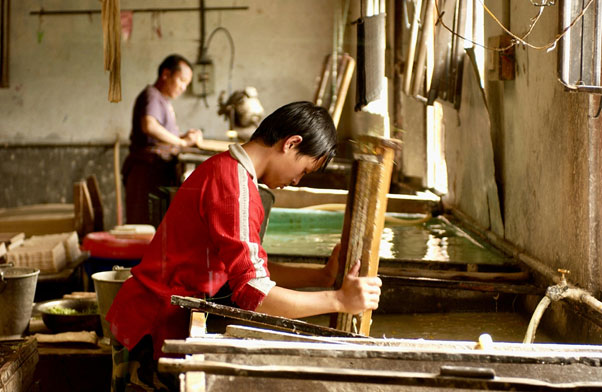
Male employees were working in a paper factory in Thimpu, Bhutan. Accession to WTO will enhance business opportunities for local SMEs. Credit: Unsplash/Bradford Zak
- Bhutan’s decision to restart its accession to the World Trade Organization (WTO) comes at an important junction. Since graduating from Least Developed Country (LDC) status in 2023, the country is entering a new phase of development, which requires stronger competitiveness, deeper global engagement and greater economic resilience.
Yet Bhutan’s experience is not only about joining a global institution. It also offers an important lesson on why South-South cooperation matters in an increasingly uncertain world.
Global trade today is becoming more fragmented and unpredictable. Geopolitical tensions, supply chain disruptions and shifting trade alliances are reshaping the engagement of countries with the global economy. For small developing economies, the challenge is particularly complex.
Accessing international markets is no longer only about expanding exports, it is also about navigating changing rules, building institutional readiness and strengthening resilience against external shocks.
Based on this, the decision to restart the WTO accession from Bhutan is particularly significant. After years of standstill, Bhutan has resumed discussions on the terms of accession under the WTO Working Party process.
For a small economy transitioning beyond LDC status, WTO accession represents an opportunity to strengthen long-term economic foundations, improve investor confidence and integrate more effectively into regional and global markets.
However, the WTO accession is never easy, particularly for small economies with limited institutional capacity. Negotiating accession requires the readiness of the domestic market and industry, but also government capacities to navigate highly technical issues and in-house analysis for self and competitors’ assessments, from market access commitments and regulatory reforms to notification obligations and legal frameworks.
Officials must understand not only the rules themselves but also the practical implications of commitments that will shape national economic policy for years to come.
For many developing countries, the most useful policy lessons often come from peers facing similar realities. Countries across the Global South frequently operate under comparable constraints: limited institutional resources, competing development priorities and the need to balance openness with domestic policy space.
In these contexts, learning from neighbouring and comparable economies can often be more practical and relatable than relying solely on textbook models or distant examples. Bhutan’s WTO preparations offer a good example of the approach can work in practice.
In response to a request from the Royal Government of Bhutan, the United Nations Economic and Social Commission for Asia and the Pacific (ESCAP) through its Subregional Office for South and South-West Asia, partnered with Indian think tanks to support Bhutanese officials as they prepare for WTO accession.
Rather than focusing solely on theoretical understanding, the initiative emphasized practical learning, negotiation experiences and peer exchanges with experts and former trade negotiators who had worked directly on WTO processes.
The approach responded directly to Bhutan’s needs. Officials serving on Bhutan’s WTO Negotiating Team and Technical Working Groups were able to deepen their understanding of complex accession issues, including market access negotiations, institutional reforms, scheduling commitments and post-accession obligations. More importantly, they engaged directly with practitioners who understood the realities of policymaking and negotiations in developing country settings.
Peer learning also brought an important practical pillar. Discussions moved beyond legal provisions and technical terminology to focus on real experiences what challenges emerge during accession, how governments navigate difficult trade-offs and what institutional arrangements work in practice.
Exchanges on economic diversification, including lessons related to Special Economic Zones (SEZs), also offered useful reflections for Bhutan as it considers pathways to sustainable economic growth.
At a time when multilateralism faces growing pressures and geopolitical divisions increasingly influence trade relations, regional cooperation and peer learning are becoming more important. Small and developing economies often face similar structural constraints and often attempt to navigate major transitions in isolation.
Trusted regional partnerships can help countries access practical expertise, reduce learning costs and build confidence in undertaking complex reforms.
Bhutan’s WTO journey reminds us that successful South-South cooperation is not simply about technical assistance or transferring knowledge. It works best when countries define their own priorities, partnerships respond to genuine demand and peers contribute practical experiences with humility and mutual respect.
As Bhutan moves forward in its WTO accession process, its experience offers an important lesson for the wider region. In a fragmented and uncertain global economy, developing countries are often strongest when they learn from one another.
South-South cooperation may not remove every challenge, but it can help countries navigate difficult transitions with greater confidence, stronger institutions and more practical solutions.
Jing Huang is Economic Affairs Officer, ESCAP Subregional Office for South and South-West Asia; Mikiko Tanaka is Head of ESCAP Subregional Office for South and South-West Asia & Rajan Ratna is Coordinator, DAKSHIN-Global South Centre of Excellence.
IPS UN Bureau


 Print
|
Print
|