
Saturday, October 17, 2026



News and Views from the Global South
Women Peacebuilders: The Missing Voices at the Negotiating Table
- For most individuals, the process of peace starts with the signing of a ceasefire or an agreement among politicians. However, those who live in regions experiencing violence understand that peace is made long before politicians meet at the negotiating table. Peace is created among communities by people who work everyday to ensure that no violence takes place, and that disputes are sorted out.
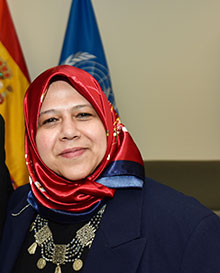
Muna Luqman, Yemeni peacebuilding advisor and humanitarian leader.
Speaking to IPS Inter Press Service, Yemeni peacebuilding advisor and humanitarian leader Muna Luqman challenged conventional thinking about who builds peace and where peacebuilding truly begins, “Communities never wait until peace happens,” Luqman said. “They’re working to protect peace on a daily basis.”
Based on her extensive experience working in Yemen for more than 15 years, Luqman explained how local communities, especially women, resolve disputes, provide crucial services, negotiate humanitarian assistance and create dialogical spaces way ahead of any intervention of international organizations.
Luqman is the founder and chairperson of Food for Humanity, has seen first-hand the changes conflict brings about in society. While living through the Yemeni civil war, she faced airstrikes and negotiated the evacuation of civilians caught up in the war zone. These experiences led her to realize that humanitarian response alone is inadequate.
“If we only respond to the consequences of conflict without addressing its causes, we will always be a step behind,” she reflected. Her experience also exposed one of the greatest challenges facing local peacebuilders and that is of recognition.
“We thought we would be the first to be supported,” she said, referring to local organisations that led humanitarian responses before international actors arrived. “But we found out that it was a long process.”
According to a report by UN Women, around 676 million lived within 50 kilometers of deadly conflict in 2024 – the highest figure since the 1990s. Sima Bahous, Executive Director of UN Women, said, “Women and girls are being killed in record numbers, shut out of peace tables, and left unprotected as wars multiply. Women do not need more promises, they need power, protection, and equal participation.”
Data collected by the United Nations from 2020-2024 found that, “Women’s representation as negotiators, mediators and signatories in peace processes is far below the target set by the UN. In 2024, women made up only seven percent of negotiators on average worldwide, and nearly nine out of ten negotiation tracks included no women negotiators”. The report stated, women were slightly more represented in mediation roles, averaging 14 percent but still, two-thirds of mediation efforts did not include women.
The discrepancy for Luqman pointed to an underlying problem in international peacebuilding. While local groups responded immediately to communities in need, other institutions were bound by mandates, funding, and procedures. It becomes evident, she says, why true inclusion in peacebuilding should be more than merely symbolic in nature.
True inclusion requires recognizing women not as mere recipients of help or observers of processes, but as active participants in negotiating, mediating, and taking crucial decisions. It is proven that peace treaties are much more sustainable in those cases where women are actively involved in the negotiation process. Women broaden the agenda from purely political aspects like political power-sharing to such crucial areas as justice, education, health care, livelihoods, displacement, and community reconciliation.
Luqman believes that local women possess a unique understanding of these realities because they remain deeply embedded within their communities. “Women mediators are willing to prevent disagreements before they become violence,” she explained. She has witnessed women in Yemen securing the release of prisoners, organizing their communities to rebuild schools and water supplies, and preventing children from joining armed groups. This is often done discreetly, outside the limelight of the international community.
“The strength of women peacebuilders is their ability to mobilize their communities,” she said. However, it is precisely these women who find themselves in extraordinary circumstances. They are threatened, intimidated, forced to flee, and often lack funds despite helping others. Protecting women peacebuilders must be a priority on the global agenda, Luqman asserts.
“They do this work while they are facing either lack of funding or no funding at all. They remain resilient, they remain vulnerable at the same time, and they remain under threats.”
She believes that the international community needs to go beyond recognizing the contribution of women and work to provide financial support to women-led organizations that are trusted and credible within the local communities.
While serving as the United Nations National Coordinator on Inclusion in the Peace Process of Yemen, Luqman developed an approach that would allow local people to speak up. The initiative did not consider participation just as a formal aspect but actually aimed to bring in the community perspective. “It wasn’t symbolic participation,” she told me. “We really took that analysis and used it in our system.” This is because peace processes cannot be made by the political elite only; they need to be inclusive of communities that have been experiencing conflict.
In Luqman’s opinion, local governance, climate challenges, livelihoods, transitional justice, and building trust are not marginal questions but rather central factors in avoiding further outbreaks of violence.
Luqman insists on the need for peacebuilding to involve listening: “Sometimes listening to the people themselves and giving them a space is in itself a peace process.”
In the context of rising complexity of conflicts, the importance of inclusion into peace processes has never been so urgent. Women’s involvement in the processes cannot be considered as some kind of equality issue or simply as an obligation under international mechanisms.
On the contrary, it is strategically necessary based on experience and community trust. The message from Luqman to policymakers is obvious: local women peacebuilders are not marginal figures in peacebuilding but its cornerstone. “The local women peacebuilders are the structure and the backbone of these societies,” Luqman said. “They are valuable. They should be treated as valuable assets. They should be supported and protected.” Constructing sustainable peace is not possible only through negotiations of the parties involved in armed conflict but also through investing in people who have done so many years of keeping communities together despite the situation being unrecognizable.
Sania Farooqui is an independent journalist and host of The Peace Brief, a platform dedicated to amplifying the voices of women in peacebuilding and human rights.
IPS UN Bureau Report


 Print
|
Print
|




