Wednesday, August 26, 2026



News and Views from the Global South
MEDIA: Young Journalists Explore What It Means to Be Muslim in Italy
Sabina Zaccaro
- With the help of a new monthly magazine, ‘Yalla Italia’ (Come On, Italy), some young second-generation Egyptian, Moroccan and Tunisian immigrants are attempting to explore and address the stereotypes considered an obstacle to their full integration in this predominantly Catholic European country.
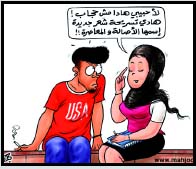
No, dear, this is not a veil, it's a new hairdo called 'tradition and modernity'. Credit: Yalla Italia - Vita
Made up of two young men and six young women, the editorial team belies Muslim stereotypes starting from its very composition. Buthaina Bussy Ibrahim, Karim Bruneo, Hassan Bruneo, Lubna Ammoune, Rassmea Salah, Sarah Sayed, Lubna Ammoune and Buthaina Ibrahim comprise the editorial staff of ‘Yalla Italia’, published as a monthly insert in ‘Vita’ (Life), an Italian weekly magazine featuring articles on social and multicultural topics.
The staff includes mainly university students and young people participating in an “integration programme” launched in the schools of Milan, a northern Italian city that is home to 23,000 young Muslims, according to recent city government figures.
In its first edition – published last Saturday – ‘Yalla Italia’ goes straight to the point, tackling the critical issue of humour and cartoons in the Muslim world. “Smile, Please: Eight Pages Against Stereotypes” is the title of the cover story.
After the weeks of often violent protests around the world last year, triggered by the publication of cartoons of the Prophet Muhammad by a Danish newspaper, “I remember I felt irritated, since the media reports reflected Arabs as people without a sense of humour,” says 24-year-old Rassmea Salah, born in Italy to a Roman Catholic mother and an Egyptian father of Muslim faith. In Milan, she teaches Arabic to the children of immigrants.
“Public debates often simplify Islam-related issues, as if Muslims were a monolithic bloc, when in reality the Muslim faith embraces many different cultures,” she said. “Yes, even Arabs can smile, without feeling insulted.”
The cartoons published by ‘Yalla Italia’ address religion (“What are you reading, daddy?” “The Koran, my son, I have read it since I was a child.” “And haven’t you finished it yet?”) and traditional values (“No, dear, this is not a veil,” explains an Egyptian girl pointing to her long hair wrapped around her head like a hijab, the veil worn by Muslim women, “it’s a new hairdo called ‘tradition and modernity’.”)
“The original group had some 200 people, from whom a team of eight young people with skills in writing and creativity was selected,” Martino Pillitteri, editorial coordinator of the ‘Yalla Italia’ project, told IPS.
“As second-generation immigrants, they all have Italian identity cards, and feel equal to their Italian friends. But most of all, they represent the silent majority of Muslims, who seek peaceful integration within the receptor community, without giving up their values,” he said.
The monthly issue of this magazine, said Pillitteri, can become a space for young people to share the everyday things from their lives that they have in common, in a fun and ironic way.
The ultimate goal is to strengthen the integration process. “What is hard for these young people is to be part of a community seen as a problematic one,” said Paolo Branca, professor of Arabic and Islamic Studies at the Catholic University of Milan.
“They cannot drink alcohol, they cannot eat pork, and they cannot go to the beach (without wearing proper cover). The most common view considers Muslims as people to whom everything is forbidden, but this is not true,” he told IPS.
Salah said she is finding a new identity, based on an Islamic faith that is more “open” and less radical than that of her father. “True integration,” she said, “requires a deep study of the recipient culture and our own religion as well as the Koran, from a historic-critical approach. We must not be so presumptuous to think that we have the truth inside us; only God has the truth.”
But the first reactions after the publication of ‘Yalla Italia’ suggest that dialogue is not only needed amongst people of different cultures.
“Coming back from the mosque, Rassmea told us that some of her friends did not appreciate the ironic cartoons we published, which they found disrespectful,” said Pillitteri. “This is confirmation of the theory that there are sometimes more difficulties in dialogue between moderate and fundamentalist Muslims than between Catholics and Muslims.”
But future editions are to be even more explicit, covering all the arguments of concern to the children of immigrants: the generation gap with their parents, the use of the veil, mixed marriages, respect for Ramadan – the Muslim sacred month of fasting – the Sept. 11, 2001 terrorist attacks on New York and Washington, and balance between religion and freedom.
The aim of the editorial staff is to offer a chance to talk about aspects of immigration that are commonly ignored or hard to find in the mainstream Italian media, through the voices of those involved in the process.
“In Arabic, Yalla is an exhortation to be dynamic, and leave behind the victim approach,” Pillitteri explained.
“Sometimes the older members of our community see us as people who have lost their way,” said Sarah Sayed, another young member of the editorial staff. “We’re not afraid to say that we are against violence resulting from fundamentalism. Democracy and freedom are absolutely not in contradiction with our religion.”
 Print
|
Print
|