
Saturday, October 3, 2026



News and Views from the Global South
LABOUR-MALAYSIA: Flawed Policy Results in Flood of Migrant Workers
Baradan Kuppusamy
- As thousands of migrant workers from Bangladesh stranded at the international airport here await deportation questions are being asked about Malaysia’s migrant worker policies and the dubious role of employment agencies.
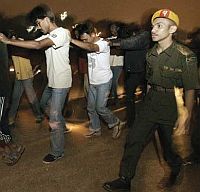
Migrant workers being marched off to detention centre Credit: Baradan Kuppusamy/IPS
“My dreams of making it here (in Malaysia) are now all shattered,’’ said Suleiman, fear and anxiety showing on his face. ”This is all I have left for lunch,’’ he said, indicating a bottle of mineral water. Suleiman is one of some 15,000 Bangladeshi workers who ended up stranded at the KLIA airport this month – many cheated by agents and trafficking syndicates.
Overwhelmed airport authorities have converted an entire floor of the multi-storey KLIA airport into a temporary holding pen for the Bangladeshi migrant workers. A putrid stench hangs over the place. Migrant workers are everywhere, sleeping on the cement floor or lining up to use the only toilet at the shelter.
“We sleep, bathe and eat here waiting to be deported,” Suleiman said. “I came here with grand dreams, but now I am going to be sent back without a single cent in my pocket and huge debts waiting back home.”
Under current rules, the immigration authorities wait for a day or two for employers to turn up for the workers they are supposed to have contracted for. However, thousands seem to have been cheated by agents who promised jobs that do not exist.
If prospective employers fail to turn up at arrivals, as in Suleiman’s case, they are transferred to a detention camp and readied for immediate deportation. ”Even though they have valid visas and work permits, if there is no employer willing to take them, we have to deport them. That’s the law,” said Ishak Mohamed, a senior immigration department official.
Across the country, stranded migrant workers are finding it tough to survive on the meagre savings that many brought with them from their villages in Bangladesh. Some had worked without wages for several months. Others were paid a small fraction of the promised wage. Many are on low-paying menial jobs.
Migrant workers have been reported living in open fields, abandoned buildings. In in Rawang, about 30 km north of the capital, about 200 Muslim Bangladeshi workers have taken refuge in a Catholic church.
The deportation of stranded workers may be delayed by months because deportation is carried out only by the national carrier, Malaysia Airlines, whose flights to Dhaka are fully booked for several months ahead.
“This is an unbearable tragedy for the workers who had borrowed heavily to come here but are now deported penniless to face mountains of debts,” said Irene Fernandez, executive director of TENAGANITA, a human rights NGO that helps migrant workers.
Fernandez said the source of the current crisis is a move by the government to allow some 200 agents to import 300,000 Bangladeshi workers this year.
“They are victims of cheating and human trafficking and should not be summarily deported,” she said. “They have legal papers and have legal status.”
Despite the many horror stories regularly emanating out of Malaysia, the country remains a magnet for foreign workers who hope to fill menial jobs that Malaysians reject.
With a small population of 26 million Malaysia is already home to three million legal foreign migrant workers, mainly from Indonesia, Bangladesh, Nepal and India. But is relative affluence continues to serve as a magnet for migrant workers.
Bangladesh has said it would dispatch a team to probe the plight of its stranded workers, but human rights activists say there is little their officials can do to alleviate their misery.
“They have no clout…it is just tough talk,” said a veteran human rights leader on condition of anonymity out of fear of reprisal. “Besides, the agents licensed to import workers are politically connected and none has ever been charged despite breaking numerous laws.”
“The control, transport and management of migrant workers is a billion dollar industry by itself,” he said. “Too many powerful people are involved.”
She also said it is illegal to deport the workers after issuing permits and allowing them to land. ”The government has violated both the law and basic human rights by holding thousand of documented workers in detention camps for deportation,” she told IPS. “The workers have permits and visas issued by the Malaysian High Commission in Bangladesh.”
Fernandez said the workers have legal status under domestic and international law. Ironically as Malaysia deports Bangladeshi workers, its construction and infrastructure development industries are crying out for cheaper migrant labour.
This is because at least three massive development projects are taking shape in the south, north and east of the country that experts say would require one million more workers.
Experts say Malaysia’s workforce of 10.8 million is insufficient to complete the three giant socio-economic projects which together cost over RM100 billion (30 billion dollars) over 20 years. One project alone, located in the southern state of Johore called Iskandar Development Region, is three times the size of neighbouring Singapore.
The government estimates that the foreign worker population will double by 2010 to six million, making Malaysia among the largest importers of migrant workers in the world.
 Print
|
Print
|




