
Friday, October 23, 2026



News and Views from the Global South
Opinion
What Faith Can Teach Agriculture
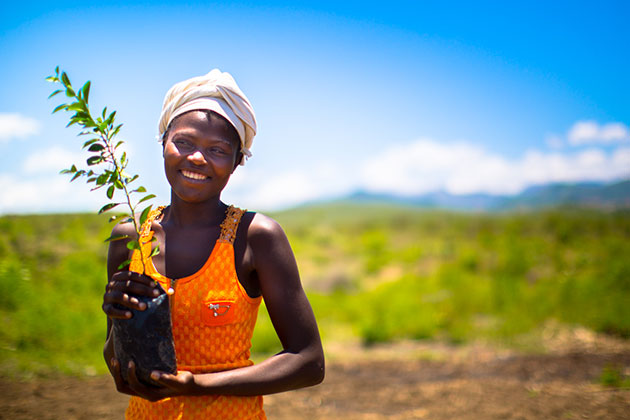
Member of Smallholder Farmer Alliance in Haiti with tree she is about to plant. Credit: A.F. Cortes/SFA
- Years ago, standing in a small farmer’s field in Haiti, I began to suspect that we had agriculture backward. The development world saw a man in need of rescue. I saw a farmer who might help rescue the rest of us.
That distinction matters. Over the next 25 years, humanity will need to grow much more food on a planet with degraded soils, shrinking biodiversity and a destabilizing climate. The usual instinct is to seek a technical fix. I want to suggest another source of help: a moral idea rooted in religion.
I am not a theologian. I am a development worker. In 2010, Haitian agronomist Timote Georges and I co-founded the Smallholder Farmers Alliance. We now work with about 10,000 farmers throughout Haiti who grow more food while rebuilding degraded land. Our “tree currency” rewards them for planting and caring for trees with credits they can exchange for seeds, tools and training.
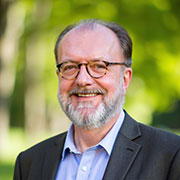
Hugh Locke
Roughly 475 million smallholder farms, each under five acres, already produce about 30% of the world’s food despite limited access to finance, markets or technical support. In my new book, Whole Earth Farming, I argue that if even half of these families received support to adopt regenerative methods, they could produce the additional food humanity will need through 2050 on 12% of the world’s arable land, with a climate benefit comparable to offsetting the aviation industry’s annual emissions.
The Green Revolution averted famine, but its gains often came with degraded soils, diminished biodiversity and polluted water. Regenerative farming aims not merely to limit damage but to restore soil, rebuild biodiversity, improve farmers’ wellbeing and deliver a net climate benefit.
That is the language investors expect. Yet a case study more than a century old anticipated this approach, and its foundation was not market logic but morality.
From 1901 to 1921, ‘Abdu’l-Baha, one of the central figures of the Baha’i Faith, directed a farming settlement called ‘Adasiyyih in the Jordan Valley. Long before the term “regenerative agriculture” existed, the community used crop rotation, agroforestry, water conservation and integrated livestock management to make the land productive without exhausting it. Just as important was the framework behind those techniques: the belief that the earth is one country and humanity one interdependent family, expressed through consultation, equality and a rejection of extraction for its own sake. Farming at ‘Adasiyyih was not simply commodity production. It was a way to build community.
Regenerative agriculture does not require religious belief. Many successful regenerative farmers are secular, and the science stands on its own. But ‘Adasiyyih addressed, on a limited scale, a coordination problem that still hinders the movement: how can independent farmers, financiers, governments and companies be persuaded to treat soil health, water and biodiversity as a shared obligation?
‘Adasiyyih began with a moral premise rather than a technical formula. That premise is worth borrowing, whether one calls it stewardship or enlightened self-interest. Farmers, buyers and governments must act as though what happens to one plot of land is everyone’s concern, because increasingly it is. For generations we have asked how much the earth can give us. We should also ask what we owe in return.
Regenerative agriculture is at a fragile moment. By my estimate, some 15 million farms and ranches worldwide now use regenerative practices, and some 25 million acres, mostly in the United States, are certified under third-party standards, though almost none of that land is farmed by smallholders. The movement is growing faster than the systems meant to support it. Farmers can face lower yields and higher costs during the transition, there is no consensus on how to measure results, and financing, training and market rewards lag well behind farmers’ interest. A shared obligation is what can turn these isolated successes into lasting change.
This is not a case for religious agricultural policy, which would be unworkable in a pluralistic world. Smallholders are not waiting for a new theology. They need capital, training and markets. But the case for providing that support may rest more persuasively on the old idea of shared stewardship than on another spreadsheet of carbon calculations.
The next great agricultural transformation may begin not on the world’s largest farms but on hundreds of millions of its smallest. Given the means, smallholders may help determine whether the next 25 years of food production heal the planet or finish degrading it.
Hugh Locke is president of the Impact Farming Foundation and author of Whole Earth Farming: Smallholders and the Great Regenerative Transformation (George Ronald Publisher, 2026).
IPS UN Bureau



 Print
|
Print
|




