
Monday, September 28, 2026



News and Views from the Global South
RIGHTS-IRAN: Gov't "Leading by Fear", Activists Say
Omid Memarian*
- Iran's recent use of extreme punishments such as amputations and public executions has deepened concerns about the situation of human rights amid the strict enforcement of Islamic law, which has worsened since President Mahmoud Ahmadinejad's hardliner government came to power in June 2005.
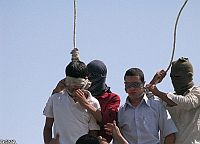
Two young men are hanged in the city of Mashhad, Iran in 2007. Credit: ISNA
Just last week in southern Iran, the right hands and left feet of five convicted robbers were amputated. The government argues that such severe sentences act as a deterrent, although no correlation between these unpopular punishments and a decrease in crime has been proven.
Iranian human rights activists have vigourously protested the new wave of state-sanctioned violence. However, the government has largely ignored domestic and international objections.
On Nov. 20, 2007, the Third Committee of the U.N. General Assembly passed a resolution condemning Iran's human rights record and calling upon the Iranian government to eliminate all such cruel practices. The resolution was adopted by 72 votes in favour, with 50 against and 55 abstentions.
In its resolution, the General Assembly expressed "its very serious concern" at a range of egregious human rights violations, including torture, flogging, amputations, public executions, stoning, execution of minors, and violent repression of women.
"These rulings show a digression of the situation with human rights in Iran," Shirin Ebadi, winner of the 2003 Nobel Peace Prize, told IPS in a telephone interview from Tehran.
"I would like to remind all that such laws and options to exercise such sentences were approved after the Islamic Revolution," she said, adding that, "We have repeatedly asked for a review of Iranian Penal Code. Unfortunately there has been no reaction from the authorities to change those laws."
Judicial officials have rarely publicised these sentences because of their unpopular nature. But the more the government insists on expanding the use of Islamic law in Iranian social life, the more radical elements within the judiciary feel free to carry out such punishments. The government argues that human rights is a domestic issue and has nothing to do with other countries and organisations.
But activists disagree. "Human rights is an international matter which transcends borders," said Ebadi. "Just as the Iranian government feels justified to express opinions about human rights violations in Palestine and in other countries, other people of the world are also justified in expressing their opinions about human rights violations in Iran."
Many observers in Tehran believe that the expanded use of unusually harsh punishments should be seen in the larger perspective of Iran's political structure, which is facing social, political and economic crises.
"The current government fully believes in the Islamic teaching of 'leading by fear.' They are also afraid of a velvet revolution," said Issa Saharkhiz, a prominent journalist and political analyst, in a phone interview from Tehran. "The government thinks that only through establishment of a state of fear, political oppression, and limitations on publications and cultural activities can it overcome the increasing dissatisfaction, ensuring and extending its own existence."
"This thinking explains the heavy and violent sentences, such as an increase in imprisonment verdicts, heavy bails, prison terms for political, journalist, and activist prisoners, sometimes adding floggings to their sentences, and in the case of ordinary convicts, stoning sentences and most recently, 'death by hauling from height'," added Saharkhiz. "We can conclude that fearing eruption of unrest and uncontrollable protests due to increasing dissatisfaction, the political decision has been to intimidate."
"Ahmadinejad's cabinet's structure suggested a change in policy and strategy from the beginning, but no one could predict the extent," he said. "This is why many political activists raised concerns about the emergence of an intelligence-military environment during the presidential elections, encouraging everyone to vote. This call to vote was not received well by people due to widespread disappointment among civil society activists, urban voters, middle class voters, and those supporting protest elections boycott."
Asieh Amini, a women's rights activist and a member of the Stop Stoning Forever Campaign in Tehran, told IPS, "I believe institutionalised violence promotes violence amongst the citizens, especially among those who are stronger against those who are weaker."
"When I look at events of the past year, I see an overall increase in violence in the society, not limited to ordinary citizens," said Amini. "Part of these violent events takes place in the hands of government, such as an increase in the number of executions of individuals below the age of 18."
"The same is true of confrontations taking place on the streets, physical violence against civil society activists, students, workers, teachers, and especially women activists who are expressing their demands within legal frameworks, facing extremely violent public treatment," she said.
Iran hanged more than 298 people in 2007, a large increase compared to the 177 hangings in 2006.
In a report released on Jan. 7, Human Rights Watch condemned the Iranian government for relying on broadly worded "security laws" to suppress virtually any public expression of dissent.
The 51-page report, "'You Can Detain Anyone for Anything': Iran's Broadening Clampdown on Independent Activism," documents the expansion in scope and number of the individuals and activities persecuted by the Iranian government over the last two years.
*Omid Memarian is a peace fellow at the Graduate School of Journalism at the University of California, Berkeley. He has won several awards, including Human Rights Watch's highest honour in 2005, the Human Rights Defender Award.
 Print
|
Print
|




