
Sunday, September 27, 2026



News and Views from the Global South
EGYPT-REFUGEES: Stepping Stones Across the Desert
Aya Batrawy
- "When I left Darfur, I left the hell of death and entered the hell of life. That is the only difference," said Galoud*, one of the many Darfuri refugees who have escaped to Egypt.
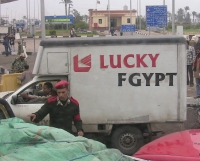
Unlucky in Egypt: finding integration difficult, thousands of refugees risk their lives to move on. Credit: Martina Fuchs/IRIN
Galoud is one of an estimated 150,000 refugees in Egypt – the figure includes refugees with official status, asylum seekers and many thousands more whose application for refugee status has been rejected but remain in the country.
Of the recognized refugees present in Egypt, 75 percent of these are Sudanese, followed by 16 percent Somalis and smaller numbers of Ethiopians, Eritreans and Sierra Leoneans, according to the United Nations High Commissioner for Refugees (UNHCR).
Galoud's only source of income came from going through trash in the hope of finding scrap metal to sell. But after three years living in the poor neighbourhood of Tora Bora just outside of Cairo, Galoud said he lost any hope of having a good life here. He made about three dollars a day, yet monthly rent for his shared apartment cost around 75 dollars a month.
"I am so exhausted from all the work. All I want is job security," said Galoud. "I cannot stay and I cannot leave. I would definitely escape to Israel if I had the money."
Unable to envision a future for himself in Egypt, Galoud made plans to be smuggled into Israel, and asked an expatriate family member to send him the $400 required for the operation.

Not a destination for migrants
The hope that life in Israel will be more promising leads thousands of refugees to try to cross illegally, even at the risk of being shot and killed at the border. With over 300 people trying to enter Israel illegally each week, Israel has put pressure on Egypt to stem the flow of illegal migrants. According to London-based Amnesty International, 13 people trying to breach the border have been killed this year.
A 2006 American University in Cairo (AUC) study entitled 'Who asked them anyway? Rights, policies and well-being of refugees in Egypt', and funded by the UK government's Department for International Development, found that a growing refugee population coupled with limited possibilities for securing adequate living conditions in Egypt made resettlement to a third country a desired solution for refugees.
Ibrahim El Nour, a Sudanese political science professor at AUC, said many of these refugees had lost everything but still wanted to pursue a better life. "Egypt is not a migration destination. Egypt is a transit destination for many of these African migrants. They come here because they have the hope of going somewhere in the global north," he said.
In a country of scarce resources where unemployment is officially at 20 percent, where 80 percent of the Egyptian work force is employed in the informal sector, and where 15 percent of Egyptian children do not go to school, it is difficult to argue successfully for the rights of refugees to jobs and schooling.
The AUC study found that in many cases solutions need to be aimed at providing for the population generally, rather than for refugees alone, and ways need to be found of integrating refugees into services provided to nationals.
Although Egypt's government considers Sudanese as "brothers" and has been generous in opening up its borders to refugees, especially those from neighboring countries, it is often difficult for refugees to integrate into Egyptian society by finding jobs, gaining access to healthcare or to continue with their education.
For example, in 2005 all foreign residents were granted access to public health services, but many tend to wait for assistance from NGO's working with refugees as they provide better treatment than the public sector can offer.
Some have no choice but to stay
While many refugees use Egypt as a stepping stone to other parts of the world, a significant number remain behind, particularly those who are not granted refugee status. Without legal status and protection in Egypt, they are usually unable to return to their countries of origin and end up living on the margins of society, struggling to secure their livelihoods.
This became most evident when in September 2005 some 1,200 protesters and refugees organized a sit-in at a central park in Cairo, near the UNHCR office. The demonstration ended three months later with an intervention by Egyptian security forces which left 28 dead. The refugees were then moved to a site outside of Cairo in a camp away from the public eye.
Another problem in securing the rights of asylum seekers is that responsibility is diffused among parties ranging from the host government, the governments of the asylum seekers and international organizations such as the UNHCR.
According to Galoud, the UNHCR office in Cairo offered him nothing more than a yellow card that meant little in terms of securing basic services. For many, it takes four to five years to obtain a blue card, which labels them with official refugee status. Thus many find fleeing to a third country such as Israel, where economic conditions are better, worth the risk.
UNHCR spokeswoman Abeer Etefa said the widespread poverty in Egypt exacerbated the difficulties facing refugees. "The economic situation in Cairo is certainly destitute for the local population as well as for refugees, and some people think they may have better opportunities elsewhere," she said.
For Galoud, getting arrested or shot for trying to illegally cross the Egyptian-Israeli border was something he would leave in God's hands, he said. As he prepared to flee Egypt, he said, "If anything happens, it is what God wanted. It would be my destiny."
*A week after speaking with IPS, Galoud (not his real name) called from the border to say he and 12 other African migrants with him had arrived safely in Israel for the next journey, that of a new life.
 Print
|
Print
|




