
Friday, October 23, 2026



News and Views from the Global South
U.N. Member States Falter in Protecting Staffers, Peacekeepers
Thalif Deen
- The United Nations has remained virtually helpless as hundreds of its staffers, mostly peacekeepers, are killed, kidnapped or victimised by unbridled violence worldwide.
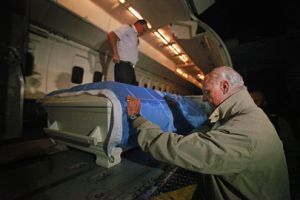
U.N. Mission receives caskets of colleagues killed in Mazar-i-Sharif attack. Credit: UN Photo/Eric Kanalstein
“They were killed when they were running out of the bunker,” said Staffan de Mistura, the U.N. special envoy in Afghanistan.
“I am profoundly sad and I am also shocked by what I saw, but we continue our work,” he told reporters in Kabul. “We are not going to be deterred.”
The attack was triggered by the burning of the Quran, Islam’s holiest book, by U.S. pastor Terry Jones last week – even though the United Nations had strongly condemned the act.
Last year, one staff member, 10 peacekeepers and three civilian subcontractors lost their lives as a result of violence.
But the biggest single loss of lives in 2010 was attributed to the January earthquake in Haiti, which killed 59 civilian personnel and 43 members of the police and military contingents of the U.N. Stabilisation Mission in the Caribbean nation.
The killings in Afghanistan last week have once again underlined the lack of protection and security for U.N. personnel in conflict zones.
But according to Secretary-General Ban Ki-moon, the vast majority of U.N. member states – 169 out of 192 – are yet to ratify or accede to a protocol extending legal protection for U.N. staff worldwide.
The Optional Protocol to the 1994 Convention on the Safety of U.N. and Associated Personnel entered into force last year but it does not have legal status in member countries until ratified by their respective parliaments or governments.
Still, there are several countries, including Britain, Ireland, Australia and Singapore, which have adopted or strengthened domestic legislation to protect U.N. staffers.
Last week, Stephen Kisambira, president of the U.N. Staff Union, singled out Singapore for special praise for having recently passed the U.N. Personnel Act, a wide-ranging piece of domestic legislation which criminalises attacks against U.N. staff, premises and vehicles.
Singapore’s Senior Minister of State for Foreign Affairs Zainul Abidin Rasheed told Parliament last month that although Singapore does not host any U.N. operations, it is the country’s duty “as a responsible member of the international community to put in place measures to protect those who carry out the important work undertaken by the United Nations in its various missions around the world”.
The legislation also ensures that perpetrators of crimes against the United Nations and its associated personnel will not find a safe haven in Singapore, he said.
Ambassador Vanu Gopala Menon of Singapore told IPS the U.N. Personnel Act essentially gives domestic effect to the 1994 Convention on the Safety of United Nations and Associated Personnel, which Singapore is party to, and the 2005 Optional Protocol to the Convention, which Singapore is planning soon to accede to.
He said it seeks to ensure that the Singapore government is able to punish any individual, including Singaporeans, who commits specified crimes against U.N. workers (or their official premises, place of residence, or vehicle) outside Singapore, which if committed in Singapore, would constitute offences in the First and Second Schedules of the Singapore Penal Code.
These include murder, grievous hurt, kidnapping, causing an explosion, causing mischief etc.
The Act additionally empowers the Singaporean government to punish threats, attempts, abetment, conspiracy or the withholding of information on such attacks on U.N. workers, he added.
“The Act also obligates Singapore to either extradite or prosecute any alleged offender found in our territory, as well as to provide mutual legal assistance to States Parties with regard to the offences,” said Menon.
According to the Staff Union, at least 28 U.N. civilian staff were detained or arrested worldwide last year, primarily in job-related incidents, while another 12 U.N. police and civilians were abducted, including one civilian staff member who was held captive in Darfur for nearly three months.
Kisambira said the Darfur region of the Sudan, the Democratic Republic of the Congo and Afghanistan continue to be among “the most dangerous areas for United Nations personnel”.
“We appeal to the governments concerned to do the utmost to guarantee the protection of United Nations staff and other related personnel. The string of kidnappings in Darfur is particularly worrisome,” he added.
In 2009, 31 United Nations civilian personnel lost their lives as a result of acts of violence, according to a recent report of the Secretary-General.
The deaths were related to terrorism (16), crime (six) and armed conflict (nine).
In the same year, 110 were injured as a result of acts of violence, 22 were abducted and 163 arrested and detained.
 Print
|
Print
|




