Monday, August 31, 2026



News and Views from the Global South
COLOMBIA: An Island of Peace and Development in the Midst of War
Patricia Grogg
- In the middle of war-torn Colombia’s vast Magdalena Medio region, small farmers have begun to grow organic cocoa beans and raise water buffalo and chickens instead of coca, as part of a “development and peace” initiative that enjoys international support.
“Colombia must be built within the midst of the conflict, because it could take 10 years to reach a solution,” Jesuit priest Francisco de Roux told IPS in Cuba.
De Roux is the director of the six-year-old Programme for Development and Peace in the central Magdalena Medio region, the winner of Colombia’s National Peace Prize in 2001, granted by local media outlets.
The programme has the support of the World Bank, the United Nations and the European Union. “When you do something that is worth the effort, support is always available,” said the priest.
De Roux was one of the participants at the Peace Summit, which drew representatives of the Colombian government of Andrés Pastrana, the National Liberation Army (ELN – the second largest rebel group), Colombian civil society and the international community to Havana from Jan 29-31.
“This is a grassroots programme. We are a group of Colombians who are convinced that war is not the way out,” said the priest, who conversed at the Peace Summit with authorities and guerrilla leaders from Colombia to discuss concrete solutions for the area around the middle stretch of the Magdalena River.
“We were talking here with the ELN to try to create a space in Colombia where civilians do not suffer economic or social hostilities, nor aggression from the state or the guerrillas,” he said.
Through the 30,000-square-kilometer Magdalena Medio region runs 300 kms of the Magdalena River, Colombia’s largest.
The region includes 29 municipalities in the departments of Bolivar, Cesar, Antioquia and Santander, and is rich in oil, gold, farm production, stockbreeding, logging and fishing, but poor in quality of life for local inhabitants.
A majority of the region’s 810,000 people lack the means of “a decent and dignified” lifestyle, and live in constant fear, caught in the crossfire of the leftist rebel groups, the army and right-wing paramilitary militias.
According to de Roux, the war costs the region an estimated 15 million dollars a month, and “it is the peasant farmers who suffer the worst pressure from armed groups that want to displace them, and force them off their land and out of the region.”
He pointed out that the Magdalena Medio region produces around 2.8 billion dollars in added-value a year, but that only 400 million of that remains in the region.
Although in terms of per capita income, the region is as rich as a medium-sized European country, 70 percent of the local population lives in poverty, he underlined.
De Roux said the 13,500-strong paramilitary United Self-Defence Forces of Colombia (AUC) – which are trying to equal the 15,000- member Revolutionary Armed Forces of Colombia (FARC) in size – had a growing interest in the Magdalena Medio region.
There are also roughly 20,000 hectares of coca planted in the Magdalena Medio region, which help “finance the war,” because small farmers are forced “to pay ‘taxes’ to the various groups involved in the conflict,” said de Roux.
He described the Programme for Development and Peace in the Magdalena Medio as an effort to help people live with dignity, to build peaceful coexistence based on trust and confidence among the local population, and to transform and strengthen local institutions.
The initiative is also working on building “a just, sustainable economy, open to the rest of the country and the rest of the world,” mindful of the need to preserve the environment, and controlled by local inhabitants themselves, he added.
“It is an economic model in which we want the business community not to be unfair, and in which the market will not dominate the economy, but will be at the service of people….We refer to it as the ‘productive occupation of the territory’ by the organised local population.”
After a study was carried out to assess the situation and needs of the area and its inhabitants, the programme implemented around 90 economic, educational, communications and so-called “coexistence and peace” projects from 1998 to 2001.
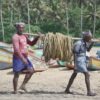
Despite the risks and the uncertainty stemming from the war, farmers are planting rice, cocoa beans, yucca, coffee, beans, and mulberries and other fruit to cover their daily dietary needs, while setting up chicken farms and fish marketing companies.
“Each project that we chose is a negotiating table in the conflict, and we try to implement the projects in such a way that the groups clashing over opposing interests have no choice but to sit down and work together. This is what we call ‘development in the heat of the moment’,” said the priest.
Under the wing of the programme, hundreds of peasant families are now producing organic cocoa beans and African palm oil, or raising water buffalo, “an ideal animal for the poor in tropical climates.”
By promoting organic agriculture and making sure local farmers have markets for their crops, the programme has helped recover around 48,000 small farms, which de Roux described as “the greatest treasure” in the region.
“The idea is to organise peasant farmers in cooperatives, and to revitalise farming towns as starting-points for promoting the development of the countryside,” he added.
 Print
|
Print
|