Languages
Sunday, October 11, 2026



News and Views from the Global South

Slaves
For over 400 years, more than 15 million men, women and children were the victims of the transatlantic slave trade, one of the darkest chapters in human history. Slavery is, nevertheless, far from being just a chapter of the past—it still there, with estimated 21 million victims of forced labour and extreme exploitation around the world--nearly the equivalent to of the combined population of Scandinavian countries.
Don’t Understand Clouds? But You Should!
Obviously, there are so many issues and phenomena that have been brought up by growing impact of climate change that one would likely not think about. Some of them, however, are essential and would be good to learn about. For instance, the fact that clouds play a "pivotal role" in weather forecasts and warnings.
No Water, No Life – Don’t Waste It!
During the final exams of Spanish official high school of journalists, a student was asked by the panel of professors-examiners: If scientists discover that there is water in Planet Mars, how would you announce this news, what would be your title? The student did not hesitate a second: “There is life in Mars!” The student was graduated with the highest score.
Oh Happy Day!
Once a year, there is a day when the seven billion inhabitants of Planet Earth should feel happy or at least are encouraged to do so--the World Happiness Day, which is marked every year on March 20. So far, so good.
UN FARMS to Create One Million Days of Work for Mideast Migrants
The problem is rather complex and often not recognised: in one of the major regions of both origin and destination for migrants and refugees -- the Near East and North of Africa, 10 per cent of rural communities is made up of forcibly displaced persons, while more than 25 per cent of the young rural people plan to emigrate.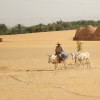
New Evidence Confirms Risk That Mideast May Become Uninhabitable
New evidence is deepening scientific fears, advanced few years ago, that the Middle East and North Africa risk becoming uninhabitable in a few decades, as accessible fresh water has fallen by two-thirds over the past 40 years.
The Indigenous ‘People of Wildlife’ Know How to Protect Nature
In the northern part of Mount Kenya, there is an indigenous community -- the Il Lakipiak Maasai ("People of Wildlife") -- which owns and operates the only community-owned rhino sanctuary in the country.
These Women Cannot Celebrate Their Day
This is a story that one would wish to never have to write—the story of hundreds of millions of life-givers whose production and productivity have systematically been ‘quantified’ in much detailed statistics, but whose abnegation, human suffering and denial of rights are subject to just words.
Antarctic Ice Lowest Ever – Asia at High Risk – Africa Drying Up
For those who still deny the tangible impact of climate change, please note that the extended spell of high global temperatures is continuing; the Arctic is witnessing exceptional warmth with record low ice volumes--the lowest on record; global heat is putting Asia on higher risk than ever, and Africa is drying up.
UN Declares War on Ocean Plastic
The available data is enough for the United Nations to literally declare war on oceans plastic: more than 8 million tonnes of leaks into their waters each year – equal to dumping a garbage truck of plastic every minute, wreaking havoc on marine wildlife, fisheries and tourism, and costing at least 8 billion dollars in damage to marine ecosystems.
Of Arabs and Muslims and the Big Ban
Now that President Donald Trump’s decision to ban citizens of seven Muslim majority countries from entering the United States continues to drift into legal labyrinths about its legality–or not, it may be useful to clarify some myths that often lead to an even greater confusion regarding the over-written, under-reported issue of who are Arabs and who Muslims.
Every Year 700 Million People Fall Ill from Contaminated Food
It may sound like an endless tale of modern seven plagues: mad cows, avian flu, led-poisoned fish, swine fever, desert locusts being the most dangerous of migratory pests, let alone new, aggressive rust threatening entire wheat crops in three continents, just to mention a few. Now it is about contaminated food that every year causes illness to 1 in 10 people around the world – or around 700 million - killing 420,000 people as a result.
A Dire Vacuum in a World in Crisis
“The world is in a crisis, not least because governing élites have estranged themselves from the needs and aspirations of ordinary people. This sense of being left behind has lead the latter to rebel against their country’s stratified governance,” warns a Geneva-based human rights and dialogue centre.
Indigenous Peoples Lands Guard 80 Per Cent of World’s Biodiversity
They are more than 370 million self-identified peoples in some 70 countries around the world. In Latin America alone there are over 400 groups, each with a distinct language and culture, though the biggest concentration is in Asia and the Pacific– with an estimated 70 per cent. And their traditional lands guard over 80 per cent of the planet’s biodiversity.
It’s Women’s Turn in Rural Development
Josefina Stubbs, from the Dominican Republic, may become the first woman to preside over the International Fund for Agricultural Development (IFAD), which is dedicated to eradicating rural poverty.
World’s 40,000 MP’s Must Enjoy Their Rights – But Are They?
“Members of Parliament must be free to enjoy their human rights. If not, how can they defend and promote the rights of those who elected them? Yet, around the world vocal parliamentarians find themselves under threat. The 40,000-strong community of parliamentarians includes many men and women who have risked careers and even their lives to express their beliefs.”
Want to Prevent Stroke, Diabetes, Cancer? Get Moving… Now!
Tired, lazy, bored, laying down long hours watching TV or seated checking your email? Wrong. And dangerous: not enough exercise contributes to cancer, diabetes, depression and other non-communicable diseases.
Trump to Pull Out of the UN, Expel It from the US?
So far, Donald Trump’s first decisions as president of the United States have left no doubt that he intends to implement his electoral threats, while most likely not fulfilling the promises he made as a candidate.
Inequality (III): Less Employment… and More ‘Junk’ Jobs
While just eight men are enjoying their huge wealth, equivalent to that of half the world, new forecasts project darker shadows by predicting rising unemployment rates, more precarious jobs and worsening social inequality. To start with, there will be more than 1.4 billion people employed in vulnerable working conditions.
Inequality (II): “It Will Take 170 Years for Women to Be Paid as Men Are”
While just eight individuals, all of them men, own the same wealth as 3.6 billion people -- half of world’s total population -- it will take 170 years for women to be paid the same as men, warns a new major report on inequality.
Inequality (I): Half of World’s Wealth, in the Pockets of Just Eight Men
Just eight men own the same wealth as the 3.6 billion people who make up the poorest half of humanity, according to a major new report by an international confederation of 19 organisations working in more than 90 countries.« Previous Page — Next Page »





The Week with IPS

NEXT STOP - SDGs
Tracking global progress towards a sustainable world
Tracking global progress towards a sustainable world
