Languages
Wednesday, November 11, 2026



News and Views from the Global South
RECONSTRUCTION AFTER TSUNAMI MUST BEGIN QUICKLY
Reconstruction should begin quickly, the author writes in this analysis. This stage is not just a matter of financial resources and physical infrastructure but also human beliefs and emotional pressures. It is rebuilding the individual lives of real people. As we move from relief to rebuilding, it is critical that we work to break the cycle of poverty and create a better, more hopeful future for the peoples of the region and not recreate the circumstances that made them vulnerable to the disaster. There is an increasing concern that the overall level of assistance to help all these poor countries including the tsunami-stricken nations won\'t actually increase but will merely come from shifting existing funds. This is not the answer. We simply cannot divert resources from other essential development projects to one emergency after another.Ecobreves – GUATEMALA: Plans for Planting 75 Million Trees
Some 75 million trees are to be planted in Guatemala before 2008 as part of the ''Guate Verde'' plan, Environment and Natural Resources Minister Mario Dary told Tierramérica.
Agrarian Reform Reaches the Forest Edge
The land intervention policy of Venezuelan President Hugo Chávez could hurt nature preserves that are that are rich in biological resources, warn environmentalists.Ecobreves – HONDURAS: Reporter Faces Trial for Defending Environment
- Journalist Frank Mejía tried to protect the trees in the Honduran capital's main park, and ended up in the courts, accused of ''disobedience''.Human Development at the Service of Wildlife
Improving the quality of life in the communities of the developing South is indispensable for protecting species diversity, said eminent biologist Edward O. Wilson in a conversation with Tierramérica.
How Much Is the Biodiversity of the Andes Worth?
The issue of access to genetic resources will continue to complicate free trade negotiations with the United States, warn Peruvian experts on the eve of the seventh round of talks.Ecobreves – BRAZIL: Bio-Construction at the World Social Forum
The 5th World Social Forum put into practice the technique of bio-construction -- ''less expensive and more ecologically correct'' -- in building the venues for five days of conferences and debate by 120,000 civil society activists gathered in the southern Brazilian city of Porto Alegre.Ecobreves – CHILE: Ecologists Applaud Energy Efficiency Plan
The non-governmental Sustainable Chile Program congratulated Economy Minister Jorge Rodríguez for presenting a National Energy Efficiency Project, which includes standards for both the public and private sectors for rational use and saving energy.Ecobreves – CARIBBEAN: Community Education to Save Birds
Residents of coastal ecosystems in two Cuban provinces, like their counterparts in Haiti, Dominican Republic and Jamaica, are learning in conference and workshops about protecting the 'yaguasa criolla' (Dendrocygna arobrea), a Caribbean bird that faces extinction.Ecobreves – VENEZUELA: Indians Pro-Water, Anti-Coal
Indigenous and peasant communities of the northwestern Venezuelan oil-producing state of Zulia, bordering Colombia, founded the Water for Life Committee as a counterweight to a government proposal to mine coal in the watersheds of the area's two main rivers, the Socuy and Cachirí, and the Tulé reservoir.20 YEARS AFTER BHOPAL: MULTINATIONALS AND HUMAN RIGHTS-FREE ZONES
To mark the twentieth anniversary of the Bhopal disaster, Amnesty International published a report that documented the continuing plight of people who continue to suffer chronic and debilitating illnesses for which treatment is largely ineffective, writes Irene Khan, Secretary General of Amnesty International. In this article, Khan writes that the Bhopal disaster is a prime case of the failure of international and national law to hold corporations accountable for human rights abuses. Notwithstanding the far-reaching impact of companies on human rights, most companies oppose any move towards binding regulations. Instead, following several high-profile cases and public pressure, some business sectors have drawn up voluntary codes of conduct, but these have failed to reduce the negative consequences of corporate behaviour on human rights. Under the current state of law, national systems are effectively unwilling or unable to hold companies operating in their countries accountable. Governments are afraid that, in a globalised economy, if they exercise strict control over businesses, foreign investors will go elsewhere. Companies must be brought within the framework of international human rights law. Yet global rules governing trade and investment are being drawn up without regard to their human rights impact. Amnesty International believes that the United Nations Norms on the Responsibilities of Transnational Corporations and Other Business Enterprises with Regard to Human Rights (UN Norms) are the logical next step in a strategy to develop corporate legal accountability This column is part of the series on Globalisation and Human Rights, a joint project of Dignity International and IPS Columnist Service (http://www.dignityinternational.org).
Voyage to the Fragile Beauty of Antarctica
The international renowned photographer Sebastiao Salgado shares with Tierramérica his first days aboard the Tara, which set sail this month on an Antarctic expedition.
Death Traps Below the Big Cities
The ever-growing number of underground transportation networks, shopping centers and parking ramps in the world's mega-cities are vulnerable to natural disasters, warn experts. Not even the wealthiest cities of the United States and Europe have given this serious issue much thought.
Tsunami Forces Issue of Early Warning System
United Nations experts have announced an early warning system for tsunamis in the Indian Ocean to be launched in Julio. But there is still much to do. ''We are worried the importance of rehabilitating the local communities is being sidelined in this process,'' say NGOs.Ecobreves – ARGENTINA: Demands for More Forest Protection
Social and environmental groups from the northern Argentine province of Santiago del Estero, which lost 2.5 million hectares of forest in the 20th century, denounce the government's bill on forest conservation and use.Ecobreves – COLOMBIA: A Guide to Fruits and Seeds
The EcoAndina Foundation has launched the ''Guide to Fruit and Seeds of the Middle Otún River'', a record of the great diversity of the flora of the Colombian AndesEcobreves – PERU: Investigation Into Gas Leak
Elena Foronda, head of the Peruvian Society for Environmental Law, and representatives of the Machiguenga indigenous council are demanding that the authorities conduct a public environmental inspection of the gas leak that occurred in the pipeline that runs from the south-central zone of Camisea to the central Peruvian coast on the Pacific.Ecobreves – GUATEMALA: Protests Against Mine Continue
Opposition to open-pit mining in Guatemala will continue, rural leader Daniel Pascual told Tierramérica, despite the violence that erupted on Jan. 11, claiming the life of one protester.Ecobreves – CUBA: Bays Increasingly Contaminated
Contamination from organic waste in Cuba's bays increased 2.3 percent during 2004, in contrast to a decline of 3.6 percent of the waste burden received by the island's eight main basins.Ecobreves – VENEZUELA: Shrimp Granted a Visa for U.S.A.
The United States has lifted a ban that since the late 1990s prohibited entry of shrimp from Venezuela, saying the South American country now meets the international requirements for protecting sea turtles that accidentally get caught in the fishing nets.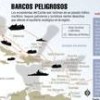
Ships Leave Tons of Waste in Caribbean Waters
Each of the thousands of cruise ships that sail through the Caribbean Sea generate up to 1,200 cubic meters of liquid waste daily, including wastewater from kitchens and showers. The region lacks effective system for handling organic and toxic waste generated by the shipping industry.« Previous Page — Next Page »





The Week with IPS

NEXT STOP - SDGs
Tracking global progress towards a sustainable world
Tracking global progress towards a sustainable world
