Languages
Monday, November 9, 2026



News and Views from the Global South
Education
EDUCATION: Fighting Computer-Assisted Plagiarism in Latin America
Student plagiarism is becoming more and more common in Latin America, with the infinite possibilities offered by the Internet to those who follow the law of least effort.RIGHTS-MESOAMERICA: Indigenous Peoples Particularly Vulnerable to Disasters
In the areas of Guatemala recently devastated by Hurricane Stan, which claimed the lives of more than 655 people, indigenous children last year played Kumatzin, a board game in the Maya language and with Mayan illustrations, used as an educational tool on how to prepare for and survive natural disasters.EDUCATION-SOUTH AFRICA: The Past Isn’t History Yet
Clever student, top grades, demanding university course...For anyone in this position, using a cheque book or managing medical insurance should be a cinch, right?POPULATION: Youth Unemployment Hits All-Time High
With nearly half the world's population of six billion people under 25 years old, the U.N. warned this week that poverty and lack of education is creating a new generation of marginalised youth.EDUCATION-NIGERIA: Making School a Tasty Experience
A government programme to provide primary school children with free lunches has been launched in Nigeria, to encourage parents to educate their children - and to ensure that pupils learn effectively.MALAYSIA: Campus Poll Boycott Sets Liberals Back Further
Just when student activists felt that procedures for campus elections in Malaysia could not get more restrictive, tighter regulations were introduced during polls last week, sparking boycotts that have not helped matters.DEVELOPMENT: And the Alternative Nobel Prize Goes To…
Social activists from Mexico, Malaysia, Botswana and Canada have won the 2005 "Right Livelihood Award", an honour meant to celebrate groups and individuals who show outstanding vision and work on behalf of the natural world and its people.POLITICS-US: Faith-Based Hiring Sets up Congressional Rift
Advocates for separation of church and state took a major hit yesterday as the U.S. House of Representatives voted to allow "faith-based" groups to discriminate on the basis of religion in hiring personnel to participate in the Head Start education programme for poor children.DEVELOPMENT: Making Children the Sixth Pillar of Islam
The Islamic world, which encompasses nations as diverse in wealth and culture as Niger and Saudi Arabia, has some of the highest child mortality rates in the world, says a new report that calls on Islamic states to make children the focal point for greater unity and solidarity.EDUCATION-BURKINA FASO: For Greater Literacy, Go Local
In 1990, Burkinabe linguist Benoit Ouoba used his own funds to set up a teaching programme with a difference: it focused on using local languages to develop literacy, rather than the customary French.FINANCE: IMF Policies Thwart Poverty Goals – Report
If U.S. President George W. Bush is serious about his enthusiastic embrace last week at the United Nations of democracy and the Millennium Development Goals (MDGs) to slash global poverty, he will press his treasury secretary and other members of the governing board of the International Monetary Fund (IMF) meeting here this week to stop imposing strict spending limits on poor-country governments.LATIN AMERICA: Gender Equality in Education not Matched in Labour Market
One of the few Millennium Development Goals (MDGs) that the countries of Latin America and the Caribbean have already met or are well on their way to fulfilling refers to gender equality at all levels of education.DEVELOPMENT: Poor Victimised By Extortion, Large and Small
Antonio María Costa, head of the U.N. Office on Drugs and Crime, was a happy man. With Ecuador's ratification of the Convention Against Corruption, his agency has finally come into its own.HEALTH: Disaster’s Psychic Wounds Take Longest to Heal
Public anger over the failures of U.S. federal, state and local authorities to respond quickly to the massive flooding in New Orleans and the U.S. Gulf Coast following Hurricane Katrina can only deepen the survivors' lasting psychological trauma, says a Yale University sociologist.EDUCATION: Empty Classrooms, Bleak Futures
Enrolling children in school is one thing, but ensuring that they stay in class is a challenge that is being failed by nearly half of the world's countries.EDUCATION-SOUTH AFRICA: From Blackboard to SMARTboard
The electronic board in front of the class flickers, and a periodic table is projected onto the screen. "Do you all know what this is?" booms a voice from the loud speaker. "Yes!" the students chorus, as any typical class would.DEVELOPMENT: Digital Divide Becoming a Vast Chasm
While information and communications technologies (ICTs) have an important role in meeting internationally agreed development goals, one in every six people still does not even own a telephone, according to experts meeting here.MILLENNIUM GOALS-CUBA: Educational Focus Shifts from Quantity to Quality
Universal primary education, one of the eight Millennium Development Goals set by the United Nations in 2000, has been a reality in Cuba for so long that it essentially taken for granted, leading both parents and the authorities to shift their attention to the quality of education received by Cuban schoolchildren.RIGHTS: Child Labour a ‘Necessary Evil’
"Child labour is evil," says Aimé Bada, a defender of minors' rights from Senegal. "But it is a necessary evil, because without the income the children earn in the poorest countries of the world, their families would be worse off."POLITICS-US: Visa Policy Costing Economy Billions
As Congress returns to Washington facing what promises to be a rancorous debate on how to protect U.S. borders, a leading immigration think-tank is charging that U.S. visa policies - a key tool in promoting national security - are in danger of compromising U.S. economic competitiveness and foreign policy goals.EDUCATION-BRAZIL: Integration Now Extends to Language
South American integration has finally extended to language training in Brazil, thanks to a new law that makes it mandatory for all secondary schools in this Portuguese-speaking giant to teach Spanish, the language spoken by the vast majority of the continent's nations.« Previous Page — Next Page »





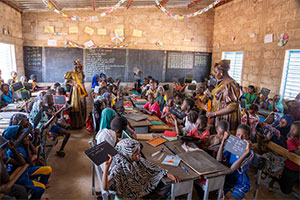 Two teachers work in a classroom in Forces Vives School in Dori, Burkina Faso. Credit: UNICEF/UNI978361
Safe and uninterrupted education is a fundamental right for all children. Education is paramount to global development, as it has been proven that investing in education – especially for girls and children – contributes significantly to economic growth and prosperity. Although more than 1 billion children go to school, many are subjected to conditions that are not conducive to a proper learning environment, including makeshift facilities, a lack of supplies, violence in classrooms, inadequate sanitation, untrained instructors, and widespread school closures. Since 2015, there have been immense gains in education with an increase of 109 million children in school. However, as of 2023, 272 million children are still out of school.
High poverty levels in developing countries also impede children’s access to a proper education. For example, from the early to mid 2000s, Sub-Saharan African nations witnessed a dramatic decline in trained teachers due to inadequate funding in the education sector. Furthermore, major cuts to United States international aid threaten an estimated 23 million additional children's access to education, as USAID‑funded school programmes across Africa and Asia face closure.
Various other factors contribute to the decline of education, notably hunger, which has increased as conflict and climate change interfere with global food production and dissemination. Meanwhile, certain social and cultural practices also impede children’s access to education, with gender inequality, discrimination, child labour, and child marriages preventing millions of children from attending school. Economic conditions such as the inaccessibility of higher education also affect disenfranchised communities across the world. In extreme situations, such as warfare where educational facilities are destroyed in their totality, notably in Gaza and Sudan, entire generations of children might grow up without access to education. Rebuilding educational infrastructure is a long and arduous process, especially when violence persists across generations, and this significantly stunts the development of societal prosperity and stability.
IPS is dedicated to telling the shocking truths about worldwide education through impassioned opinion pieces and comprehensive articles, highlighting global issues that impede worldwide education and the courses of action being taken by organizations such as UNICEF and Education Cannot Wait.

The Week with IPS

NEXT STOP - SDGs
Tracking global progress towards a sustainable world
Tracking global progress towards a sustainable world
