Languages
Sunday, November 8, 2026



News and Views from the Global South
Education
ARGENTINA: ‘Storytelling Grandmothers’ Spark Interest in Reading
In the northeastern Argentine province of Chaco, the poorest part of the country, the Storytelling Grandmothers programme has been so successful that the Ministry of Education has taken up the idea and turned it into national policy.SCIENCE-BRAZIL: An Astronaut Opens a Door to Space
When the first Brazilian astronaut, Marcos Cesar Pontes, leaves for outer space in March, he will be opening the doors to the heavens not only for some renowned scientists in his country, but also for dozens of children at 39 municipal schools.ARGENTINA: Bringing Preschool Education to the Slums
Almost half of all children in Argentina between the ages of three and five are not enrolled in any preschool programme. The Oscarcito Project was conceived to help fill the gap and provide an early boost to the linguistic and cognitive development of children living in extreme poverty.BRAZIL: A Push for More Local Scientists in the Amazon
Foreign experts conduct most of the scientific studies of the vast and biologically rich Amazon region. Brazil is trying to triple the number of local graduate students in related fields by 2010.ARGENTINA: Education to Overcome Tradition of Tax Evasion
A novel plan for tax education in Argentina is using theatre, puppets, educational games, entertainment centres, and competitions to teach youngsters about the importance of paying taxes to finance and preserve what belongs to everybody. They are all useful methods, according to those in charge of the programme.RIGHTS: In Plain Sight, But Still Invisible
Each year, more than 50 million children go unregistered at birth, depriving them of basic services like health care and education, and making them more vulnerable to exploitation later in life.EDUCATION-LATIN AMERICA: School Is Not a Cure-All for Inequality
Education alone will not solve the huge inequalities that afflict Latin America and the Caibbean, authorities and researchers warned at the first meeting convened by UNESCO to evaluate the progress of an educational project agreed by the countries of the region in 2002.DEVELOPMENT-SOUTH AFRICA: Youths at the Service of Youth
They've spent the past year confronting many of South Africa's problems head on, from the high incidence of rape to the fact that many school children battle hunger. They expected nothing less.HEALTH-INDIA: HIV/AIDS Messages Reach Communities Via Classrooms
Across India, from the densely-populated western metropolis of Mumbai to the conservative southern temple city of Madurai, students are taking messages to end the stigma and discrimination around HIV/AIDS from classrooms to communities.RIGHTS: Spare the Rod, Save the Child
Fifteen years after the ratification of the Convention on the Rights of the Child, only 17 governments in the world have passed laws explicitly barring the use of corporal punishment at home.RUSSIA: Foreign Students Under Attack
Students from developing countries are coming under increasing attacks from extremist groups in Russia.RIGHTS: Native Canadians to Get 1.7 Billion for School Abuse
The Canadian government announced Wednesday an "agreement in principle" to pay 1.7 billion dollars to tens of thousands of Canada's indigenous peoples who were physically and sexually abused in government-financed, largely church-run "residential schools".HEALTH-ASIA: Sex Education Can Be Creative, Say Experts
Many Asian countries now have sexual health education in schools, but teachers often focus on health and biology and leave out the very issue they need to address - sexuality, said experts at a regional conference here, this week.WSIS: This Cranked Up Computer Could Close a Gap
This little green computer runs without electricity or batteries, and it costs 100 dollars. And it could do more than all thhe speeches made at the World Summit on the Information Society to help narrow that 'digital divide'.EDUCATION-LATAM: The Internet, Friend or Foe of Learning?
A school in the Chilean capital has decided to prohibit students from writing their assignments on computers. "The kids just download material from the Internet and hand it in without making any changes. They don't even read it. Now they will have to write out their assignments by hand, which means they will have to take the time to read them," teacher Josefina Arriagada told IPS.EDUCATION-SPAIN: Changes in Religious Instruction on Track for Approval
Despite the fierce opposition of Spain's right-wing Popular Party and the Catholic Church, an educational reform bill that would change religious instruction in the country's schools is on the road to approval.EDUCATION-US: Slowly Reversing the 9-11 Slump
The plunge in the number of foreign students enrolling in U.S. colleges and universities after the Sep. 11, 2001 terrorist attacks appears to have leveled off over the past year, according to the latest edition of "Open Doors", the annual survey of the Institute of International Education (IIE) released here Monday.EDUCATION-LATIN AMERICA: To Ma’am With Love
The story of María Angélica Lizama, a 56-year-old teacher who works at two schools in the Chilean capital, is a litany of sacrifice and illness, like those of most of her fellow teachers in Latin America who pay for the educational system's deficiencies with their health.EDUCATION: Venezuela Declares Itself Illiteracy-Free
Venezuela declared itself an "illiteracy-free territory" Friday, announcing that 1.482 million adults have learned to read and write in the past two years, and that less than two percent of the population of 26 million remains illiterate.TECHNOLOGY: Welcome to Ruralkenya.com
A generator rumbles behind the two-roomed building, which looks like one of the maize mills that dot Kenya's rural landscape. But, you're not likely to find a harvest of any sort in here - rather, food for thought.FINANCE: Wal-Marting Philanthropy
Upon the death of Helen Walton, the frail and aging widow of Sam Walton - founder of the Wal-Mart empire - the Walton Family Foundation could receive as much as 20 billion dollars, making it the largest and potentially most powerful foundation in the world.« Previous Page — Next Page »





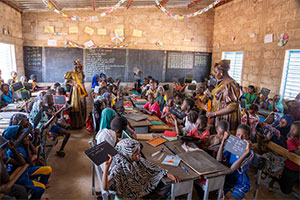 Two teachers work in a classroom in Forces Vives School in Dori, Burkina Faso. Credit: UNICEF/UNI978361
Safe and uninterrupted education is a fundamental right for all children. Education is paramount to global development, as it has been proven that investing in education – especially for girls and children – contributes significantly to economic growth and prosperity. Although more than 1 billion children go to school, many are subjected to conditions that are not conducive to a proper learning environment, including makeshift facilities, a lack of supplies, violence in classrooms, inadequate sanitation, untrained instructors, and widespread school closures. Since 2015, there have been immense gains in education with an increase of 109 million children in school. However, as of 2023, 272 million children are still out of school.
High poverty levels in developing countries also impede children’s access to a proper education. For example, from the early to mid 2000s, Sub-Saharan African nations witnessed a dramatic decline in trained teachers due to inadequate funding in the education sector. Furthermore, major cuts to United States international aid threaten an estimated 23 million additional children's access to education, as USAID‑funded school programmes across Africa and Asia face closure.
Various other factors contribute to the decline of education, notably hunger, which has increased as conflict and climate change interfere with global food production and dissemination. Meanwhile, certain social and cultural practices also impede children’s access to education, with gender inequality, discrimination, child labour, and child marriages preventing millions of children from attending school. Economic conditions such as the inaccessibility of higher education also affect disenfranchised communities across the world. In extreme situations, such as warfare where educational facilities are destroyed in their totality, notably in Gaza and Sudan, entire generations of children might grow up without access to education. Rebuilding educational infrastructure is a long and arduous process, especially when violence persists across generations, and this significantly stunts the development of societal prosperity and stability.
IPS is dedicated to telling the shocking truths about worldwide education through impassioned opinion pieces and comprehensive articles, highlighting global issues that impede worldwide education and the courses of action being taken by organizations such as UNICEF and Education Cannot Wait.

The Week with IPS

NEXT STOP - SDGs
Tracking global progress towards a sustainable world
Tracking global progress towards a sustainable world
