Languages
Friday, October 23, 2026



News and Views from the Global South
Education
Authorities Urged to Take Lawful Measures to Stop Mass Abductions in Nigeria
On the morning of 17 November 2025, darkness cloaked Maga town in the Danko/Wasagu Local Government Area, Kebbi State, until gunfire shattered the silence. It was around 4 am when armed attackers stormed the Government Girls Comprehensive Secondary School, firing into the air to terrify residents before heading to the staff quarters. There, they killed two, including Hassan Yakubu, the school’s Chief Security Officer and then abducted 26 female students.
Explosive Weapons Now Leading Cause of Child Casualties in Global Conflicts
Recently, global conflicts have grown increasingly brutal, with deaths and injuries caused by explosive weapons now surpassing those from previous leading causes such as malnutrition, disease, and a lack of healthcare services. As these conflicts intensify, children continue to bear the brunt of the casualties while impunity for perpetrators persists and funding gaps exacerbate the lack of critical protection services.
Continued Inaction Despite G20 Report on Worsening Inequality
Although inequality among countries still accounts for a far greater share of income inequality worldwide than national-level inequalities, discussions of inequality continue to focus on the latter.
The Rising Threat of Digital Abuse: Women’s Vulnerability in the Age of AI and Online Harassment
As the digital landscape continues to expand and integrate into various aspects of daily life, humanitarian experts have raised concerns about the associated risks, particularly as artificial intelligence (AI), online anonymity, and the absence of effective monitoring frameworks heighten the potential for abuse and harassment. Women and girls are disproportionately affected by digital abuse, facing heightened risks, with nearly half of them worldwide lacking effective legal protections.
Innovative Approaches to Climate, Peace and Security: Opportunities for India–Germany–Australia Collaboration
Emerging research on the nexus between climate, peace and security (CPS) supports the integration of climate adaptation and mitigation methods to advance sustainable peace. While climate change itself may not be the direct cause of conflict, its cascading effects such as resource scarcity, displacement, and economic stress could become focal points of tension. Although these links remain debated, meaningful responses could have delayed stabilizing effects. Locally driven responses become essential in addressing climate change as a security concern, to mitigate future cycles of conflict. A nuanced CPS framing can support smarter climate action while enhancing security at multiple levels. India’s scalable local models, Germany’s technical expertise, and Australia’s Pacific engagement pose an opportunity for the three countries to collaborate on advancing integrated CPS approaches.

The World Social Summit in Doha: Time to Act
Qatar hosted the Second World Summit for Social Development from 4–6 November. According to the United Nations, more than 40 Heads of State and Government, 230 ministers and senior officials, and nearly 14,000 attendees took part. Beyond plenaries and roundtables, more than 250 “solution sessions” identified practical ways to advance universal rights to food, housing, decent work, social protection or social security, education, health, care systems and other public services, international labor standards, and the fight against poverty and inequality.
Hurricane Melissa Devastates The Caribbean As The UN Distributes Lifesaving Aid
In late October, Hurricane Melissa, a powerful Category 5 storm, made landfall in the Caribbean, causing catastrophic damage to civilian infrastructure and a devastating loss of life. Humanitarian agencies have mobilized on the ground to deliver urgent assistance to affected communities facing widespread destruction of homes, mass displacement, fatalities, and severe shortages of essential services, including food, water, medicine, shelter, and electricity.
Education Cannot Wait Interviews Dr. David Edwards, General Secretary of Education International
Dr. David Edwards is the General Secretary of Education International, the voice of teachers and other education employees around the world. Through its 386 member organizations, Education International represents over 32.5 million teachers and education support personnel in 178 countries.

From Slogans to Systems: Five Practical Steps for Turning Social Development Commitments into Action at Doha and Beyond
Thirty years ago, world leaders gathered in Copenhagen and made a promise: people would be at the center of development. This November, Heads of State and Government will meet again in Doha, Qatar, for the Second World Summit for Social Development or WSSD2.
Children’s Education Must Be Put At The Forefront of Climate Discussions At COP30
In 2024, the climate crisis has disrupted schooling for millions of students worldwide, weakening workforces and hindering social development on a massive scale. With extreme weather patterns preventing students from accessing a safe, and effective learning environment, the United Nations (UN) and the Geneva Global Hub for Education in Emergencies (EiE Hub) continue to urge the international community to assist the most climate-sensitive areas in building resilient education systems that empower both students and educators.
UN Agencies Calls for Urgent Action as Sudan’s Humanitarian Crisis Reaches Breaking Point
In recent weeks, Sudan’s humanitarian crisis has deteriorated considerably, as escalating hostilities, mass displacement, disease outbreaks, and a widespread lack of access to basic, essential services continue to endanger civilians across the country. The situation has been further compounded by a sharp increase in attacks on healthcare facilities throughout October, which has severely weakened the country’s already fragile health system and deprived thousands of people of lifesaving care.
When Taliban Shut Down the Internet, Women Lost their Lifeline to Aid, Education & Each Other
When the Taliban recently cut off the Internet and phone networks across Afghanistan, millions of women and girls were silenced. For those with connectivity, the blackout severed their last link to the outside world – a fragile connection that had kept education, work, and hope alive.
World Food Programme Warns of Emergency Levels of Hunger Amid Severe Funding Cuts
In 2025, unprecedented cuts to foreign aid and humanitarian funding have exacerbated global hunger crises, leaving millions without access to food or basic services. Funding shortfalls have forced aid agencies to scale back or suspend lifesaving programs in some of the world’s most food-insecure regions, particularly across the Global South—exacerbating already dire conditions caused by conflict, displacement, economic instability, and climate shocks.
They Have Known Nothing but War—The Plight of Syria’s Out-of-School Children
The war has deprived thousands of Syrian children of their right to education, especially displaced children in makeshift camps. Amidst difficult economic conditions and the inability of many families to afford educational costs, the future of these children is under threat.
UNICEF Calls for Global Support to Protect Displaced and Starving Children in Haiti
New figures from the United Nations Children’s Fund (UNICEF) show that displacement has surged significantly in Haiti, deepening existing security and humanitarian crises in a country where nearly 90 percent of the capital is controlled by armed gangs.
Invest in Girls’ Education: Invest in Our Future
On today’s International Day of the Girl Child, Education Cannot Wait (ECW) and our strategic partners call for substantial new funding to ensure every girl impacted by crises is able to access 12 years of quality education.
Parliamentarians Seek Solutions to Protect Children from Digital Abuse
Vulnerable children are being targeted online faster than parliamentarians and law enforcers can act, a conference convened by the Asian Population and Development Association (APDA) heard. Yet, with international cooperation and sharing of ideas, lawmakers believe the scourge of online abuse can be addressed.
Education Cannot Wait Interviews Mohamed M. Malick Fall, UN Resident and Humanitarian Coordinator in Nigeria
Mohamed M. Malick Fall was appointed as the United Nations Resident Coordinator in Nigeria in February 2024. He has more than 20 years of experience in the development, humanitarian and peacebuilding fields. Prior to his appointment, he served as the UNICEF Regional Director for Eastern and Southern Africa, where he provided oversight and guidance to 21 UNICEF Countries Offices, including on the formulation and implementation of the Country Programme Documents, the UN Reform process, and the engagement with the Regional and Economic Commission and African Union and the private sector.

World War II Era Weapons Still Threatening Lives and Development in the Solomon Islands
Last century the remote Solomon Islands was the stage for some of the most intense battles fought during the Pacific campaign of the Second World War. But while Allied troops departed on the heels of victory, the military forces of both sides left a massive legacy of unexploded ordnance (UXO) which is still scattered across the country and others in the region.
Our Teachers, Our Heroes
1 calls on people everywhere to provide teachers and the communities they serve with the resources they need to succeed in their crucial profession.
Are Youth-led Revolutions in South Asia a Cause for Concern?
In the Global South, where people under the age of 18 comprise more than 50 percent of the population, youth activism is increasing rapidly. Youngsters are more agile and volatile than older people, less restrained by family, prestige and work. However, many suffer from marginalisation, lack of employment, and poverty. Furthermore, insecurity and limited life experience make young people an easy target for manipulating and unscrupulous politicians, criminal networks, and religious fanatics.« Previous Page — Next Page »





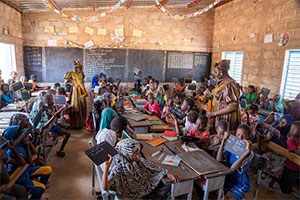 Two teachers work in a classroom in Forces Vives School in Dori, Burkina Faso. Credit: UNICEF/UNI978361
Safe and uninterrupted education is a fundamental right for all children. Education is paramount to global development, as it has been proven that investing in education – especially for girls and children – contributes significantly to economic growth and prosperity. Although more than 1 billion children go to school, many are subjected to conditions that are not conducive to a proper learning environment, including makeshift facilities, a lack of supplies, violence in classrooms, inadequate sanitation, untrained instructors, and widespread school closures. Since 2015, there have been immense gains in education with an increase of 109 million children in school. However, as of 2023, 272 million children are still out of school.
High poverty levels in developing countries also impede children’s access to a proper education. For example, from the early to mid 2000s, Sub-Saharan African nations witnessed a dramatic decline in trained teachers due to inadequate funding in the education sector. Furthermore, major cuts to United States international aid threaten an estimated 23 million additional children's access to education, as USAID‑funded school programmes across Africa and Asia face closure.
Various other factors contribute to the decline of education, notably hunger, which has increased as conflict and climate change interfere with global food production and dissemination. Meanwhile, certain social and cultural practices also impede children’s access to education, with gender inequality, discrimination, child labour, and child marriages preventing millions of children from attending school. Economic conditions such as the inaccessibility of higher education also affect disenfranchised communities across the world. In extreme situations, such as warfare where educational facilities are destroyed in their totality, notably in Gaza and Sudan, entire generations of children might grow up without access to education. Rebuilding educational infrastructure is a long and arduous process, especially when violence persists across generations, and this significantly stunts the development of societal prosperity and stability.
IPS is dedicated to telling the shocking truths about worldwide education through impassioned opinion pieces and comprehensive articles, highlighting global issues that impede worldwide education and the courses of action being taken by organizations such as UNICEF and Education Cannot Wait.

The Week with IPS

NEXT STOP - SDGs
Tracking global progress towards a sustainable world
Tracking global progress towards a sustainable world
