Languages
Friday, October 23, 2026



News and Views from the Global South
Education
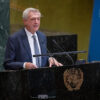
International Community, Civil Society Urge Minority Rights and Accountability Amid Ongoing Violence Against Rohingyas in Myanmar
On September 30, the United Nations (UN) convened a high-level meeting on the situation of Rohingya Muslims and other minorities in Myanmar shortly following the end of the 80th session of the General Assembly (UNGA80). The conference was an opportunity to draw global attention once more to the Rohingya refugee situation with dialogue from UN officials, world representatives and civil society organizations.
Education Cannot Wait Interviews Tom Dannatt, Founder and CEO of Street Child
Tom Dannatt is a Founder and CEO of Street Child, an international non-government organization active in over 20 disaster-hit and lowest-income countries – working for a world where all children are ‘safe, in school and learning’. Tom founded Street Child in 2008 with his wife Lucinda and has led the organization since its inception. Street Child leads the civil society constituency within ECW’s governance and, accordingly, Dannatt represents the constituency on the Fund’s High-Level Steering Committee.

Afghanistan’s Overlapping Crises Deepen Following 6.0 Magnitude Earthquake
Over the past week, Afghanistan’s humanitarian situation has deteriorated significantly following the August 31 earthquake, which measured over 6.0 in magnitude and caused an immense loss of life and widespread destruction of critical infrastructure. Compounded by the nation’s fragile economy, severe shortages of essential resources, and persistent access challenges, humanitarian organizations have found it increasingly difficult to reach vulnerable communities—especially women and children.
Climate Change is Deepening Child Poverty in Latin America and Caribbean
2025 has been marked by a significant escalation of the climate crisis and its effects on vulnerable populations, as the World Meteorological Organization (WMO) warn that average global temperatures could exceed the 1.5°C threshold within the next five years. In Latin America and the Caribbean, rising temperatures and emissions continue to strain access to essential services and deepen poverty, particularly among children.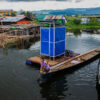
One in Four People Lack Access to Clean Drinking Water: UNICEF, WHO Warn of Deepening Disparities
Over the past decade, major strides have been made in expanding global access to water, sanitation, and hygiene (WASH) services, with billions of people around the world seeing improvements in overall health and well-being. Despite these gains, people largely from low-income countries and marginalized groups still lack access to clean water, leaving them vulnerable to disease and hindering social development and inclusion.
Education Cannot Wait Interviews Dr. Faiza Hassan, Director of the Inter-Agency Network for Education in Emergencies
Dr. Faiza Hassan is the Director of the Inter-Agency Network for Education in Emergencies (INEE). A chemical engineer who transitioned into education leadership, Dr. Hassan brings close to 20 years of diverse experience in education, social policy reform and humanitarian response. She has a proven track record in strategic management, technical leadership and driving impactful, large-scale complex programmes.
‘Life in Gaza’s Shelters Is Marked by Deprivation – but Also by the Endurance of Human Dignity’
CIVICUS speaks with a West Bank-based Palestinian activist about her family members currently enduring the war in Gaza. She has asked to remain anonymous for security reasons.
From Conflict to Climate Crusade, Refugees Lead the Charge in Kenya
For 18-year-old Lionel Ngukusenge, a refugee from Burundi, where he was forced into hiding because of a repressive regime, he has found another foe to contend with at the Kakuma refugee camp in Kenya: climate change.
From Semei to Hiroshima: Astana Times Editor on Bringing Global Solidarity Through Journalism
Eighty years ago, the atomic bombings of Hiroshima and Nagasaki left a lasting reminder to humanity of the inhuman nature of nuclear weapons. Kazakhstan, too, is a nation deeply scarred by nuclear tests conducted during the Soviet era. Having covered the activities of Soka Gakkai International (SGI) in Kazakhstan—including its support for exhibitions and documentary productions on nuclear abolition in Astana—, INPS Japan recently interviewed Zhanna Shayakhmetova, editor-in-chief of The Astana Times, a leading English-language newspaper in the country that continues to convey messages of disarmament and peace to the world. In the interview, Shayakhmetova spoke about the role of religious leaders who will gather in Astana from around the world this September, the importance of passing on memories to younger generations, and the responsibility journalism holds in this endeavor.
In Syria’s Sectarian Fights for Power, Humanity is the Loser
As sectarian violence rises in Syria, the number of displaced people has climbed exponentially since Syrian forces joined clashes between the Druze and Bedouin groups in the Sweida region.
From Haor to Brickfields
 Nikli Upazila, located in the Kishoreganj district of Bangladesh, is part of the haor region, a vast wetland ecosystem characterized by bowl-shaped depressions. This unique geography subjects the area to significant climatic challenges, particularly recurrent flooding. The haor region, including Nikli, experiences a subtropical monsoon climate with distinct wet and dry seasons. During the monsoon season, heavy rainfall often leads to extensive flooding. Flash floods have become increasingly unpredictable and severe in recent years, causing substantial damage to agricultural lands and affecting the livelihoods of local communities. These people, trapped by water and driven by poverty, journey from the Haor to brickfields, where their lives become an endless cycle of hardship.

From Gaza to Georgia, Human Rights Defenders Pay a High Price for Change. Here’s How You Can Help
Across the globe—from Gaza’s rubble to the streets of Tbilisi—people are standing up for justice, dignity, and basic rights. But far too often, they are paying with their freedom, their safety, even their lives.
Human Rights in an Increasingly Digitizing World
Over the past several decades, digital technologies have transformed nearly every aspect of human life, revolutionizing developments across multiple sectors, including healthcare, education, and commerce, to name a few. However, these changes have also brought forth new concerns surrounding the preservation of human rights in an increasingly digitizing world.
3.4 Billion People Left Behind: Interest Payments Now Outpace Education Spending in Half the World
Today, 3.4 billion people live in countries that spend more on debt interest payments than on health or education. This marks a trembling indication that the United Nations’ promise for the 2030 Agenda could be slipping away.
NATO’s Trillion-dollar Gamble: The Dangers of Defence Without Accountability
Donald Trump’s bullying tactics ahead of NATO’s annual summit, held in The Hague in June, worked spectacularly. By threatening to redefine NATO’s article 5 – the collective defence provision that has anchored western security since 1949 – Trump won commitments from NATO allies to almost triple their defence spending to five per cent of GDP by 2035. European defence budgets will balloon from around US$500 billion to over US$1 trillion annually, essentially matching US spending levels.
#KeepHopeAlive Through Education
On the first International Day of Hope, we are all responsible to #KeepHopeAlive for the children impacted by the world’s most severe humanitarian crises. Perhaps the strongest responsibilities lie with those entrusted to lead the world and make the right moral and legal choices. This is especially so today, when we have led the world into an abyss of excruciating pain for nearly a quarter of a billion innocent children now suffering brutal conflicts and violence, forced displacement and punishing climate disasters – without quality education.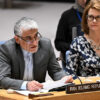
Afghan Refugees Expelled from Iran and Exposed to Horrific Abuse
Since early June, Afghan refugees in Iran have endured increasingly harsh humanitarian conditions, with many being forced to repatriate under conditions that violate the principles of international humanitarian law. In 2025 alone, over one million refugees have returned to Afghanistan, further stretching the limited supply of resources amid a severe and multifaceted humanitarian crisis.
The New Silk Road of Central Asia: Landlocked Countries Now Connected
Once landlocked, now connected, the UN Global Compact has bridged the gap between Europe, Asia, and the Middle East: having many call it the “New Silk Road”.
WHO Launches Initiative to Tax Tobacco and Beverage Corporations to Boost Public Health
On July 2, the World Health Organization (WHO) launched the “3 by 35” initiative in an effort to boost public health and limit global consumption of harmful substances. By urging international governments to implement taxes on tobacco, sugary drinks, and alcohol, WHO seeks to reduce worldwide cases of noncommunicable disease amid heightened strains on global health systems and a shrinking supply of funding.
The Juggling of Aid: How WFP is Delivering More with Less
Serious-to-severe food insecurity has been widely felt among those living through the worst, protracted humanitarian crises. For organizations like the World Food Programme (WFP), they must work under the “relentless demand” for humanitarian aid, including food.
FFD4 Must Deliver for the World’s Most Vulnerable Nations
Five years from the 2030 deadline for the Sustainable Development Goals (SDGs), we face a development emergency. The promise to eradicate poverty, combat climate change, and build a sustainable future for all is slipping away. The SDG financing gap has ballooned to over $4 trillion annually—a crisis compounded by declining aid, rising trade barriers, and a fragile global economy.« Previous Page — Next Page »





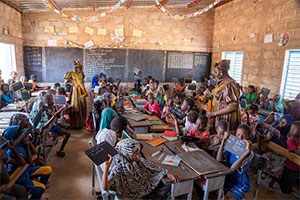 Two teachers work in a classroom in Forces Vives School in Dori, Burkina Faso. Credit: UNICEF/UNI978361
Safe and uninterrupted education is a fundamental right for all children. Education is paramount to global development, as it has been proven that investing in education – especially for girls and children – contributes significantly to economic growth and prosperity. Although more than 1 billion children go to school, many are subjected to conditions that are not conducive to a proper learning environment, including makeshift facilities, a lack of supplies, violence in classrooms, inadequate sanitation, untrained instructors, and widespread school closures. Since 2015, there have been immense gains in education with an increase of 109 million children in school. However, as of 2023, 272 million children are still out of school.
High poverty levels in developing countries also impede children’s access to a proper education. For example, from the early to mid 2000s, Sub-Saharan African nations witnessed a dramatic decline in trained teachers due to inadequate funding in the education sector. Furthermore, major cuts to United States international aid threaten an estimated 23 million additional children's access to education, as USAID‑funded school programmes across Africa and Asia face closure.
Various other factors contribute to the decline of education, notably hunger, which has increased as conflict and climate change interfere with global food production and dissemination. Meanwhile, certain social and cultural practices also impede children’s access to education, with gender inequality, discrimination, child labour, and child marriages preventing millions of children from attending school. Economic conditions such as the inaccessibility of higher education also affect disenfranchised communities across the world. In extreme situations, such as warfare where educational facilities are destroyed in their totality, notably in Gaza and Sudan, entire generations of children might grow up without access to education. Rebuilding educational infrastructure is a long and arduous process, especially when violence persists across generations, and this significantly stunts the development of societal prosperity and stability.
IPS is dedicated to telling the shocking truths about worldwide education through impassioned opinion pieces and comprehensive articles, highlighting global issues that impede worldwide education and the courses of action being taken by organizations such as UNICEF and Education Cannot Wait.

The Week with IPS

NEXT STOP - SDGs
Tracking global progress towards a sustainable world
Tracking global progress towards a sustainable world
